
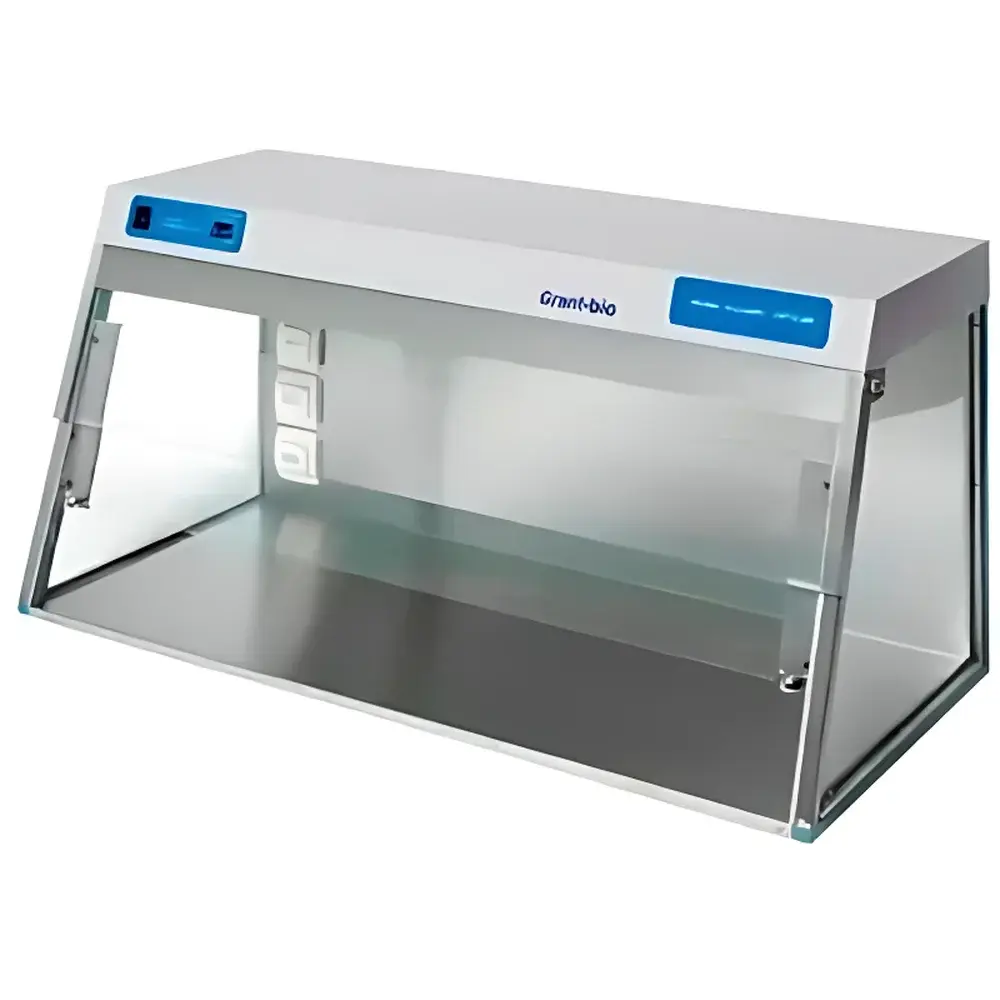
Grant UVT-S-AR UV Workstation for PCR Applications
| Brand | Grant Instruments |
|---|---|
| Origin | United Kingdom |
| Model | UVT-S-AR |
| Instrument Type | Class I Biological Safety Cabinet |
| External Dimensions (L×W×H) | 1245 × 585 × 585 mm |
| Internal Dimensions (L×W×H) | 1200 × 520 × 520 mm |
| Filter Efficiency | ≥99% |
| UV Wavelength | 254 nm |
| UV Lamp Power | 30 W (ozone-free) |
| Air Recirculation Rate | 25 m³/h |
| Timer Range | 0–24 h (digital) |
| Illumination | 15 W white LED work surface lighting |
| UV Protective View Window | UV-absorbing coated glass |
| Front Sash | 3-position height adjustment |
| Electrical Supply | 230 V |
Overview
The Grant UVT-S-AR UV Workstation is a purpose-engineered Class I biological safety cabinet designed specifically for molecular biology workflows requiring stringent nucleic acid contamination control—particularly polymerase chain reaction (PCR), cloning, sequencing library preparation, and handling of low-biomass or highly sensitive biosamples. Unlike conventional laminar flow hoods, the UVT-S-AR integrates germicidal ultraviolet irradiation with continuous internal air recirculation to achieve sustained decontamination of surfaces and airborne particulates within the enclosed workspace. Its operation relies on 254 nm short-wave UV-C radiation, which induces thymine dimer formation in microbial DNA/RNA and inactivates viruses—including non-enveloped and prion-associated agents—without generating ozone. The unit complies with core principles outlined in ISO 14644-1 (cleanroom classification), EN 12469 (biological safety cabinets), and supports Good Laboratory Practice (GLP) requirements for contamination mitigation in diagnostic and research settings.
Key Features
- Stainless steel construction (304 grade) for chemical resistance, ease of decontamination, and long-term structural integrity in high-use laboratory environments.
- Ozone-free 30 W UV-C lamp (254 nm peak emission) with integrated digital timer (0–24 h), enabling precise, repeatable irradiation cycles and eliminating operator exposure risk via automatic shutoff when the front sash is opened.
- Dual-function UV system: direct surface irradiation + forced-air recirculation through a high-efficiency UV chamber delivering 25 m³/h of continuously sterilized airflow—achieving ≥99% microbial inactivation per pass.
- UV-absorbing acrylic-coated tempered glass viewport that blocks >99.9% of 254 nm radiation while maintaining optical clarity and ergonomic visibility during operation.
- Three-position adjustable front sash (low/medium/high) optimized for user comfort, glove compatibility, and workflow flexibility across varying sample volumes and pipetting ergonomics.
- Dedicated 15 W white LED task lighting mounted beneath the sash, providing uniform, shadow-free illumination without UV interference or thermal load on temperature-sensitive reagents.
- Integrated 230 V AC power outlet (IEC 60320 C13) inside the chamber for safe operation of centrifuges, vortexers, or other low-power peripherals during UV-free phases.
Sample Compatibility & Compliance
The UVT-S-AR accommodates standard PCR tube racks (0.2 mL, 0.5 mL), microcentrifuge tubes, gel trays, electrophoresis combs, and small benchtop instruments up to 1200 mm length. Its internal volume (≈0.32 m³) supports simultaneous processing of multiple reaction sets while maintaining consistent UV dose distribution. The workstation meets functional equivalence to Class I BSC performance criteria per EN 12469:2000 Annex A, including inward airflow velocity ≥0.38 m/s at the working aperture and containment assurance verified by potassium iodide (KI) smoke testing. It is routinely deployed in ISO/IEC 17025-accredited molecular diagnostics labs and supports compliance with CLIA, CAP, and UKAS audit requirements for pre-PCR area segregation. While not certified as a Class II cabinet, its design explicitly excludes recirculation to the external environment—ensuring operator protection aligns with WHO Biosafety Manual (4th ed.) recommendations for handling Category 2 pathogens and prion-susceptible materials.
Software & Data Management
The UVT-S-AR operates as a standalone hardware platform with no embedded firmware or network connectivity. All operational parameters are controlled manually via tactile push-button interface and a backlit LCD display showing elapsed/remaining UV time. No data logging, remote monitoring, or electronic audit trail is provided—consistent with its role as a physical containment and decontamination tool rather than a regulated analytical instrument. However, the digital timer’s precision (±1 minute over 24 h) enables traceable documentation of UV exposure duration in lab notebooks or LIMS entries. For GLP/GMP-regulated environments, users may integrate usage logs into electronic batch records using external timestamped entries, satisfying FDA 21 CFR Part 11 requirements when paired with validated procedural SOPs.
Applications
- Routine decontamination of PCR workspaces prior to nucleic acid amplification to prevent carryover contamination.
- Preparation of sterile reagent aliquots, master mixes, and oligonucleotide stocks under UV-sterilized conditions.
- Handling of clinical specimens containing RNA viruses (e.g., SARS-CoV-2, influenza), prion-associated tissues, or other biosafety level 2 (BSL-2) agents where aerosolized nucleic acid persistence is a concern.
- Decontamination of electrophoresis equipment, pipette tips, and reusable plasticware between runs.
- Supporting next-generation sequencing (NGS) library prep workflows where ultra-low background is critical for detecting rare variants or low-input samples.
FAQ
Does the UVT-S-AR provide personnel protection during active UV irradiation?
No—UV irradiation must only occur when the workspace is unoccupied. The unit features interlocked sash sensing: UV lamps deactivate instantly upon sash opening.
Can the UVT-S-AR be used for cell culture work?
No—it lacks HEPA-filtered downward laminar airflow and is not designed for viable cell handling; it is strictly for non-living, nucleic acid–sensitive applications.
What maintenance is required for the UV lamp and recirculation system?
Lamp output should be verified annually using a calibrated UV-C radiometer; replacement is recommended after 8,000 hours or if intensity falls below 70 µW/cm² at 1 cm distance. The recirculation fan filter requires cleaning every 6 months.
Is ozone generation a concern with this unit?
No—the lamp is explicitly rated as ozone-free (emission <0.05 ppm), compliant with OSHA PEL and EU Directive 2004/108/EC electromagnetic compatibility standards.
How does the UVT-S-AR differ from a standard UV transilluminator or crosslinker?
Unlike transilluminators (designed for gel visualization) or crosslinkers (for covalent nucleic acid–membrane binding), the UVT-S-AR delivers whole-chamber disinfection via reflective cavity geometry and forced-air circulation—enabling volumetric, not just surface-level, decontamination.




