
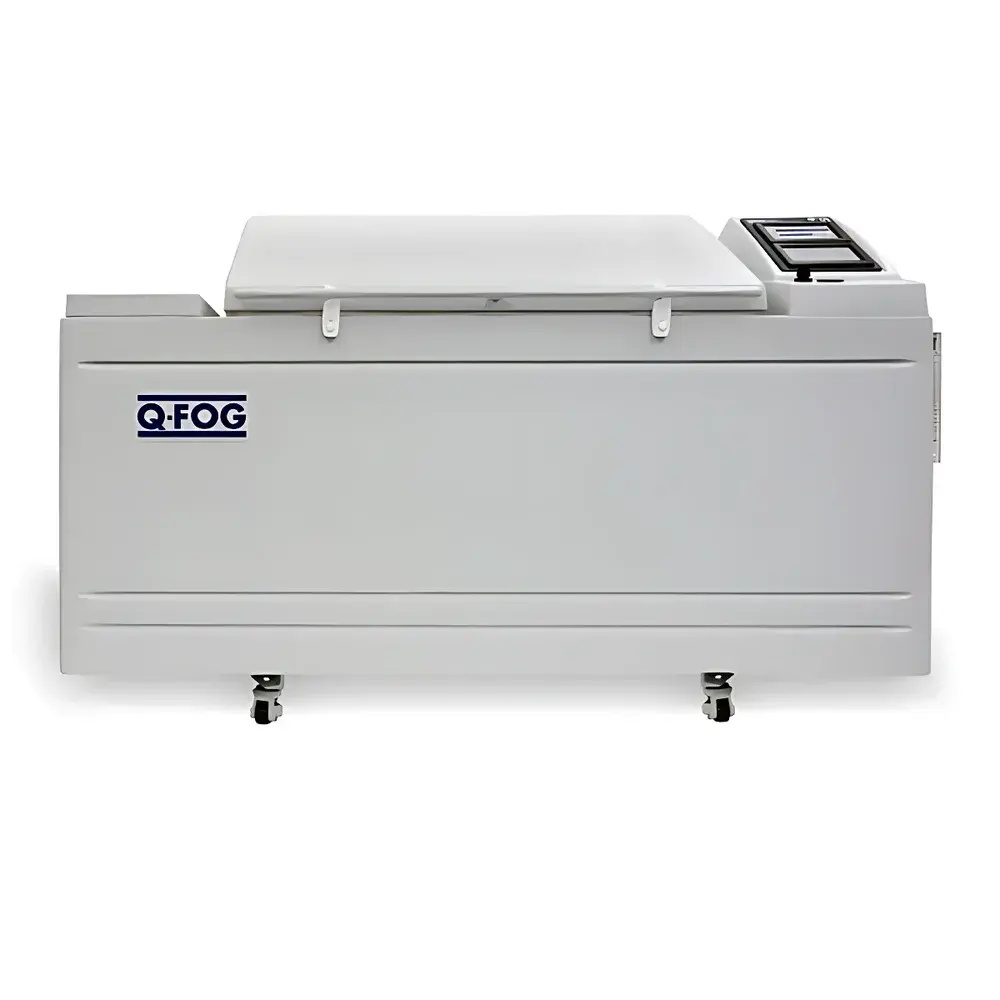
Q-Lab Q-FOG CCT SSP CRH Cyclic Corrosion Test Chamber
| Brand | Q-Lab |
|---|---|
| Origin | USA |
| Model | Q-FOG CCT SSP CRH |
| Temperature Range | 20–60 °C (spray/soak), 20–70 °C (dry), 20–60 °C (RH/humidity) |
| Chamber Capacity | 640 L (CCT-600/SSP-600/CRH-600) or 1103 L (CCT-1100/SSP-1100/CRH-1100) |
| Internal Salt Solution Reservoir | 120 L |
| Sample Rack Capacity | 160 pcs (75 mm × 150 mm) for 600-series |
| Relative Humidity Control | 95–100% RH (CCT), fully adjustable 10–95% RH (CRH) |
| Air Pressure Requirement | 3–10 bar |
| Water Purity | <8 ppm TDS, resistivity >50 kΩ·cm |
| Power Supply | 208–230 V, 50/60 Hz, up to 38 A |
Overview
The Q-Lab Q-FOG CCT SSP CRH Cyclic Corrosion Test Chamber is an advanced environmental test system engineered for high-fidelity laboratory simulation of atmospheric corrosion mechanisms. Unlike conventional continuous-salt-spray chambers operating under static ASTM B117 conditions, the Q-FOG platform implements programmable multi-phase exposure cycles—including salt fog, dry-off, high-humidity condensation, and ambient soak—thereby replicating the dynamic wet/dry transitions observed in real-world outdoor environments. This capability enables statistically significant correlation between accelerated lab results and field performance, particularly for coated metals, electroplated components, automotive assemblies, and aerospace hardware. The chamber’s architecture integrates precision-controlled temperature zones, independently regulated air pressure and solution delivery, and a microprocessor-based controller compliant with ISO 9227, ASTM G85 Annexes A1–A5, DIN 50021, BS EN ISO 11997, and SAE J2334 protocols. Its design adheres to GLP-compliant operational traceability requirements, supporting audit-ready data logging and user-accessible calibration verification routines.
Key Features
- Triple-platform versatility: SSP models support ASTM B117 and Prohesion (ASTM G85 Annex A2); CCT models add full 95–100% RH capability for automotive OEM cycles (e.g., GM 9540P, Ford APGE, Renault D17 2029); CRH models extend control to fully adjustable 10–95% RH with integrated air pre-conditioning.
- High-reproducibility雾 dispersion: Dual-parameter control via peristaltic pump (solution flow rate) and precision air pressure regulator (droplet trajectory and deposition uniformity), eliminating reliance on fixed nozzle geometry.
- Integrated 120 L internal brine reservoir with built-in filtration, low-level alarm, and 7+ day autonomy for standard test durations—reducing manual refills and contamination risk.
- Rapid thermal transition: Optimized heating/cooling airflow paths and high-capacity fan systems enable sub-15-minute transitions between spray (20–60 °C), dry (20–70 °C), and humidity (20–60 °C) phases—critical for cycle fidelity and throughput efficiency.
- Modular sample handling: Standard 75 mm × 150 mm test panel capacity of 160 (600-series) or 240 (1100-series); optional angled racks (15°), 20 mm diameter suspension rods, and load-rated fixtures (up to 113 kg per rack, 544 kg total distributed load).
- Self-diagnostic controller with predictive maintenance alerts, service interval tracking, and fail-safe shutdown logic—ensuring operational continuity and compliance with ISO/IEC 17025 preventive maintenance expectations.
Sample Compatibility & Compliance
The Q-FOG chamber accommodates flat panels, three-dimensional components, and assembled sub-systems across diverse industrial sectors. Its interior dimensions (e.g., 109 cm W × 66 cm D × 72 cm H for 600-series) allow vertical or horizontal orientation of specimens up to 304 mm × 102 mm. All models meet UL 61010-1 and CE safety directives. For regulatory validation, the system supports 21 CFR Part 11-compliant electronic records when paired with Q-Lab’s optional Q-Support software suite—enabling secure user authentication, audit trails, and electronic signatures. It is routinely specified in automotive supplier quality agreements (e.g., IATF 16949 clause 8.5.1.5) and referenced in corrosion testing sections of MIL-STD-810H Method 509.6 and ISO 16701.
Software & Data Management
The embedded Q-FOG controller features a tactile membrane keypad and LCD interface enabling intuitive creation, storage, and recall of up to 100 custom test programs. Each program defines time-segmented sequences across four core states: salt fog, dry, humidity (CCT/CRH only), and ambient soak. Real-time monitoring includes chamber temperature, solution level, compressor status, and fault codes. Optional Q-Support PC software provides remote supervision, automated report generation (PDF/CSV), trend analysis, and integration with LIMS platforms via OPC UA or Modbus TCP. All logged data—including timestamps, setpoints, actual values, and operator IDs—is stored with SHA-256 hashing to satisfy GLP/GMP data integrity requirements.
Applications
- Automotive: Validation of paint systems, galvanized steel, fasteners, and battery enclosures against OEM-specific cyclic protocols (e.g., VW PV1210, BMW GS 95024).
- Aerospace: Corrosion resistance assessment of aluminum alloys, titanium components, and protective coatings per ASTM D1654 and SAE AMS 2401.
- Electronics: Evaluation of printed circuit board conformal coatings, connector housings, and solder joint reliability under mixed-flow environments.
- Construction & Infrastructure: Testing of stainless steels, weathering steels, and architectural cladding materials per ISO 12944-9 and ASTM D5894.
- Academic Research: Mechanistic studies of pitting initiation, crevice corrosion kinetics, and inhibitor efficacy under controlled multi-stress conditions.
FAQ
What distinguishes the CCT, SSP, and CRH models?
The SSP model performs salt fog and Prohesion cycling only. The CCT adds 95–100% RH capability for automotive humidity-dry cycles. The CRH replaces fixed humidity with fully adjustable 10–95% RH using an external air pre-conditioner.
Is deionized water mandatory?
Yes. Feed water must have 50 kΩ·cm to prevent nozzle clogging and ensure consistent droplet chemistry per ISO 9227 Annex A.
Can the chamber operate unattended for extended periods?
With its 120 L internal reservoir and self-diagnostic controller, the Q-FOG supports uninterrupted operation for ≥7 days under typical test profiles, provided ambient utility conditions remain within specification.
How is temperature uniformity validated?
Per ASTM E2297, Q-Lab supplies a certified temperature mapping protocol with NIST-traceable sensors and documented uncertainty budgets—required for ISO/IEC 17025 accreditation.
Are replacement parts and service support globally available?
Q-Lab maintains authorized service centers in over 30 countries and stocks critical spares—including pump tubing, air filters, and solution filters—with 48-hour dispatch from regional distribution hubs.



