
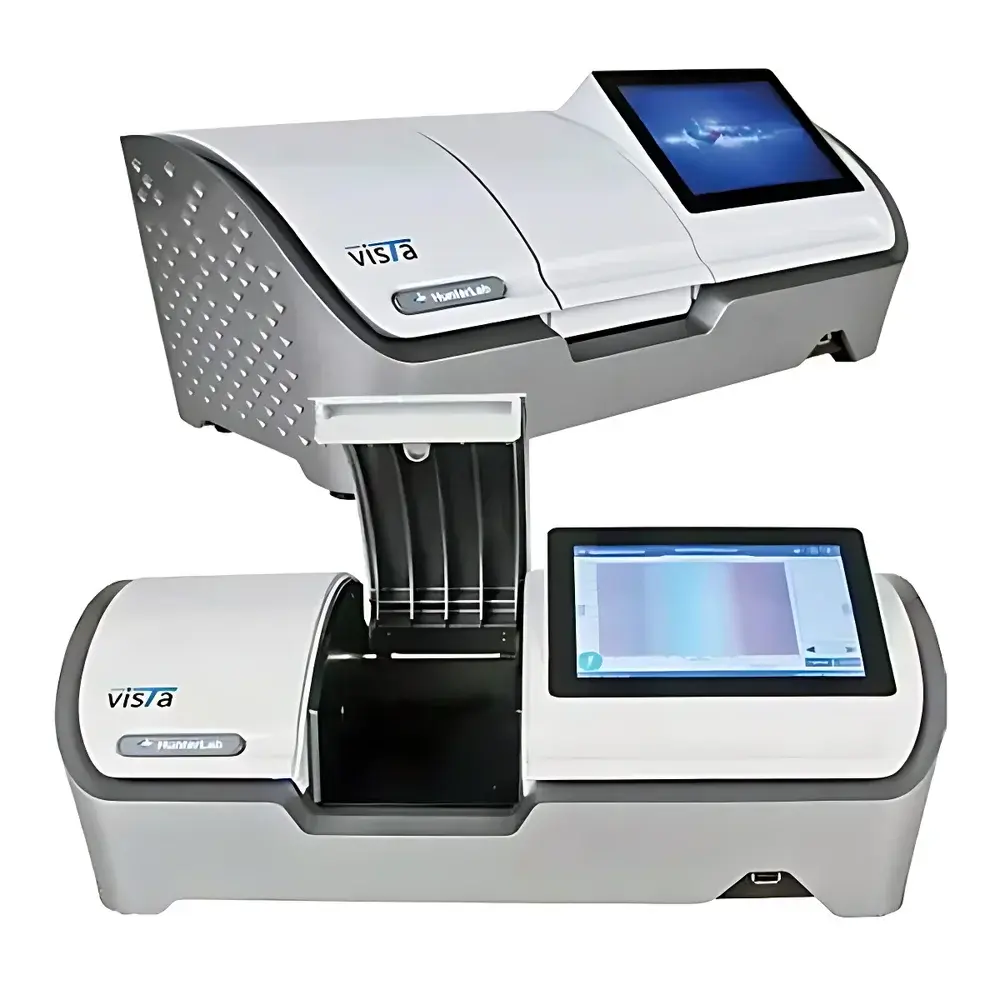
HunterLab Vista VST Benchtop Color and Haze Meter
| Brand | HunterLab |
|---|---|
| Origin | USA |
| Manufacturer Status | Authorized Distributor |
| Origin Category | Imported |
| Model | Vista VST |
| Product Type | Color Difference Meter |
| Instrument Type | Benchtop |
| Light Source | LED |
| Spectral Range | 400–700 nm |
| Repeatability | 0.02 ΔE (CIE L*a*b*) |
Overview
The HunterLab Vista VST is a benchtop spectrophotometric color and haze measurement system engineered for precision, speed, and regulatory compliance in quality control laboratories across pharmaceuticals, chemicals, food & beverage, and polymer industries. It operates on the principle of diffuse transmission spectroscopy—measuring both spectral reflectance/transmittance and light scattering behavior across the visible spectrum (400–700 nm) to simultaneously quantify color (in CIE L*a*b*, CIELCh, and multiple industry-specific scales) and haze (per ASTM D1003 and ISO 14782). Unlike handheld or single-parameter instruments, the Vista VST integrates dual optical pathways within a single optical cavity, enabling concurrent acquisition of colorimetric and turbidity-related metrics without sample repositioning or instrument recalibration. Its solid-state LED illumination ensures stable spectral output over time, eliminating lamp drift and reducing long-term maintenance requirements.
Key Features
- Simultaneous color and haze measurement in a single acquisition cycle—reducing analysis time by up to 50% compared to sequential methods.
- 7-inch high-resolution capacitive touchscreen interface with intuitive icon-driven navigation, supporting multilingual UI (English, German, French, Japanese, Chinese).
- Removable front door design accommodates samples up to 50 mm in height and 100 mm in width—including bottles, cuvettes, Petri dishes, and irregularly shaped containers.
- Integrated connectivity via USB 2.0 (for firmware updates and data export) and Ethernet (for networked deployment, remote monitoring, and integration with LIMS or MES systems).
- One-touch calibration for both color and haze using NIST-traceable standards; automatic validation of calibration status before each measurement sequence.
- Onboard storage for ≥10,000 measurements with timestamp, operator ID, and method metadata—fully compliant with audit trail requirements under FDA 21 CFR Part 11 when paired with optional software modules.
Sample Compatibility & Compliance
The Vista VST accepts liquid, semi-liquid, and translucent solid samples in standard 10 mm, 20 mm, and 50 mm pathlength cuvettes, as well as custom vessels (e.g., USP vials, ISO 6271 test tubes). It supports measurement of transparent, translucent, and mildly opaque liquids—including aqueous solutions, solvents, oils, syrups, and suspensions. Regulatory alignment includes full support for pharmacopeial color scales (USP , EP 2.2.45, JP 6.04), APHA/Pt-Co/Hazen (ASTM D1209), Gardner (ASTM D1544), Saybolt (ASTM D156), and Yellowness Index (ASTM E313). Haze calculations conform to ASTM D1003 (Method A, 2° observer) and ISO 14782, with optional haze correction algorithms for low-transmittance samples. The instrument meets IEC 61000-4 electromagnetic compatibility standards and carries CE, UKCA, and RoHS certifications.
Software & Data Management
VistaLink™ PC software (included) enables advanced method development, statistical process control (SPC), trend analysis, and report generation in PDF/CSV/XLSX formats. All data fields—including raw spectral data (31-point, 10 nm intervals), tristimulus values, delta-E deviations, haze %, and derived indices—are exportable with full metadata. Optional VistaLink IQ software provides electronic signatures, role-based access control, and 21 CFR Part 11-compliant audit trails—including immutable records of user actions, calibration events, and result modifications. Data synchronization with enterprise platforms (e.g., SAP QM, LabWare LIMS) is supported via HL7 and RESTful API interfaces.
Applications
- Pharmaceutical QC: Verification of excipient color consistency, injectable solution clarity per USP , and stability-indicating assays for oxidation or degradation.
- Chemical manufacturing: Monitoring batch-to-batch variation in dyes, resins, and catalyst solutions; validating APHA compliance for industrial solvents.
- Food & beverage R&D: Quantifying browning index in juices, caramel color intensity in soft drinks, and haze development in beer or wine filtration processes.
- Polymer & coating labs: Assessing yellowing in UV-exposed plastics, haze in acrylic sheets, and color shift during thermal aging per ASTM D2244.
- Regulatory submissions: Generating GLP/GMP-compliant datasets for FDA, EMA, or PMDA filings—particularly where simultaneous color/haze correlation is required (e.g., parenteral product specifications).
FAQ
Does the Vista VST require annual recalibration by HunterLab service engineers?
No—routine user-performed calibration with certified standards is sufficient for daily operation. Annual verification by an accredited third-party lab or HunterLab-certified technician is recommended for GMP environments.
Can the instrument measure samples with particulates or sedimentation?
Yes, provided the sample is homogenized immediately prior to measurement and the cuvette is free of bubbles or wall adhesion. For highly unstable suspensions, optional agitation accessories are available.
Is spectral data export supported for external chemometric modeling?
Yes—full 400–700 nm transmittance spectra (31 data points) are exportable in ASCII format for PCA, PLS regression, or other multivariate analysis workflows.
What is the minimum sample volume required for accurate haze measurement?
For 10 mm pathlength cuvettes, ≥2 mL is recommended; for 50 mm cells, ≥8 mL ensures optimal signal-to-noise ratio and minimizes meniscus effects.
How does the Vista VST handle temperature-sensitive samples?
The instrument does not include active temperature control; however, optional Peltier-cooled sample holders (VST-TCU) maintain ±0.5 °C stability between 10–40 °C for thermally sensitive formulations.




