
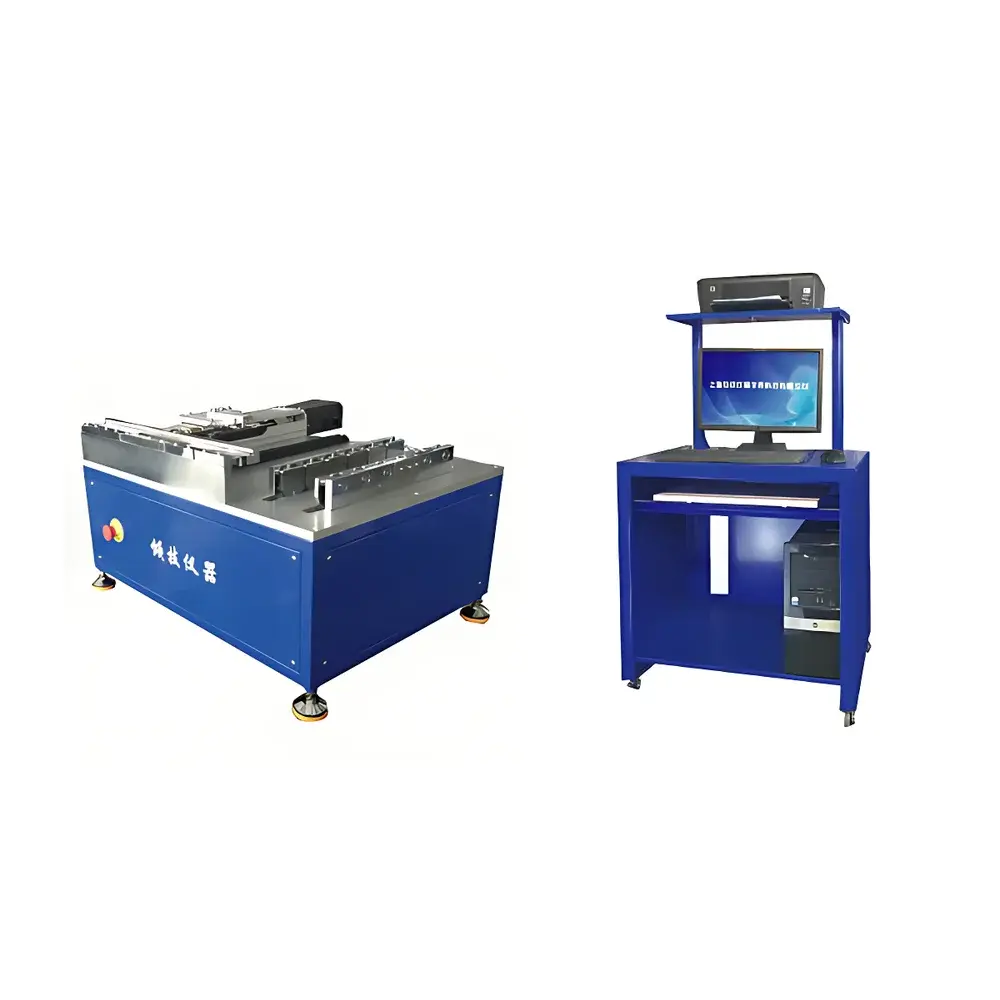
Qinji QJ-ICWQ IC Card Bending and Torsion Testing Machine
| Brand | Qinji |
|---|---|
| Model | QJ-ICWQ |
| Origin | Shanghai, China |
| Maximum Torque | 10,000 N·mm |
| Torque Measurement Range | 0–10,000 N·mm |
| Torque Resolution | 1–9,999 cycles |
| Torsion Angle Range | ±15° (±1° accuracy) |
| Bending Speed | 29 rpm |
| Test Cycle Count | 1–9,999 |
| Actuator Stroke | ±50 mm |
| Force Accuracy | ±1% (2–100% FS) |
| Dynamic Force Ripple | ≤2% |
| Closed-loop Control Frequency | 10 kHz |
| Waveform Options | Sine, Triangle, Square, Trapezoidal, Sawtooth, Half-sine, Half-triangle, Random, and External Input |
| Frequency Range | 0.01–80 Hz |
| Power Supply | AC 220 V ±5%, 35 W |
| Dimensions (L×W×H) | 670 × 380 × 220 mm |
| Weight | 70 kg |
Overview
The Qinji QJ-ICWQ IC Card Bending and Torsion Testing Machine is a precision-engineered electromechanical test system designed specifically for evaluating the mechanical durability of integrated circuit (IC) cards under standardized bending and torsional stress conditions. It operates on a dual-axis dynamic loading principle—combining controlled angular displacement (±15° bidirectional torsion) with synchronized rotational bending at 29 rpm—to replicate real-world handling, insertion, and flexing scenarios defined in international standards including ISO/IEC 7816-1, ISO/IEC 10373-6, and GB/T 16649.1. Unlike general-purpose torsion testers, the QJ-ICWQ integrates a high-fidelity hydraulic servo actuation system with full digital closed-loop control (10 kHz sampling), enabling precise waveform fidelity across sine, triangle, square, trapezoidal, and user-defined profiles. Its architecture supports both static and dynamic fatigue testing modes, making it suitable for qualification testing in card manufacturing, banking security validation, and smart card certification laboratories.
Key Features
- Compliant dual-mode testing: Simultaneous or independent bending and torsion execution per ISO/IEC 10373-6 Annex D and GB/T 16649.1 Clause 6.2
- High-resolution torque measurement: Full-scale range 0–10,000 N·mm with ±1% accuracy across 2–100% of capacity and resolution down to 1 N·mm
- Precision angular control: Bidirectional torsion capability with ±15° range and ±1° positional repeatability, calibrated traceably to national metrology standards
- Digital hydraulic servo controller: Enables real-time force, displacement, and strain feedback with seamless mode switching between load, position, and deformation control
- Programmable fatigue cycling: Adjustable cycle count from 1 to 9,999 with automatic termination and data logging upon completion or failure detection
- Modular waveform generation: Supports standard waveforms (sine, triangle, square) plus arbitrary external input via analog voltage interface for custom stress profile simulation
- Compact benchtop footprint: 670 × 380 × 220 mm dimensions with integrated vibration-damped base, optimized for ISO 17025-accredited lab environments
Sample Compatibility & Compliance
The QJ-ICWQ accommodates standard ISO/IEC 7810 ID-1 format cards (85.6 × 53.98 × 0.76 mm) as well as thicker contactless and dual-interface variants up to 1.2 mm thickness. Fixturing uses non-marring polymeric clamps with adjustable centering to prevent edge deformation during torsional loading. All test protocols align with regulatory requirements for EMVCo, PCI SSC, and China UnionPay card certification. The system meets electromagnetic compatibility (EMC) per IEC 61326-1 and electrical safety per IEC 61010-1. Calibration certificates are provided with NIST-traceable references for torque and angular displacement sensors, supporting GLP/GMP audit readiness and ISO/IEC 17025 method validation.
Software & Data Management
Control and analysis are executed via Qinji’s proprietary TestMaster v4.x software suite, compatible with Windows 10/11 (64-bit). The interface provides real-time oscilloscope-style visualization of torque vs. angle, bending angle vs. time, and cycle-count progression. Raw data export is supported in CSV, XML, and HDF5 formats for third-party statistical analysis (e.g., Weibull lifetime modeling). Audit trails record operator ID, timestamp, parameter settings, calibration history, and pass/fail status per test sequence—fully compliant with FDA 21 CFR Part 11 requirements when configured with electronic signature modules. Data integrity safeguards include write-once storage options, checksum verification, and automated backup to network drives or NAS endpoints.
Applications
- Conformance testing of payment cards to ISO/IEC 10373-6 Clauses 7.2 (bending) and 7.3 (torsion)
- Accelerated life-cycle validation for contactless smart cards used in transit, healthcare, and government ID systems
- Material-level evaluation of PVC, PETG, and polycarbonate substrate laminates under cyclic mechanical stress
- Failure mode analysis—including delamination, antenna fracture, and chip detachment—via synchronized high-speed imaging integration
- Supplier qualification testing per contractual SLAs requiring ≥5,000-cycle durability without functional degradation
- Research into anisotropic mechanical behavior of embedded antenna foils and conductive inks under torsional shear
FAQ
What standards does the QJ-ICWQ directly support?
It is configured out-of-the-box for ISO/IEC 10373-6, GB/T 16649.1, and ISO/IEC 7816-1 mechanical stress tests, with preloaded test templates and reporting formats aligned to those specifications.
Can the system perform combined bending-torsion sequences in a single test run?
Yes—the controller supports synchronized multi-axis motion profiles, allowing simultaneous application of bending rotation and torsional oscillation with independent amplitude and phase control.
Is the torque sensor calibrated and certified?
Each unit ships with a factory calibration certificate traceable to CNAS-accredited reference standards; annual recalibration services are available with documented uncertainty budgets.
Does the software support automated pass/fail evaluation?
Yes—threshold-based logic can be defined for torque deviation, angular hysteresis, or cycle interruption, triggering automatic test termination and classification.
What maintenance is required to ensure long-term measurement stability?
Routine verification includes quarterly zero-drift checks, biannual actuator seal inspection, and annual full-system recalibration—documented in the included Maintenance Logbook template.



