
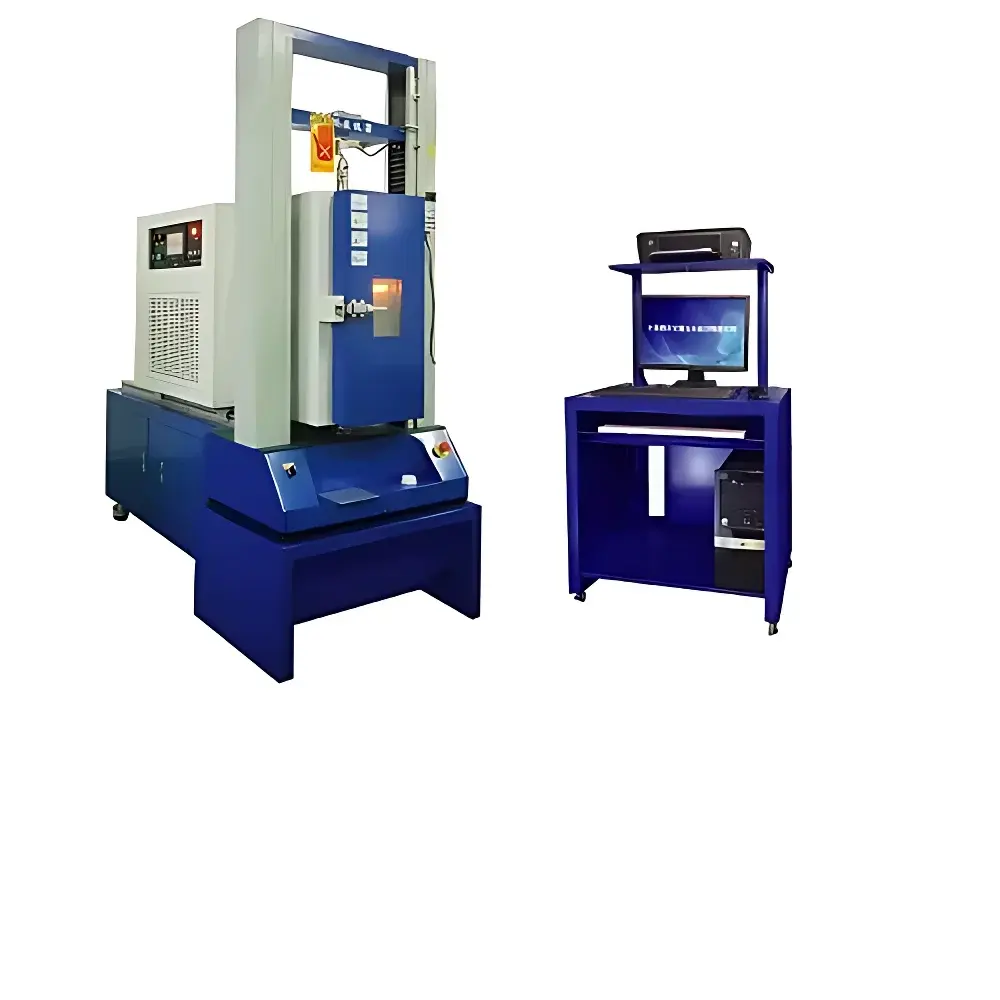
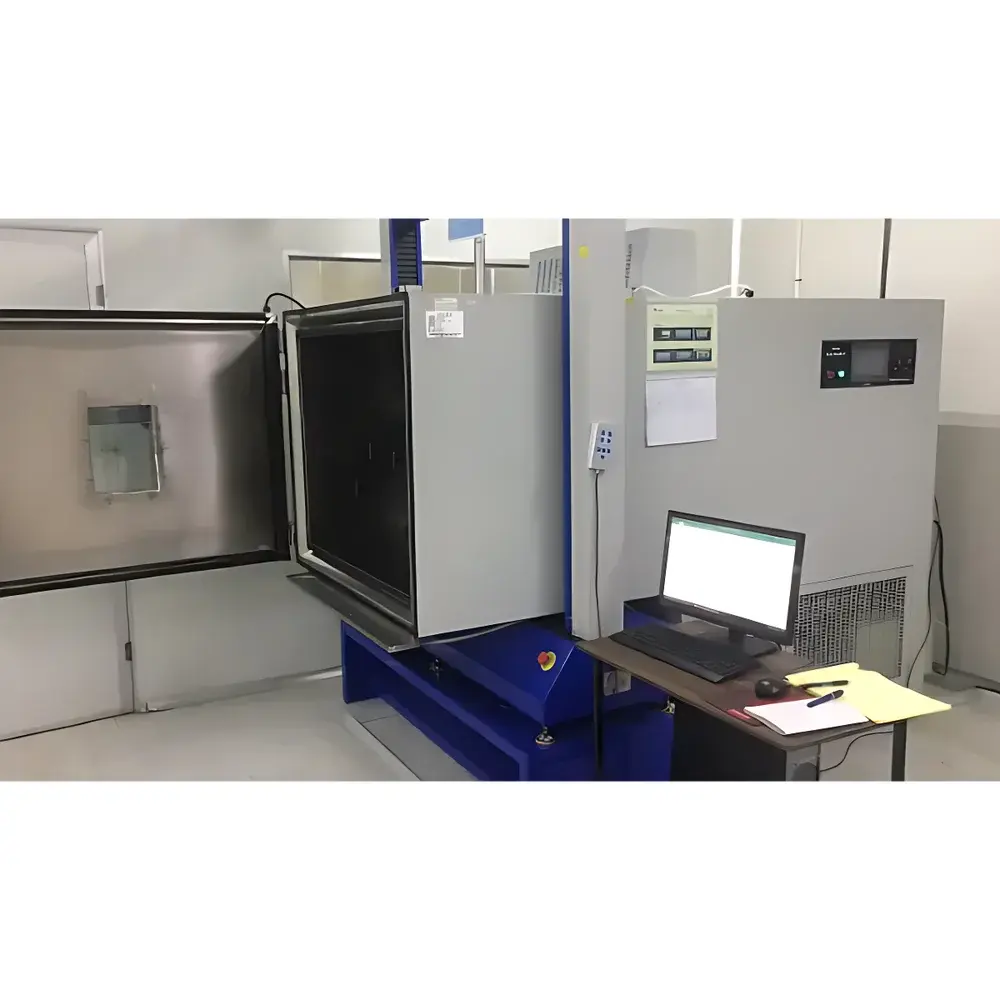
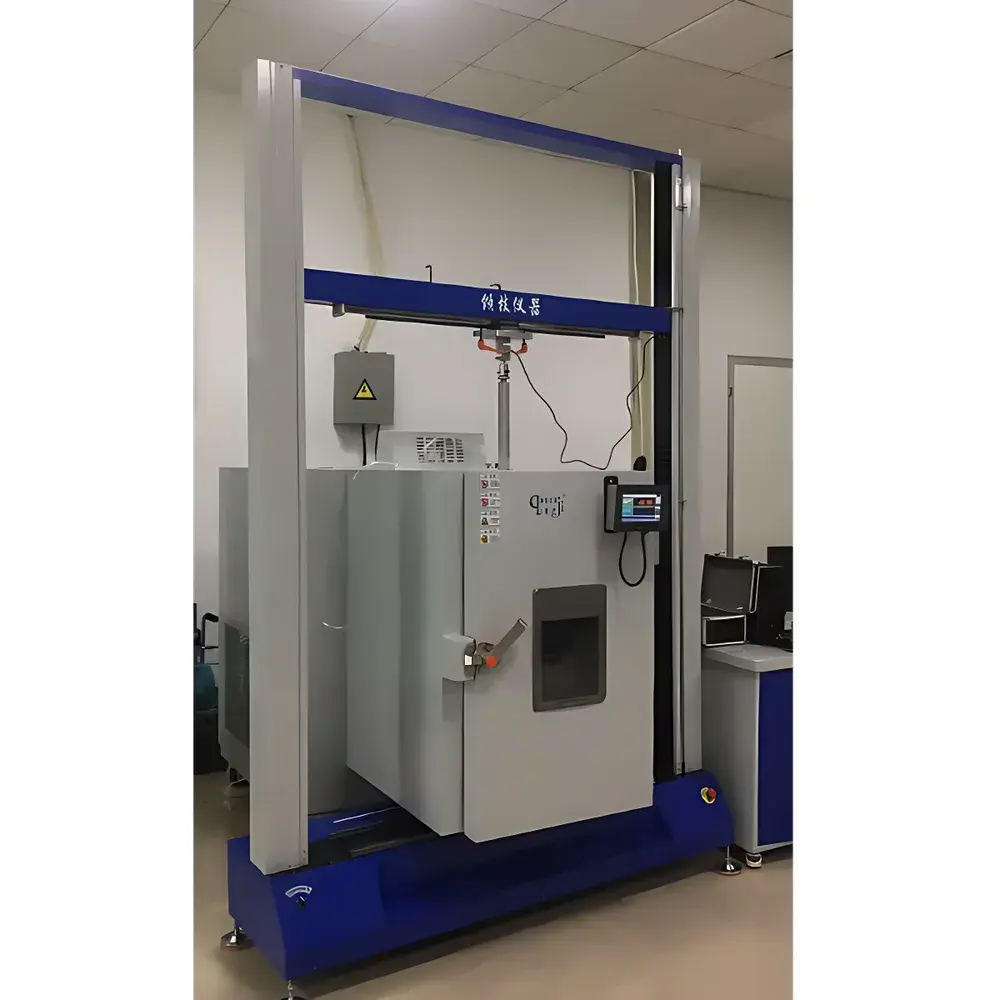
Qinji High-Temperature Flexural Strength Testing Machine Model 211B
| Brand | Qinji |
|---|---|
| Origin | Shanghai, China |
| Model | 211B |
| Load Capacity | 0–40 kN |
| Load Accuracy | ±0.5% FS |
| Temperature Range | –7 °C to 350 °C (isothermal hold at 350 °C) |
| Heating Rate | ≥5 °C/min |
| Temperature Resolution | 0.1 °C |
| Crosshead Speed | 0.01–500 mm/min (±0.5% accuracy) |
| Effective Test Width | 420 mm |
| Effective Stroke | ~800 mm (extendable) |
| Displacement Measurement Accuracy | ±0.5% |
| Strain/Deformation Measurement Accuracy | ±0.5% |
| Safety Features | Electronic travel limit protection, emergency stop button |
| Machine Weight | 365 kg |
Overview
The Qinji High-Temperature Flexural Strength Testing Machine Model 211B is an electromechanical universal testing system engineered for precise mechanical property evaluation of structural and polymeric materials under controlled thermal conditions. It operates on the principle of three-point or four-point bending (flexure) per ASTM C1161, ISO 178, and GB/T 232 standards, enabling quantitative determination of flexural modulus, flexural strength, and load-deflection behavior across a wide temperature spectrum—from sub-zero cold environments (–7 °C) to sustained high-temperature exposure (up to 350 °C). Unlike ambient-only testers, the Model 211B integrates a thermally insulated furnace chamber with PID-controlled heating and active cooling capability, ensuring stable isothermal conditions during dynamic loading. Its rigid dual-column frame, preloaded ball-screw drive, and high-resolution load cell (0.01% full-scale resolution) collectively support repeatable, traceable measurements required in R&D laboratories, quality assurance departments, and third-party certification facilities.
Key Features
- Integrated high-temperature furnace chamber with uniform axial temperature distribution (±2 °C over 100 mm test zone) and rapid thermal ramping (≥5 °C/min)
- High-precision load measurement system with 40 kN capacity and ±0.5% full-scale accuracy, compliant with ISO 7500-1 Class 0.5
- Dual-mode control architecture supporting both fully automated PC-based operation (via dedicated Windows software) and manual digital panel interface for immediate parameter adjustment
- Modular fixture system accommodating standard flexural fixtures (ASTM D790-compliant), compression platens, tensile grips, and peel fixtures—enabling multi-test versatility without hardware reconfiguration
- Real-time synchronization of thermal, mechanical, and displacement data streams with 100 Hz sampling rate for transient behavior capture
- Comprehensive safety architecture including dual-channel electronic end-limit switches, hardware-based emergency stop circuitry, and thermal runaway monitoring
Sample Compatibility & Compliance
The Model 211B accommodates specimens ranging from thin polymer films (≥0.1 mm thickness) to ceramic bars (up to 25 mm × 25 mm cross-section) and metallic rods (≤20 mm diameter). Compatible material categories include thermoplastics (e.g., PEEK, PEI), elastomers (silicone, EPDM), fiber-reinforced composites, sintered ceramics, and metal alloys. All thermal and mechanical test protocols align with international regulatory frameworks: ASTM D618 (conditioning), ASTM E220 (thermocouple calibration), ISO 11359 (dynamic mechanical analysis prerequisites), and GB/T 1040 series for plastics. The system supports GLP-compliant audit trails when configured with optional 21 CFR Part 11–enabled software modules, including user access logs, electronic signatures, and immutable result archiving.
Software & Data Management
The proprietary QTest Suite v4.2 provides ISO/IEC 17025-aligned test method definition, real-time curve overlay (load vs. displacement, stress vs. strain, temperature vs. time), and automated report generation in PDF/XLSX formats with embedded metadata (operator ID, calibration certificate IDs, environmental logs). Raw data export is supported in ASCII (.txt) and HDF5 formats for post-processing in MATLAB, Python (NumPy/Pandas), or Minitab. Calibration parameters are digitally signed and stored within encrypted firmware; recalibration intervals adhere to manufacturer-recommended 12-month cycles or after 5,000 test cycles—whichever occurs first. Software validation documentation (IQ/OQ/PQ templates) is provided upon request for GMP-regulated environments.
Applications
- Evaluation of high-temperature flexural retention in aerospace-grade polyimide laminates
- Thermal degradation onset detection in biodegradable PLA and PHA films via progressive modulus loss tracking
- Quality conformance testing of refractory ceramic tiles per EN 14411 Annex E
- Creep-bending characterization of carbon-fiber epoxy composites under sustained 250 °C load
- Low-temperature embrittlement assessment of PVC pipe compounds at –5 °C per ASTM D1784
- Interlaminar shear strength (ILSS) validation of wind turbine blade prepregs using modified short-beam shear fixtures
FAQ
What temperature stability can be achieved during a 350 °C isothermal flexural test?
At 350 °C, the furnace maintains ±1.5 °C uniformity over the central 80 mm of the specimen span for durations up to 120 minutes, verified by NIST-traceable Type K thermocouples.
Is the system compatible with third-party environmental chambers?
No—the Model 211B uses an integrated, purpose-built furnace optimized for mechanical coupling integrity; external chambers introduce alignment uncertainty and violate ISO 20487 mounting requirements.
Can deformation be measured optically instead of via extensometer?
Yes—optional DIC (Digital Image Correlation) integration is available via USB3.0 camera interface and QDeform add-on module, supporting non-contact strain mapping with ≤0.005 mm/pixel spatial resolution.
What maintenance intervals are recommended for the load cell and drive system?
Load cell zero-check every 30 days; full recalibration annually or after impact events. Ball-screw lubrication every 6 months using ISO VG 68 synthetic grease; timing belt tension verification quarterly.
Does the system support ASTM E8/E21 high-temperature tensile testing?
While primarily configured for flexure, the base frame and controller support tensile configurations up to 40 kN at elevated temperatures when equipped with high-temp grips and furnace-compatible extensometers (sold separately).



