
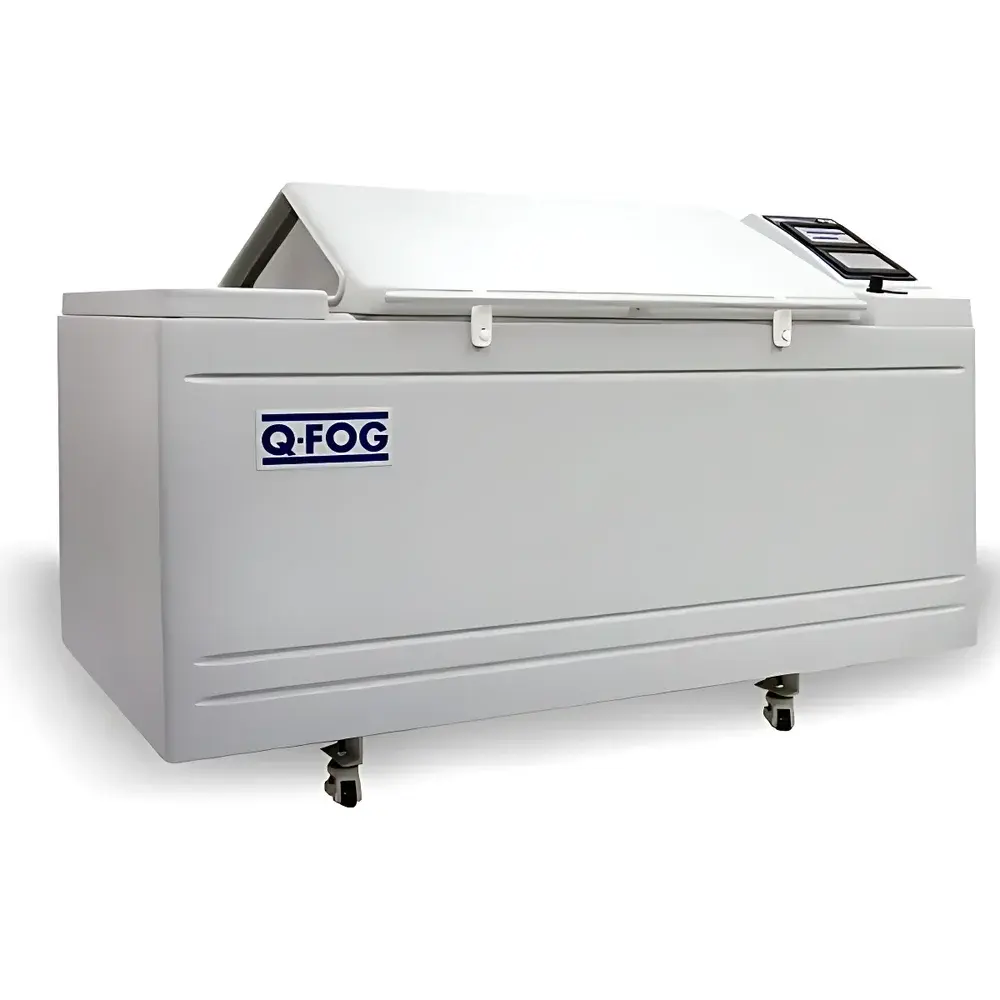
Q-Lab Q-FOG CRH-600 Corrosion Test Chamber
| Brand | Q-Lab |
|---|---|
| Origin | USA |
| Model | CRH-600 |
| Temperature Range | 20–60 °C (spray/soak), 20–70 °C (dry), 20–60 °C (RH) |
| Internal Chamber Volume | 640 L (incl. lid) |
| Salt Solution Reservoir | 120 L |
| Sample Capacity | 160 × 75 mm × 150 mm panels |
| RH Control Range | Fully adjustable 10–95% RH (CRH model only) |
| Compressed Air Requirement | 4–10 bar, ≤1.7 L/s |
| Deionized Water Specification | <8 ppm TDS, >50 kΩ·cm resistivity |
| Power Supply | 230 V ±10%, 50/60 Hz, 32 A single-phase |
Overview
The Q-Lab Q-FOG CRH-600 is an advanced, fully programmable cyclic corrosion test chamber engineered for high-fidelity simulation of real-world atmospheric degradation mechanisms. Unlike conventional continuous-salt-spray systems (e.g., ASTM B117), the CRH-600 implements multi-stage environmental cycling—including salt fog, controlled relative humidity (RH), elevated-temperature drying, and ambient soak—enabling correlation with field exposure data in coating integrity, corrosion morphology, and relative corrosion rates. Its core architecture integrates a precision air-preconditioning subsystem that enables independent, dynamic control of RH from 10% to 95%—a capability absent in SSP or CCT models—making it uniquely suited for evaluating modern automotive coatings, aerospace alloys, and electronics enclosures under ISO 16701, GMW 14872, SAE J2334, and Ford CETP 00.00-L-467 specifications. The chamber operates on electrochemical corrosion principles driven by alternating electrolyte deposition, wetting, drying, and condensation cycles—mimicking natural diurnal and seasonal transitions critical to predictive lifetime modeling.
Key Features
- Full RH modulation (10–95% RH) via integrated air pre-conditioner—eliminates need for separate humidity chambers or manual sample transfers
- Triple-stage corrosion cycle control: salt fog (ASTM B117-compliant), programmable RH dwell, and rapid thermal drying (20–70 °C) using high-capacity forced-air heating/cooling
- Microprocessor-based Q-FOG controller with intuitive touchscreen interface, built-in diagnostics, service alerts, and fail-safe shutdown protocols
- 120 L internal salt solution reservoir with integrated filtration, low-level alarm, and ≥7-day unattended operation under typical test profiles
- Optimized雾 dispersion system: peristaltic pump regulates brine flow; independently adjustable air pressure controls spray pattern and droplet distribution uniformity
- Robust stainless-steel chamber construction with double-wall insulation, 32 mm drain outlet, and 102 mm ventilation duct interface compliant with ASHRAE 110 and ISO 9227 installation guidelines
- Modular sample support: accommodates up to 160 panels (75 × 150 mm) on 10-tier racks or custom 20 mm diameter suspension rods (max. 45 kg/rod)
Sample Compatibility & Compliance
The CRH-600 supports diverse specimen geometries—from flat coated substrates and electroplated fasteners to complex 3D automotive components—via configurable mounting options including angled (15°) panel holders (F-9008-K kit) and heavy-duty suspension rods (F-9014-K). All operational parameters meet traceability requirements for GLP and GMP environments: temperature uniformity ±2 °C (per IEC 60068-2-11), RH stability ±3% (at setpoint), and time-based cycle repeatability within ±15 seconds. The system complies with ASTM G85 Annexes A1–A5 (Prohesion), ISO 9227, DIN 50021, BS EN ISO 11997, and JIS Z 2371. For regulated industries, optional 21 CFR Part 11-compliant software packages provide electronic audit trails, user access controls, and secure data archiving.
Software & Data Management
The embedded Q-FOG controller stores up to 100 user-defined test programs with nested sub-cycles, conditional branching, and real-time parameter logging (temperature, RH, elapsed time, spray status). Data export is supported via USB 2.0 or Ethernet (Modbus TCP/IP) to external LIMS or QA databases. Optional Q-Lab’s CCI (Corrosion Cycle Intelligence) software enables remote monitoring, automated report generation (PDF/CSV), statistical trend analysis (e.g., time-to-white-rust), and deviation alerting based on ISO 16701 pass/fail thresholds. All firmware updates are digitally signed and validated to ensure integrity per NIST SP 800-193 guidelines.
Applications
The CRH-600 serves as a primary qualification tool across sectors requiring accelerated corrosion validation: OEM automotive suppliers validating zinc-nickel plating per GMW 14872; aerospace manufacturers assessing chromate-free conversion coatings against MIL-DTL-5541; electronics firms testing conformal coating adhesion under IPC-J-STD-001; and R&D labs developing self-healing polymer systems per ASTM D610/D1654 rating protocols. Its RH flexibility allows replication of coastal fog events, desert dry-down phases, and tropical monsoon cycles—enabling failure mode analysis not possible with static-spray methods.
FAQ
What distinguishes the CRH-600 from the CCT-600?
The CRH-600 replaces fixed 100% RH and dry/soak stages with fully variable RH control (10–95%), enabling precise emulation of non-saturated atmospheric conditions critical for modern coating systems.
Is deionized water mandatory?
Yes. Feed water must meet 50 kΩ·cm resistivity to prevent nozzle clogging and chamber contamination per Q-Lab Technical Bulletin TB-001.
Can the CRH-600 run ASTM B117 tests?
Yes—its salt fog module meets all B117 requirements for solution concentration, pH, collection rate, and chamber temperature stability.
What maintenance intervals are recommended?
Peristaltic pump tubing replacement every 6 months; air filter inspection monthly; full system calibration annually per ISO/IEC 17025-accredited service providers.
Does the system support third-party automation integration?
Yes—via Modbus TCP/IP or RS-232, allowing synchronization with robotic sample handlers or MES platforms under ISA-95 Level 2 interoperability standards.



