
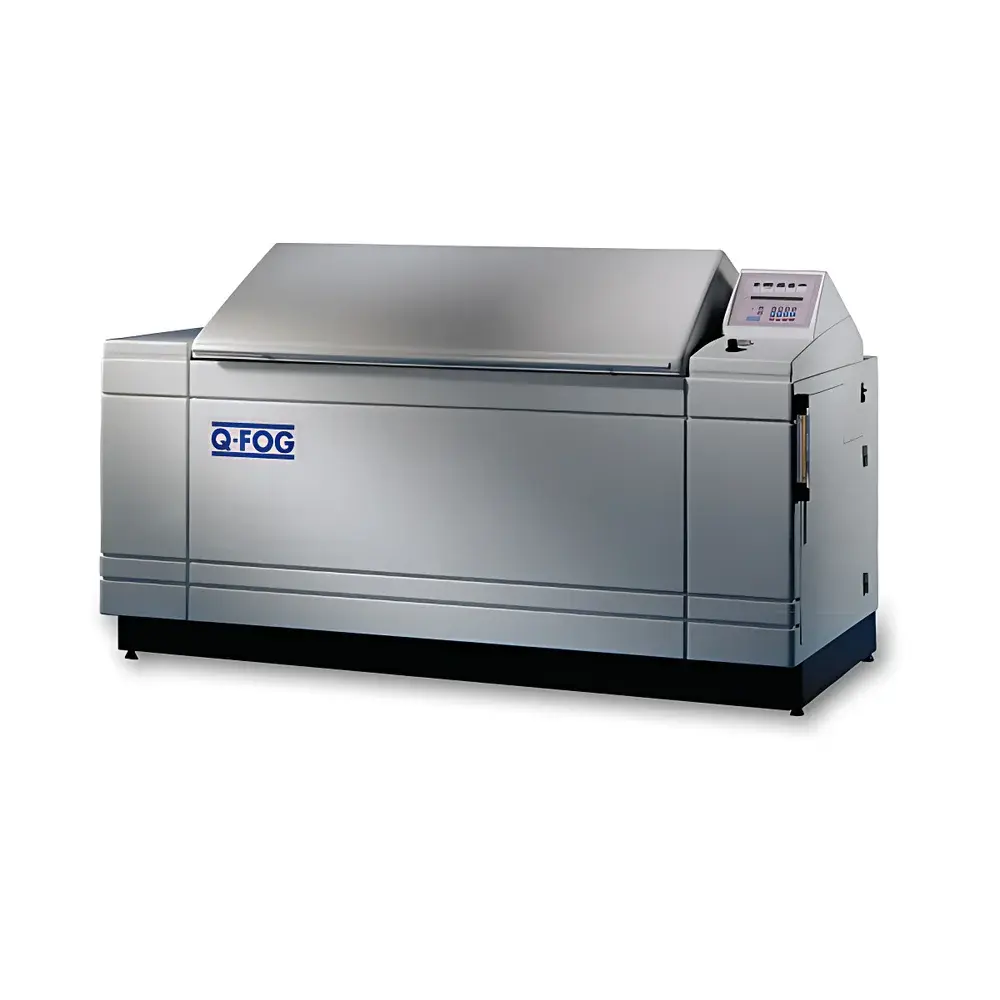
Q-Lab Q-FOG SSP-600 / SSP-1100 / CCT-600 / CCT-1100 Cyclic Corrosion Test Chambers
| Brand | Q-Lab |
|---|---|
| Origin | USA |
| Model | Q-FOG SSP-600, Q-FOG SSP-1100, Q-FOG CCT-600, Q-FOG CCT-1100 |
| Temperature Range | 20–70 °C (spray/dry), 20–60 °C (RH/humidity) |
| Chamber Capacity | 640 L (SSP/CCT-600), 1103 L (SSP/CCT-1100) |
| Salt Solution Reservoir | 120 L |
| Sample Capacity | 160 panels (75 × 150 mm) for 600-series |
| Spray Rate | 1–2 mL/80 cm²·hr |
| Air Pressure | 0.7–1.0 kg/cm² (≈70–100 kPa) |
| Humidity Control | 95–100% RH (CCT models only) |
| Power Supply | 208–230 V, 50/60 Hz, 13–38 A |
| Weight (dry) | 224–378 kg |
| Water Purity Requirement | <8 ppm TDS, >50 kΩ·cm resistivity |
Overview
The Q-Lab Q-FOG series represents a benchmark in cyclic corrosion testing (CCT) instrumentation, engineered to replicate the complex, time-dependent environmental stressors that drive real-world material degradation—particularly electrochemical corrosion of coated metals, plated components, and automotive assemblies. Unlike traditional continuous-salt-spray chambers governed by ASTM B117, the Q-FOG platform implements programmable multi-phase exposure cycles that emulate natural diurnal and seasonal transitions: salt fog, dry-off, high-humidity condensation, and ambient rest periods. This capability is grounded in fundamental corrosion science—where corrosion kinetics are strongly modulated by wet/dry cycling, electrolyte concentration gradients, and oxygen diffusion rates at the metal–coating interface. The system’s architecture supports standardized test protocols including ASTM G85 Annexes (Prohesion, SO₂-acidified salt), ISO 11997, SAE J2334, GMW 14872, Ford CETP, and VW PV1210—making it indispensable for R&D labs, Tier-1 suppliers, and OEM validation centers operating under IATF 16949 and AIAG CQI-11 requirements.
Key Features
- Programmable Multi-Condition Cycling: Four distinct exposure phases—salt fog, dry-off, 100% RH (CCT models only), and ambient rest—are independently controllable via an embedded microprocessor with intuitive touchscreen interface. Cycle definition includes precise temperature ramping, dwell timing, and phase sequencing—enabling full compliance with proprietary automotive CCT specifications.
- Precision Fog Generation: Dual-regulation system: peristaltic pump controls solution flow rate; precision air pressure regulator governs droplet size distribution and spray uniformity. Achieves consistent deposition across sample surfaces per ISO 9227 and ASTM B117 calibration requirements.
- Integrated 120-L Salt Solution Reservoir: Reduces manual refilling frequency; includes inline filtration, low-level alarm, and compatibility with deionized water systems meeting 50 kΩ·cm resistivity—critical for eliminating trace ion interference in quantitative corrosion assessment.
- Rapid Thermal Transitions: High-power resistive heaters and high-CFM forced-air cooling/drying fans enable sub-15-minute transitions between fog (20–60 °C) and dry (20–70 °C) states—far exceeding thermal inertia limitations of water-jacketed chambers.
- Modular Sample Handling: Standard 75 × 150 mm panel capacity: 160 units (600-series), 240 units (1100-series). Optional 15° tilt fixtures (F-9008-K/F-9011-K) and 20 mm diameter suspension rods (F-9014-K/F-9017-K) accommodate 3D parts, fasteners, and geometrically complex assemblies up to 113 kg per rack.
- Diagnostic & Compliance Readiness: Built-in self-diagnostics, service interval alerts, and automatic safety shutdown. Controller logs all operational parameters—including setpoints, actual values, alarms, and user actions—with optional audit trail functionality supporting GLP/GMP and FDA 21 CFR Part 11 compliance when integrated with Q-Lab’s Q-Support software suite.
Sample Compatibility & Compliance
The Q-FOG chamber accommodates diverse specimen geometries—from flat-coated panels and galvanized steel coupons to full-scale automotive door modules and electronic enclosures. Its internal dimensions (e.g., 109 × 66 × 72 cm for 600-series) permit vertical orientation of tall components while maintaining uniform fog distribution per ASTM D2247 nozzle placement guidelines. All models meet CE marking requirements and comply with IEC 61000-6-2/6-4 electromagnetic compatibility standards. For regulatory submissions, Q-FOG test reports are routinely accepted by global OEMs and notified bodies as evidence of coating durability under ISO 12944–6 (paint systems for steel structures) and EN 13523–8 (coil-coated metal corrosion resistance). The CCT variants further satisfy stringent humidity control requirements outlined in ISO 6270–2 (condensation testing) and DIN 50017 (Kesternich testing).
Software & Data Management
Q-FOG controllers feature non-volatile memory storing up to 100 user-defined test programs, each with up to 99 steps and nested loops. Real-time monitoring displays current phase, elapsed time, chamber temperature, and solution level. Data export is supported via USB port (CSV format) or optional Ethernet interface for integration into LIMS or MES platforms. When paired with Q-Lab’s Q-Support v5.x software, users gain advanced capabilities: remote supervision, automated report generation (PDF/Excel), trend analysis of historical test runs, and electronic signature workflows aligned with 21 CFR Part 11 Annex 11 expectations. All controller firmware updates are validated per Q-Lab’s ISO 9001:2015 quality management system and documented in release notes traceable to change control records.
Applications
- Accelerated evaluation of automotive exterior trim, chassis components, and battery enclosures per GMW 14872, Ford WDK 100, and VW TL 226.
- Qualification of architectural cladding systems (aluminum composite panels, stainless steel façades) against ISO 9223 classification tiers.
- Correlation studies linking lab-based CCT results to field performance data from coastal, industrial, and de-icing salt exposure sites.
- Development and validation of zinc-nickel, electroless nickel, and trivalent chromium passivation coatings for aerospace fasteners (per AMS 2403, AMS 2417).
- Quality assurance of printed circuit board conformal coatings under IPC-CC-830B and MIL-I-46058C.
FAQ
What distinguishes SSP models from CCT models?
SSP variants support salt fog and Prohesion (dry/salt alternation) cycles only. CCT models add fully controlled 95–100% RH conditioning—essential for simulating dew formation, hygroscopic salt deliquescence, and electrochemical activity during humid phases.
Is deionized water mandatory?
Yes. Tap or distilled water introduces conductive ions (Ca²⁺, Mg²⁺, Cl⁻) that distort corrosion morphology and invalidate comparative testing. Q-Lab specifies 50 kΩ·cm.
Can Q-FOG chambers be validated per IQ/OQ protocols?
Yes. Q-Lab provides Factory Acceptance Test (FAT) documentation, installation qualification templates, and operational qualification checklists aligned with ASTM E2500 and ISO/IEC 17025. Third-party IQ/OQ services are available through certified Q-Lab Field Service Engineers.
How is fog uniformity verified?
Per ASTM B117, fog collection is measured using six calibrated funnels distributed across the working volume. Q-FOG systems ship with NIST-traceable salt fog collection kits (part # F-9001-K) and include built-in alignment guides to ensure reproducible placement.
What maintenance intervals are recommended?
Daily: visual inspection of nozzles, reservoir level, and air filter. Quarterly: replacement of peristaltic pump tubing (8 included in annual maintenance kit). Annually: calibration verification of temperature sensors and pressure regulators by authorized Q-Lab service personnel.



