
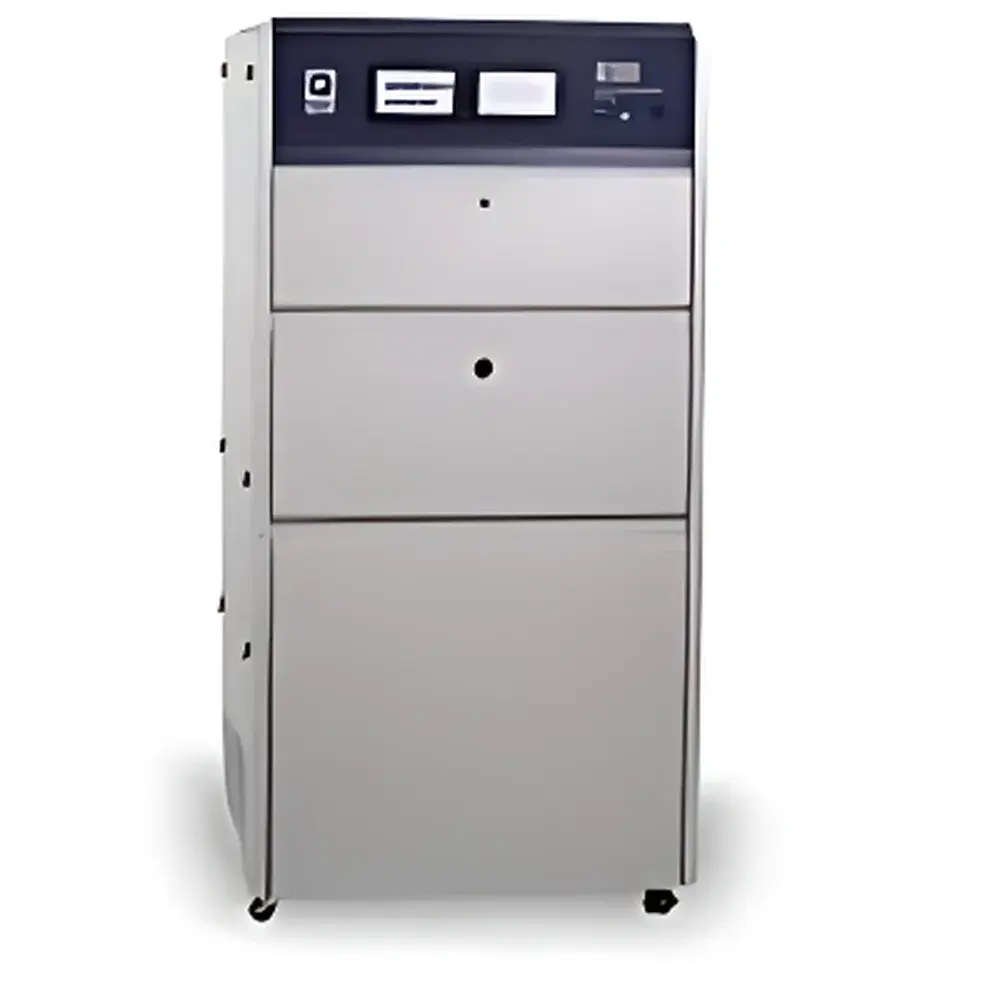
Q-Lab Q-Sun Xe-3HBSE Xenon Arc Weathering Test Chamber
| Brand | Q-Lab |
|---|---|
| Origin | USA |
| Manufacturer Type | Authorized Distributor |
| Origin Category | Imported |
| Model | Q-Sun Xe-3HBSE |
| Xenon Lamp Power | 3 × 1800 W |
| Irradiance Range | 0.55–1.3 W/m²/nm @ 340 nm |
| Light Exposure Cycle | 1–999 h |
| Humidity Range | 20–95% RH |
Overview
The Q-Lab Q-Sun Xe-3HBSE is a full-spectrum, air-cooled xenon arc weathering test chamber engineered for accelerated simulation of solar radiation, temperature, and humidity effects on materials. It operates on the principle of xenon arc irradiation—using three high-intensity, wind-cooled 1800 W lamps to replicate the spectral power distribution (SPD) of natural sunlight across UV (295–400 nm), visible (400–800 nm), and near-infrared (800–2500 nm) regions. Unlike water-cooled systems, its air-cooled architecture reduces operational complexity, maintenance frequency, and long-term ownership cost while maintaining compliance with international weathering standards including ISO 4892-2, ASTM G155, SAE J2527, and AATCC TM16. The chamber’s flat-bed sample tray (451 mm × 718 mm) accommodates irregular, three-dimensional, or oversized specimens—including automotive components, architectural coatings, textiles, packaging, and medical device housings—without requiring custom fixtures. Its modular optical system allows precise spectral tuning via interchangeable filter sets, enabling correlation to outdoor exposure, window-filtered indoor conditions, or accelerated UV-rich environments.
Key Features
- Triple 1800 W air-cooled xenon arc lamps with 1500-hour typical service life; lamp replacement requires only one connector disconnection and two set-screw loosening
- SOLAR EYE irradiance control system with continuous real-time monitoring and feedback regulation at 340 nm, 420 nm, or TUV (total UV) bands
- Black panel temperature control range: 42–120 °C; optional dual-sensor configuration enables independent regulation of black panel and chamber air temperature
- Integrated humidity control (20–95% RH) using purified water; all humidification, spray, and back-spray functions require deionized or distilled water supply
- Three spray modes: front-only spray (top-mounted nozzles), simultaneous front-and-back spray (SAE-compliant), and dual-fluid spray (e.g., acid rain + deionized water)
- Standard flat sample tray with adjustable-height fixtures for 3D parts; accommodates up to 55 specimens of 51 mm × 102 mm or heterogeneous items such as bottles, golf balls, or cosmetic containers
- ISO/IEC 17025-accredited calibration traceable to NIST for both black panel thermometers and SOLAR EYE irradiance sensors; annual recalibration recommended
Sample Compatibility & Compliance
The Q-Sun Xe-3HBSE supports broad material classes—including polymers, paints and coatings, textiles, adhesives, composites, and pharmaceutical packaging—under controlled photothermal-hygrometric stress. Its flat-bed geometry ensures uniform irradiance distribution and realistic moisture retention on inclined or curved surfaces. Filter options include Daylight-F/Q/B/B (outdoor correlation), Window-Q/B/SL/SF-5/IR (indoor/through-glass), and UV-Q/B (extended UV for automotive and aerospace qualification). The system meets regulatory requirements for method validation under GLP and GMP frameworks, with audit-ready data logging compliant with FDA 21 CFR Part 11 when paired with Q-Lab’s optional “Virtual Strip Chart” software. All configurations support third-party verification per ISO 17025, ASTM D7869, and IEC 60068-2-9.
Software & Data Management
The embedded controller features multilingual interface (English, French, Spanish, German, Italian), self-diagnostic routines, and programmable alarm thresholds for irradiance deviation, temperature excursion, or low-water conditions. Ethernet connectivity enables remote monitoring, firmware updates, and secure data export. Optional Virtual Strip Chart software provides automated time-stamped logging of irradiance, black panel temperature, chamber humidity, and cycle phase transitions. Data files are exportable in CSV or XML format for integration into LIMS or statistical process control platforms. For regulated environments, the system supports electronic signatures, user access levels, and audit trail generation—including operator ID, parameter changes, and calibration events—to satisfy 21 CFR Part 11 and EU Annex 11 requirements.
Applications
This chamber is routinely deployed in R&D labs and QC departments for predictive durability assessment across industries: automotive OEMs use it for dashboard trim, headlamp lenses, and sealant validation per SAE J2412; architectural coating manufacturers apply it for ASTM D4587 cyclic UV/condensation testing; textile labs rely on it for AATCC TM16 colorfastness evaluation; and medical device firms employ it for ISO 10993-12 extractables stability screening. Its dual-spray capability enables formulation testing of cleaning agents, anti-corrosion inhibitors, or pH-sensitive biomaterials under simulated environmental insult. The optional refrigerated model (Xe-3-HSCE) extends applicability to thermolabile products—including cosmetics and biologics—by sustaining stable exposures at 31–120 °C with ±0.5 °C black panel accuracy.
FAQ
What spectral filters are standard with the Xe-3HBSE?
The base configuration includes Daylight-F and Window-Q filters. Additional filters (e.g., UV-Q/B, Window-B/SL, Window-SF-5) are available as factory-installed or field-upgrade options.
Is purified water mandatory for all functions?
Yes—humidity generation, front/back spray, dual-fluid spray, and the optional pure water recycling system all require deionized or distilled water to prevent mineral deposition and sensor drift.
Can the Xe-3HBSE operate unattended for extended cycles?
Yes—its robust safety architecture includes overtemperature cutoff, lamp arc-failure detection, low-water shutoff, and automatic emergency cooldown. Scheduled maintenance intervals are defined in the operator manual and tracked via the controller’s service timer.
How is irradiance uniformity validated across the sample plane?
Q-Lab specifies ±15% irradiance uniformity over the central 80% of the sample tray (per ASTM G155 Annex A1); users may verify this using a calibrated reference sensor mapped at nine predefined grid points.
Does the system support external data acquisition via analog or digital I/O?
No native analog outputs are provided; however, real-time parameter streaming is supported via TCP/IP over Ethernet using Q-Lab’s documented API protocol for integration with SCADA or custom LabVIEW applications.



