
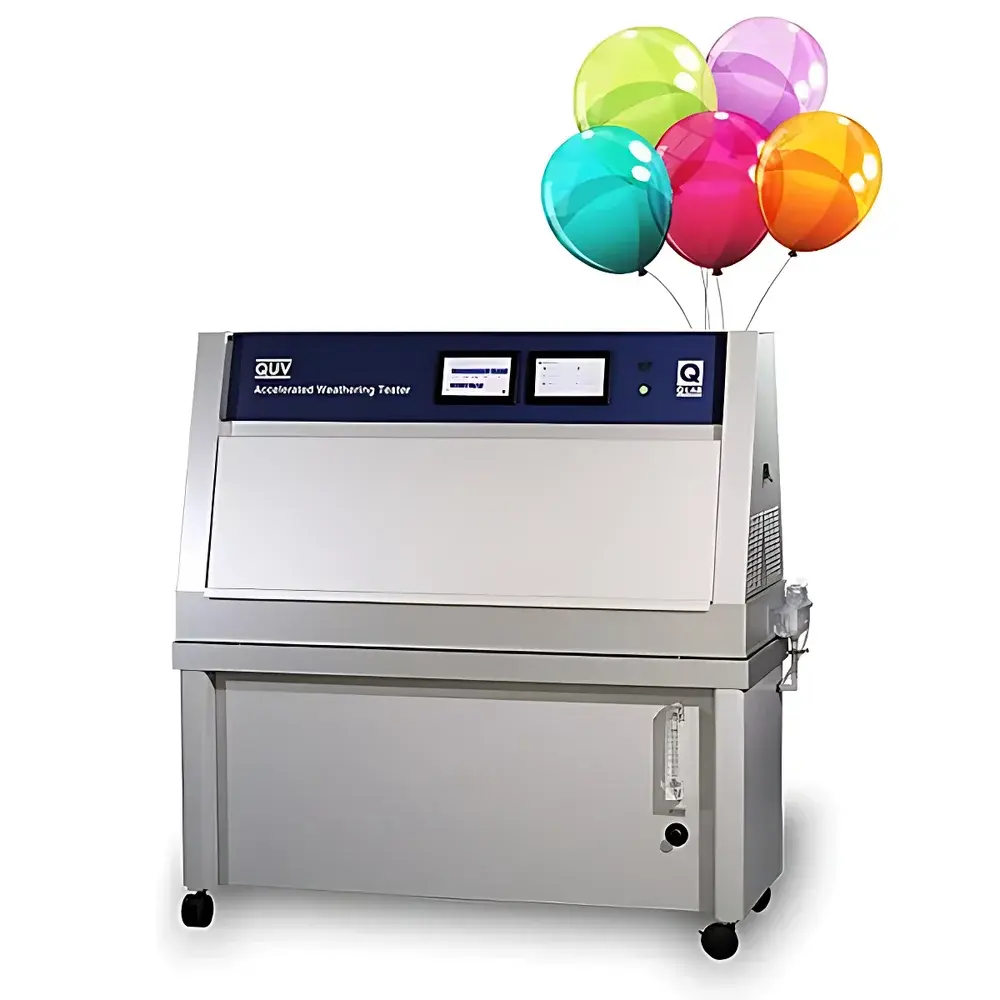
Q-Lab QUV UV Aging Test Chamber
| Brand | Q-Lab |
|---|---|
| Origin | USA |
| Manufacturer Type | Authorized Distributor |
| Product Origin | Imported |
| Model | Qsun QUV |
| Irradiance Range | 0.48–0.95 W/m² |
| Exposure Duration | 1–9999 hours (adjustable per standard) |
| UV Wavelength Range | 250–400 nm |
| Chamber Capacity | Up to 48 specimens (75 mm × 150 mm each) |
Overview
The Q-Lab QUV UV Aging Test Chamber is an industry-standard accelerated weathering instrument engineered for precision simulation of solar ultraviolet radiation, moisture condensation, and water spray exposure—key environmental stressors driving polymer degradation, coating failure, and material embrittlement. Based on the fundamental principles of photochemical degradation kinetics and humidity-driven hydrolytic aging, the QUV system subjects specimens to controlled, repeatable cycles of UV irradiation (via fluorescent lamp arrays) and moisture exposure (via condensation or spray), enabling laboratory replication of years of outdoor exposure in weeks. Its design adheres to core photostability testing paradigms defined in ASTM G154, ISO 4892-3, IEC 61215, and SAE J2020, making it a validated platform for R&D, quality assurance, and regulatory compliance testing across automotive, aerospace, architectural coatings, photovoltaics, and medical device sectors.
Key Features
- Solar-Eye™ Irradiance Control (QUV/se & QUV/spray): Closed-loop feedback system maintaining ±5% irradiance stability across UVA-340 (340 nm peak) or UVB-313 (313 nm peak) lamps; traceable to NIST-calibrated reference sensors.
- Condensation Humidity Simulation: Internally generated saturated steam condensate replicates dew formation at specimen surfaces—critical for evaluating hydrolytic degradation mechanisms in polyesters, polyurethanes, and adhesives.
- Optional Water Spray System (QUV/spray): Programmable spray cycles deliver thermal shock (rapid cooling) and mechanical erosion effects, aligned with ASTM D4329 and ISO 4892-3 Annex B protocols.
- UVC-Specific Configuration (QUV/uvc): Equipped with low-pressure mercury lamps emitting at 254 nm for germicidal UV resistance testing; integrated interlocks, shielded viewports, and ozone ventilation ensure Class 1 laser safety compliance (IEC 60825-1).
- Cold White Fluorescent Option (QUV/cw): Modified SOLAR EYE control calibrated for CWF (cool white fluorescent) spectral output—used for indoor lightfastness evaluation per ISO 105-B02 and AATCC TM16.
- Third-Generation Touchscreen Controller: Intuitive interface with real-time display of UV intensity, chamber temperature, condensation time, and cycle phase; supports up to 10 user-defined test programs with password-protected access levels.
Sample Compatibility & Compliance
The QUV accommodates flat-panel specimens up to 75 mm × 150 mm, with rack configurations supporting up to 48 samples per cycle. Specimen holders are corrosion-resistant aluminum or stainless steel, compatible with ASTM D6675 specimen mounting fixtures. All models meet CE marking requirements and conform to IEC 61000-6-3 (EMC) and IEC 61000-6-2 (immunity). Data integrity complies with FDA 21 CFR Part 11 when paired with Q-Lab’s optional QUV Data Logger software (audit trail, electronic signatures, and secure export). The system supports GLP/GMP-aligned validation protocols—including IQ/OQ/PQ documentation templates available upon request.
Software & Data Management
Q-Lab’s proprietary QUV Software Suite provides full remote monitoring, automated data logging (temperature, irradiance, cycle stage), and export to CSV or PDF formats. Calibration history, maintenance logs, and alarm records are stored with timestamped metadata. AutoCal™ functionality enables rapid field recalibration using certified reference sensors—eliminating downtime associated with third-party service visits. REPAIRPEDIA™, Q-Lab’s free online troubleshooting database, delivers step-by-step diagnostics, illustrated parts diagrams, and firmware update instructions accessible via QR code scanning from the controller interface.
Applications
- Evaluation of UV stabilizers in polyolefins, PVC, and engineering thermoplastics
- Correlation studies between QUV exposure and natural Florida/Arizona field aging (per ASTM G155)
- Qualification of automotive interior trim materials per GMW14124 and Ford CETP 00.00-L-467
- Photostability assessment of pharmaceutical packaging per USP <661.2>
- Durability screening of photovoltaic encapsulants and backsheets per IEC 61215-2 MQT10
- Validation of antimicrobial surface coatings under UVC stress (QUV/uvc configuration)
FAQ
What standards does the QUV comply with?
The QUV meets requirements of ASTM G154, ISO 4892-3, IEC 60068-2-5, SAE J2020, and GB/T 14522—covering UV exposure, condensation, and cyclic weathering methodologies.
Can the QUV replicate full-spectrum sunlight?
No—the QUV uses narrowband fluorescent UV lamps optimized for specific spectral regions (e.g., UVA-340 for solar UV-B/A simulation); full-spectrum xenon arc testing requires Q-Lab’s Q-SUN Xe-1 or Xe-3 systems.
Is distilled water required for condensation?
No—deionized or filtered tap water is sufficient; mineral buildup is mitigated by Q-Lab’s patented water-level sensor and auto-drain cycle.
How often must UV lamps be replaced?
Lamp life is typically 1,500–2,000 hours; the controller tracks cumulative exposure and triggers maintenance alerts based on irradiance decay thresholds.
Does Q-Lab provide calibration services?
Yes—NIST-traceable irradiance calibration kits (Model CAL-200) and on-site certification services are available globally through Q-Lab’s network of authorized service centers.



