
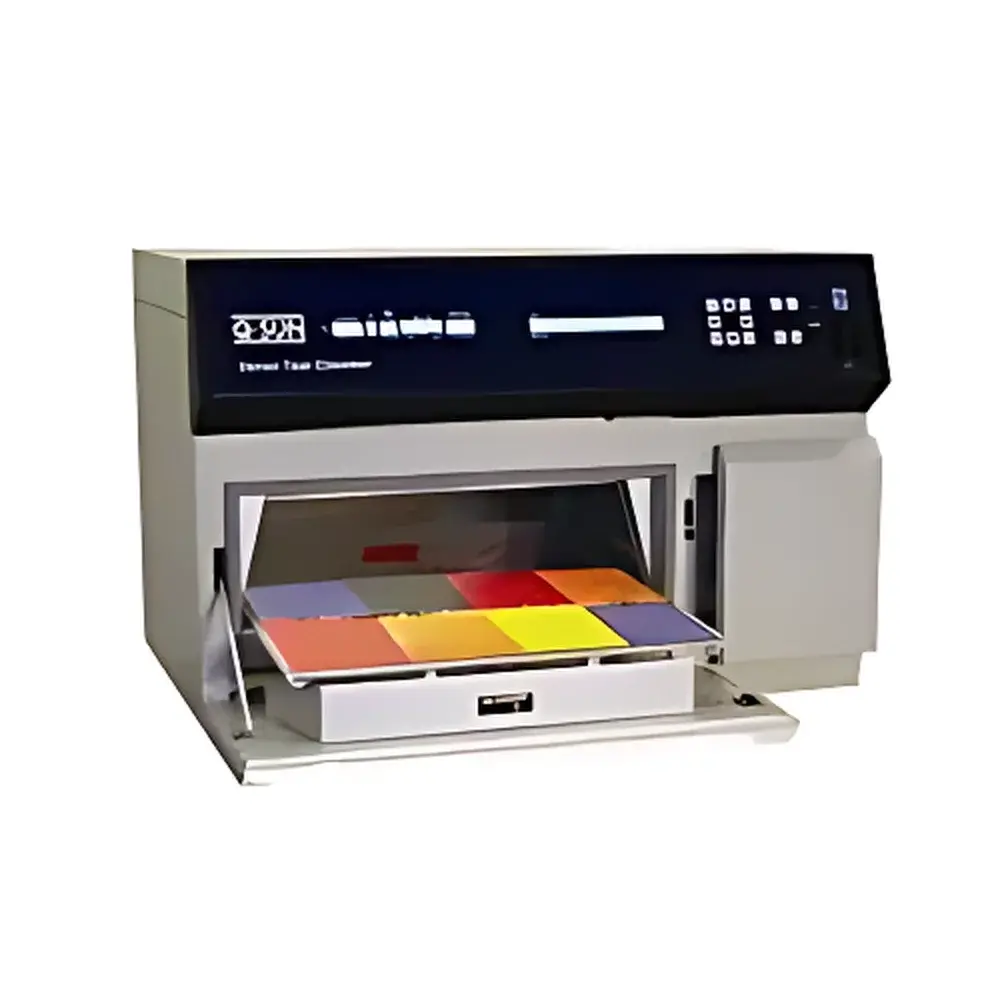
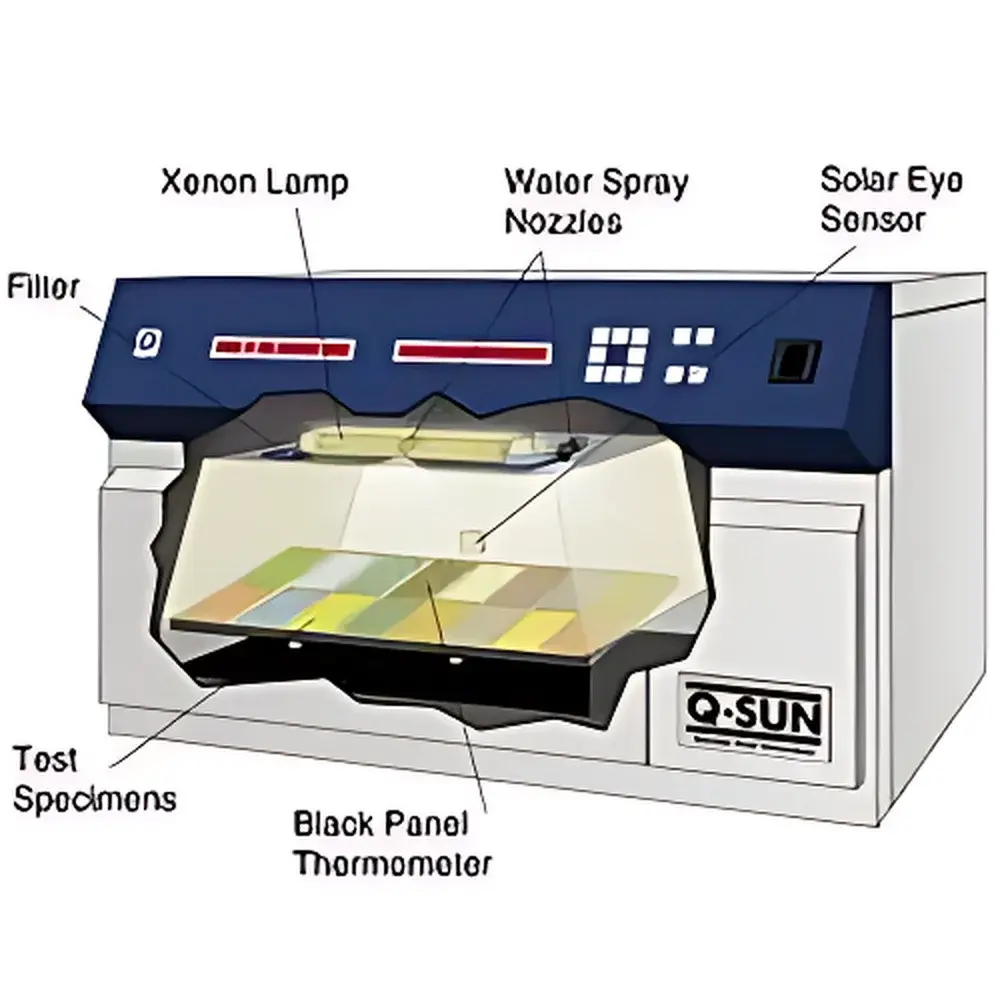
Q-Lab Q-SUN Xe-1 Xenon Arc Weathering Test Chamber
| Brand | Q-Lab |
|---|---|
| Origin | USA |
| Manufacturer Status | Authorized Distributor |
| Origin Category | Imported |
| Model | Q-SUN Xe-1 |
| Xenon Lamp Power | Not specified (air-cooled single-lamp system) |
| Irradiance Control | SOLAR EYE broadband or narrowband (340 nm, 420 nm, or TUV) |
| Light Cycle | Programmable irradiance-on/off cycles with optional water spray and refrigeration |
| Dimensions (W×D×H) | 610 × 584 × 533 mm |
| Sample Tray | 251 × 457 mm (horizontal, flat), accommodates up to seventeen 51 × 102 mm specimens |
| Lamp Life | ~1500 hours (air-cooled xenon arc lamp) |
| Temperature Range | Black Panel: 35–103 °C |
| Air Temperature (with refrigeration option) | 19–103 °C |
| Calibration | NIST-traceable CT202 (temperature) and CR20 (irradiance) |
Overview
The Q-Lab Q-SUN Xe-1 Xenon Arc Weathering Test Chamber is a benchtop, single-lamp accelerated weathering instrument engineered for reproducible simulation of full-spectrum solar radiation—including UV, visible, and near-infrared wavelengths—combined with controlled thermal and moisture stress. Based on the principles of xenon arc irradiation, the Xe-1 employs a precisely filtered air-cooled xenon lamp to replicate natural sunlight exposure under laboratory conditions. Unlike UV fluorescent or metal halide systems, xenon arc technology delivers spectrally accurate irradiance across 295–800 nm, making it the internationally preferred method for evaluating photostability, colorfastness, and material degradation per ASTM G155, ISO 4892-2, ISO 11341, AATCC TM16, and SAE J2527. Its compact footprint, horizontal sample orientation, and modular configuration (base unit + optional spray/refrigeration) enable high-fidelity outdoor aging acceleration—achieving in days what requires months or years in real-world exposure.
Key Features
- Single air-cooled xenon arc lamp (1500-hour nominal life) eliminates water cooling infrastructure, reducing maintenance complexity and operational cost.
- Horizontal flat sample tray (251 × 457 mm) supports diverse geometries—including 3D objects—and ensures realistic water retention during spray cycles.
- SOLAR EYE irradiance control system maintains precise, closed-loop regulation at user-selectable wavelengths: 340 nm (UV-A critical for polymer degradation), 420 nm (broadband UV/visible), or TUV (300–400 nm total ultraviolet).
- Black panel temperature sensor (standard) provides direct measurement of specimen surface thermal load; optional air temperature sensor available for ambient-controlled protocols.
- Integrated Ethernet port enables remote monitoring, data logging, and secure transfer of exposure parameters to Windows-based PCs via Q-Lab’s optional “Virtual Strip Chart” software.
- PATENTED AUTOCAL system simplifies field calibration of irradiance and temperature sensors using traceable CR20 and CT202 instruments—both calibrated annually to NIST standards under ISO/IEC 17025 accreditation (A2LA Cert. #2382-01, #2383-02, #2383-03).
- Five-language interface (English, French, Spanish, Italian, German) with intuitive menu navigation, self-diagnostic alerts, and automated safety shutdown protocols.
Sample Compatibility & Compliance
The Q-SUN Xe-1 accommodates flat, curved, and three-dimensional specimens—including textiles, coatings, plastics, pharmaceutical packaging, cosmetics, and automotive interior components—without requiring custom fixtures. Standard sample holders include textile clamps (X-10255-X), narrow/wide bottle racks (X-10183/X-10184), and flat-panel fixtures (X-10113-K). Optional 0° tilt adapter enables true horizontal exposure for viscous or fluid samples. All filter options—Daylight (F/Q/B/B), Window Glass (Q/B/SL/SF-5/IR), and Extended UV (Q/B)—are certified for spectral stability over lifetime use; only Window-IR filters require periodic replacement due to IR absorption characteristics. The system complies with regulatory requirements for method validation and audit trails, supporting GLP/GMP workflows through timestamped exposure logs, user-accessible calibration history, and FDA 21 CFR Part 11–compatible data integrity features when paired with Q-Lab’s enterprise software suite.
Software & Data Management
Embedded controller firmware records all exposure parameters—including irradiance setpoint, black panel temperature, cycle timing, spray activation status, and fault diagnostics—in non-volatile memory. Data export is supported via Ethernet using standard TCP/IP protocols; no proprietary drivers required. Optional Virtual Strip Chart software provides real-time graphical visualization, automated report generation (PDF/CSV), and scheduled email transmission of test logs to designated support addresses. For regulated environments, Q-Lab offers Q-TRAK™ software—a validated platform enabling electronic signatures, role-based access control, and full 21 CFR Part 11 compliance—including audit trail archiving, electronic record retention, and change management documentation.
Applications
The Q-SUN Xe-1 is routinely deployed in quality assurance labs for: accelerated lightfastness testing of dyes and pigments (ISO 105-B02); UV resistance evaluation of architectural coatings (ASTM D4364); photostability assessment of drug products per ICH Q1B; color shift analysis of automotive trim (SAE J2412); and durability validation of outdoor signage and geotextiles. Its ability to decouple irradiance intensity from chamber temperature—particularly with refrigeration-equipped models (Xe-1-BC/SC)—makes it suitable for thermally sensitive materials such as biologics, ophthalmic solutions, and cosmetic emulsions where non-photochemical thermal degradation must be suppressed. The system’s correlation to real-world exposure has been verified across decades of interlaboratory round-robin studies coordinated by ASTM Committee G03 and ISO Technical Committee TC156.
FAQ
What lamp types are compatible with the Q-SUN Xe-1?
Only Q-Lab’s proprietary air-cooled single-ended xenon arc lamps (part number Xe-1L) are approved for use. Substitution with third-party or water-cooled lamps voids warranty and compromises spectral fidelity and safety certification.
Is purified water mandatory for the spray option?
Yes. Deionized or distilled water (conductivity ≤ 5 µS/cm) is required to prevent nozzle clogging and mineral deposition on specimens and optical components. An optional recirculating deionization system (Q-Lab PureWater™) reduces consumable costs and wastewater discharge.
How often must irradiance and temperature sensors be calibrated?
Users should perform field calibration before each test series using CR20 and CT202 instruments. Annual recalibration of these reference devices at Q-Lab’s A2LA-accredited lab is mandatory to maintain traceability to NIST.
Can the Xe-1 operate unattended for extended periods?
Yes. Designed for continuous 24/7 operation, the Xe-1 includes redundant thermal cutoffs, lamp arc-failure detection, and automatic cooldown sequencing. Remote monitoring via Ethernet ensures operational visibility without physical presence.
Does the Xe-1 meet ISO 17025 requirements for accredited testing labs?
While the instrument itself is not “accredited,” its design, calibration traceability (NIST → A2LA), documented uncertainty budgets, and integrated audit-trail capabilities fully support ISO/IEC 17025 clause 6.4 (equipment) and 7.7 (reporting) when operated within a certified quality management system.



