
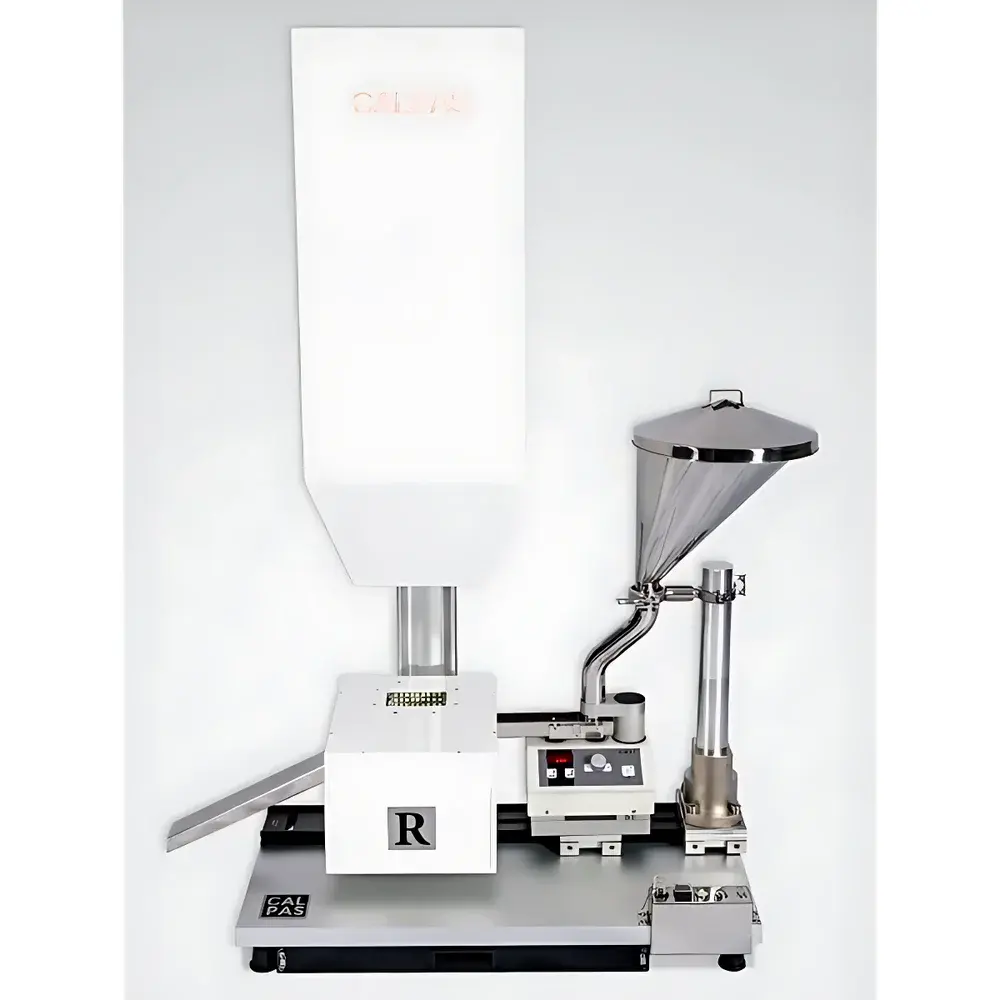
Calpas R Polyolefin Impurity Analyzer for Rubber & Plastic Industry
| Brand | Calpas |
|---|---|
| Origin | South Korea |
| Manufacturer Type | Authorized Distributor |
| Origin Category | Imported Instrument |
| Model | Calpas R |
| Price Range | USD 85,000 – 170,000 |
Overview
The Calpas R Polyolefin Impurity Analyzer is an automated optical inspection and quantitative image analysis system engineered for high-precision detection, classification, and statistical reporting of visual defects in polymer raw materials—including resin powders (e.g., PVC), granules (e.g., PP, PE, ABS), and high-transparency engineering thermoplastics (e.g., PC, PMMA). Operating on the principle of high-resolution digital imaging combined with multi-angle, intensity-tunable shadow-based illumination and real-time morphological color segmentation algorithms, the system identifies and quantifies foreign particles, discolorations (e.g., black specks, yellowing, off-color granules), shape anomalies (e.g., agglomerates, tails, fused particles), and dimensional deviations across a defined size range. Designed specifically for polyolefin and elastomer manufacturing environments, it supports quality gatekeeping at incoming inspection, in-process monitoring, and final release stages—ensuring conformance to stringent aesthetic and functional specifications demanded by automotive, medical-grade packaging, and optical-grade applications.
Key Features
- Single-platform multimodal detection: Simultaneous identification and classification of black specks, colored contaminants, gel particles, fibers, agglomerates, tailing, and dimensional outliers (length, width, aspect ratio, circularity)
- High-speed throughput: Up to 500 g of powder analyzed in ≤3 minutes; 1 kg of granules in ≤2 minutes—enabling batch-level screening without process interruption
- Adaptive illumination architecture: Four independently configurable LED light sources—including center-axis, square-array, and specialized transmissive/reflective modes—optimized for material transparency, surface reflectivity, and particle geometry
- Three-dimensional vibratory feed system: Precisely adjustable amplitude and feed height to control monolayer dispersion, flow rate, and particle orientation—critical for reproducible imaging of irregularly shaped granules
- User-defined defect taxonomy: Customizable classification rules with assignable names, color thresholds, size bins, and morphological filters—supporting internal QC nomenclature and customer-specific defect standards
- Integrated calibration traceability: Includes Calpas-certified reference standard plates for routine verification of pixel-to-micron scaling and contrast sensitivity per ISO 14484 guidelines
Sample Compatibility & Compliance
The Calpas R accommodates dry, free-flowing polymer samples ranging from fine powders (e.g., suspension-grade PVC) to cylindrical or irregular granules (e.g., PP homopolymer, HDPE copolymer, ABS terpolymer). It reliably detects sub-50 µm dark inclusions in translucent PC pellets and distinguishes low-contrast yellow index shifts in white LDPE masterbatches. System validation aligns with ISO 14484 (optical particle counting in plastics), supports ASTM D7829 (color specification in polyolefins), and provides audit-ready data structures compatible with GLP/GMP documentation workflows. Optional configurations meet cleanroom Class 7–8 requirements via integrated dust shielding and electrostatic discharge (ESD)-safe housing.
Software & Data Management
The proprietary Calpas Vision Analysis Suite runs on standard Windows 10/11 platforms and features intuitive wizard-driven operation—from method setup and auto-calibration to report generation. All image metadata (timestamp, illumination settings, feed parameters, user ID) are embedded and logged. Reports include summary statistics (count per size bin, color distribution histograms, morphology indices), annotated thumbnail galleries of each detected anomaly, and exportable CSV/Excel datasets for SPC integration. Audit trail functionality records all parameter modifications and report exports, satisfying FDA 21 CFR Part 11 requirements when deployed with network authentication and electronic signature modules.
Applications
- Raw material acceptance testing for polyolefin producers supplying Tier-1 automotive compounders
- In-line quality surveillance of extrusion-grade PP granules prior to film casting or blow molding
- Root cause analysis of gel formation in metallocene-catalyzed LLDPE batches
- Validation of melt filtration efficiency in recycled PET flake processing lines
- Supplier qualification against OEM color and defect limits (e.g., Toyota TSB-0012, Ford WSS-M99P1111-A)
- Supporting ISO/IEC 17025-compliant testing laboratories performing third-party impurity certification
FAQ
What size range can the Calpas R detect?
The system measures particles and defects from 50 µm to 30,000 µm, with user-definable size bins and dynamic thresholding for sub-pixel interpolation accuracy.
Does it support regulatory compliance for pharmaceutical-grade polymers?
While not a Class III medical device, its data integrity framework—including full audit trail, electronic signatures, and calibration logging—supports alignment with USP <661.2>, ISO 10993-12, and ICH Q5E analytical method validation expectations.
Can the system integrate with factory MES or LIMS platforms?
Yes—via OPC UA or RESTful API interfaces, enabling automated result transfer to Siemens Opcenter, Rockwell FactoryTalk, or LabVantage LIMS.
Is operator training required for daily use?
Minimal training is needed: standard operation requires only three mouse clicks (load sample → start → export report); advanced method development is supported by Calpas-certified application engineers onsite or remotely.
How often must the instrument be recalibrated?
Calibration verification using the supplied standard plate is recommended before each shift; full recalibration is performed annually or after major hardware maintenance, per ISO/IEC 17025 clause 6.5.
Related Products




