
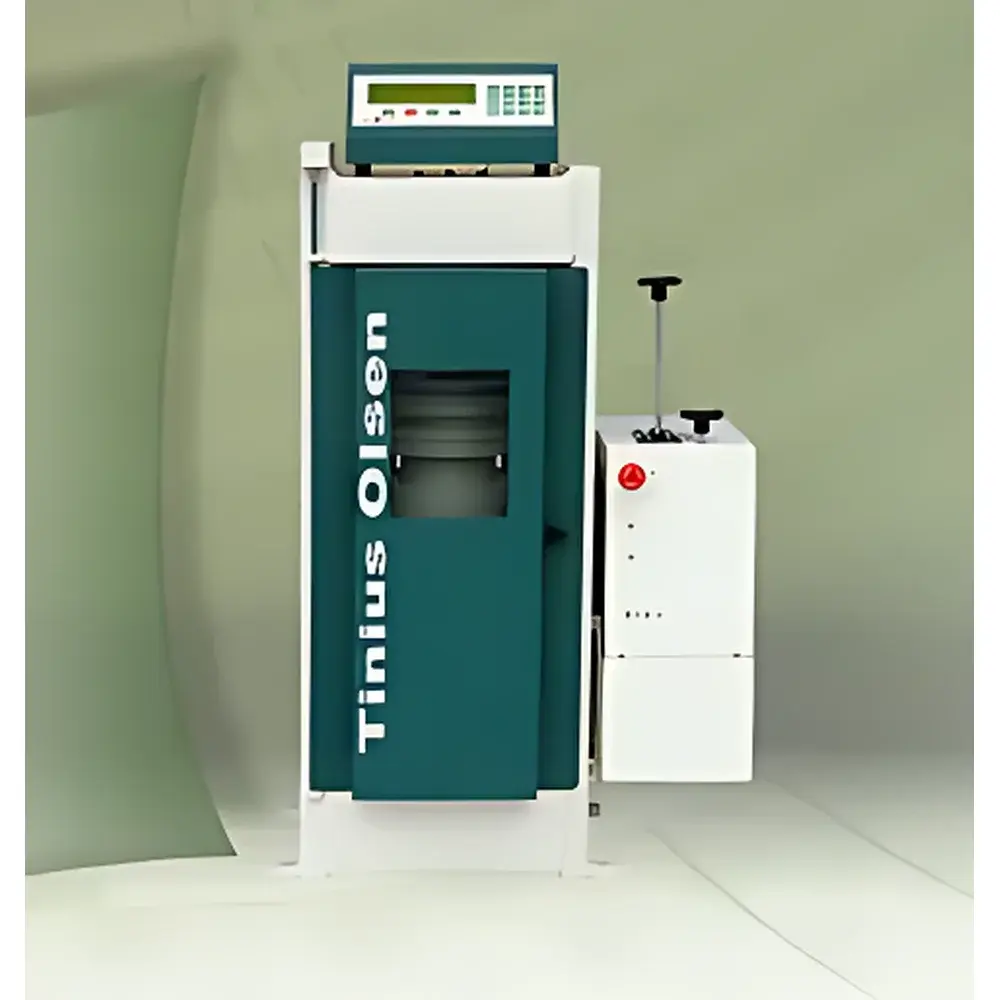
Tinius Olsen DG Series Manual Compression Testing Machine
| Brand | Tinius Olsen |
|---|---|
| Origin | United Kingdom |
| Model | DG |
| Load Capacity Options | 50 kN, 100 kN, 250 kN, 500 kN, 1000 kN, 1500 kN, 2000 kN, 3000 kN |
| Power Supply Options | 110 VAC / 220 VAC, 50 Hz or 60 Hz, 1-phase |
| Compliance | ASTM C39, AASHTO T22, EN 12390-3, -4, -5, BS 1881-116 |
| Safety Features | Interlocked safety door, overload & overtravel protection, automatic platen alignment |
| Control System | Integrated digital controller with dual-unit display (kN/lbf, MPa/psi), real-time load rate bar graph, 2000-test memory, parallel port for direct printing |
| Calibration Range | 1–100% of full-scale capacity |
| Standard Accessories | RS-232 9-pin cable, spherical seating base with upper platen, lower platen, spacers |
Overview
The Tinius Olsen DG Series Manual Compression Testing Machine is a precision-engineered, statically loaded mechanical system designed for high-reliability compressive strength evaluation of construction materials—including concrete cylinders, cubes, prisms, and masonry units. Built upon a fully welded monolithic frame architecture, the DG series employs a robust hydraulic actuation system with dual-speed pumping to deliver controlled, repeatable force application without reliance on servo-valves or complex electronics. Its fundamental measurement principle is based on direct load-cell transduction of compressive force applied through hardened, ground, and polished platens, with stress calculated in real time using user-defined specimen cross-sectional area inputs. The machine operates within a calibrated range from 1% to 100% of its rated capacity, ensuring metrological traceability across low-force calibration checks and full-scale structural testing. Designed explicitly for compliance-driven environments—such as accredited concrete laboratories, civil engineering QA/QC departments, and independent testing facilities—the DG series meets the mechanical and procedural requirements of ASTM C39 (concrete cylinders), AASHTO T22 (highway materials), and EN 12390-3/4/5 (European concrete standards), supporting both SI and imperial unit workflows.
Key Features
- Fully welded, rigid load frame with top beam, base, and reinforced side walls—engineered to minimize deflection under maximum load and ensure long-term dimensional stability.
- Precision-ground hydraulic piston mounted directly to the base, coupled with hardened, lapped, and polished upper and lower platens for uniform stress distribution and minimal eccentric loading.
- Self-aligning upper platen with spherical seating base (standard) ensures automatic angular compensation for minor specimen misalignment—critical for reproducible results per ASTM and EN standards.
- Dual-speed hydraulic pump enables rapid approach and fine-load control via a single lever-operated valve; real-time load rate bar graph provides immediate visual feedback during ramp-up phases.
- Integrated digital controller displays compressive load (kN or lbf), calculated stress (MPa or psi), and instantaneous load rate (kN/s or lbf/s); supports seamless switching between metric, imperial, and SI units.
- Interlocked safety door prevents operation when open; hardware-based overload and overtravel limits protect both operator and machine integrity.
- Back-access door and integrated debris tray facilitate rapid post-test cleanup—especially critical when handling fractured concrete specimens or aggregate-rich samples.
- Onboard data storage retains up to 2000 test records; parallel port interface allows direct connection to legacy line printers for audit-ready hardcopy output.
Sample Compatibility & Compliance
The DG series accommodates a broad spectrum of standardized and non-standard geometries through modular platen configurations and accessory kits. Standard-compliant testing includes ASTM C39 (4″ × 8″ and 6″ × 12″ concrete cylinders), EN 12390-3 (150 mm cubes), and AASHTO T22 (cylindrical and cubic specimens). Optional accessories include oil-filled spherical seats (EN 12390-compliant), split-tension fixtures for indirect tensile strength (ASTM C496), prism-specific diamond platens (475 × 250 mm), and custom-sized platens ranging from 50 mm square to 220 mm square—enabling adaptation to regional standards such as BS 1881-116 or JIS A 1108. All configurations maintain geometric conformity with ISO/IEC 17025 requirements for method validation, and the machine’s mechanical design inherently satisfies the structural rigidity criteria defined in ISO 7500-1 Class 1 accuracy classification.
Software & Data Management
While the DG series is fundamentally manual and non-computerized, its embedded controller delivers GLP-aligned data integrity features essential for regulated environments. Each test record includes timestamp, peak load, calculated stress, load rate, and operator ID (manually entered). The 2000-test memory buffer supports retrospective review without external software dependency. Data export is facilitated via RS-232 serial interface (included 9-pin cable), enabling integration with laboratory information management systems (LIMS) or custom CSV loggers. Though not FDA 21 CFR Part 11 compliant out-of-the-box due to lack of electronic signatures and audit trails, the system supports paper-based audit trails via printed reports—with all parameters, units, and calibration dates visibly recorded. For laboratories requiring full digital compliance, optional third-party DAQ modules with timestamped, encrypted logging are available under Tinius Olsen’s certified integration program.
Applications
The DG series serves as the primary compression platform in cementitious materials testing labs, routinely employed for: compressive strength determination of concrete, mortar, grout, and stabilized soil specimens; quality conformance verification per ACI 318, EN 206, and CSA A23.1; preconstruction mix design validation; durability assessment via strength development curves (e.g., 7-day vs. 28-day strength ratios); and forensic analysis of failed structural elements. Its mechanical simplicity and absence of software dependencies make it ideal for field-deployable satellite labs, teaching laboratories emphasizing first-principles mechanics, and regulatory agencies performing unannounced inspections where equipment uptime and operational transparency are paramount.
FAQ
What standards does the DG series comply with?
The DG series is mechanically and procedurally aligned with ASTM C39, AASHTO T22, EN 12390-3/4/5, BS 1881-116, and ISO 7500-1 Class 1 accuracy requirements.
Is the machine supplied with calibration certification?
Yes—each unit ships with an ISO/IEC 17025-accredited calibration certificate traceable to NPL (UK) or NIST (US), valid for 12 months from date of shipment.
Can the DG series perform flexural or tensile tests?
Not natively—but with optional bending frames (e.g., TO-33101-ASTM) and splitting tension fixtures (TO-320-5528), it supports third-point bending and indirect tensile strength testing per ASTM C78 and C496.
What is the recommended maintenance interval?
Hydraulic fluid and filter replacement every 2,000 operating hours or biannually; annual verification of platen flatness (≤0.02 mm deviation) and spherical seat functionality is advised.
Does the DG series support automated data transfer to LIMS?
Yes—via RS-232 serial protocol using ASCII command sets; Tinius Olsen provides documented communication protocols and sample Python scripts for integration.



