
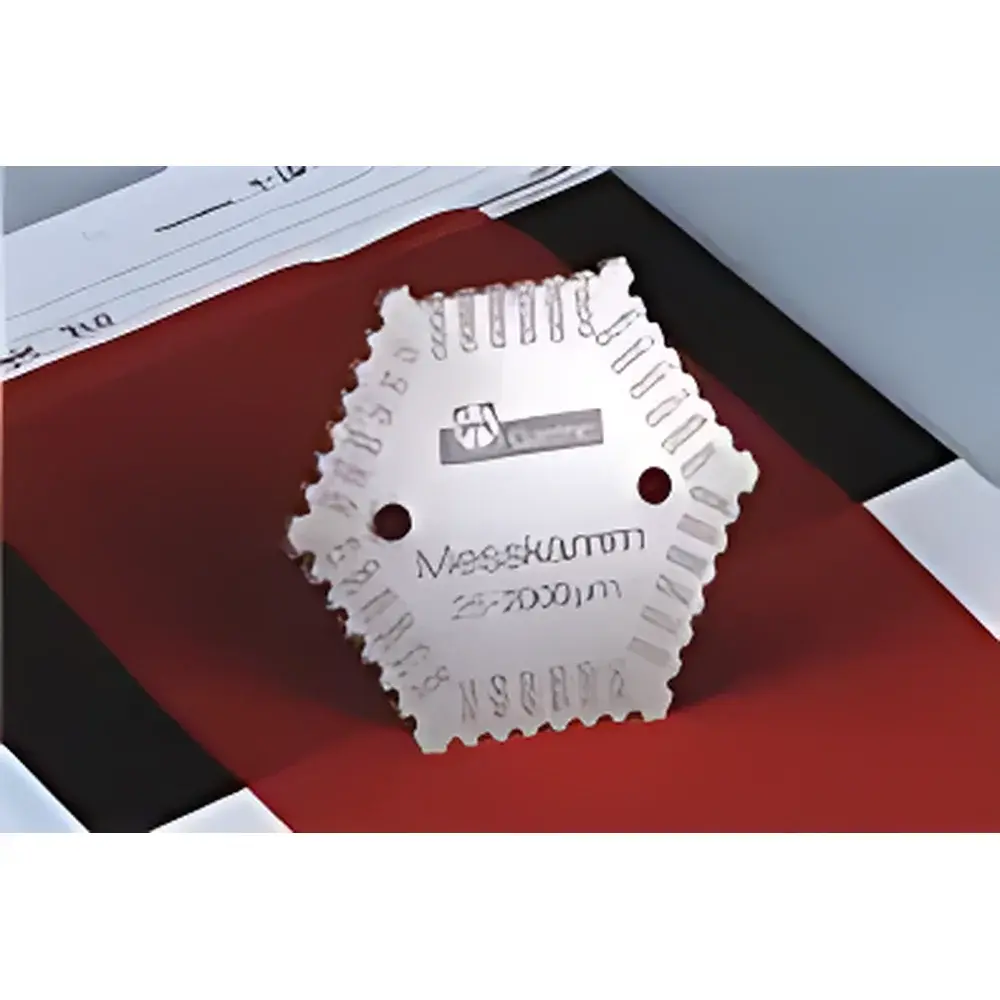
BYK-Gardner BYK-3501 & BYK-3504 Comb-Type Wet Film Thickness Gauges
| Brand | BYK-Gardner |
|---|---|
| Origin | Germany |
| Model | BYK-3501 (25–2000 µm) / BYK-3504 (5–150 µm) |
| Construction | Hexagonal stainless steel body |
| Measurement principle | Mechanical comb gauge (contact-based stepwise interpolation) |
| Compliance | Designed per ISO 2808, ASTM D1212, and DIN 53210-1 |
Overview
The BYK-Gardner BYK-3501 and BYK-3504 Comb-Type Wet Film Thickness Gauges are precision-engineered mechanical instruments for rapid, on-site determination of wet film thickness (WFT) immediately after application but before solvent evaporation or curing. These gauges operate on the fundamental principle of physical interference: a calibrated comb with graduated teeth is pressed vertically into the freshly applied coating; upon withdrawal, the wet film adheres to teeth up to a certain height—WFT is read as the largest tooth fully coated, immediately adjacent to the shortest uncoated tooth. This method delivers immediate, operator-independent verification aligned with internationally recognized test standards including ISO 2808 (Paints and varnishes — Determination of film thickness), ASTM D1212 (Standard Test Methods for Measurement of Wet Film Thickness of Organic Coatings), and DIN 53210-1 (Testing of paints and varnishes — Wet film thickness measurement). Unlike electronic or optical systems, these gauges require no power, calibration drift correction, or software interpretation—making them ideal for shop-floor QC, field inspections, and compliance audits where traceability, simplicity, and repeatability are paramount.
Key Features
- Hexagonal stainless steel construction ensures long-term dimensional stability, corrosion resistance, and mechanical durability in industrial environments—including exposure to solvents, alkyds, epoxies, and waterborne systems.
- Multi-face design: Six independent measurement faces, each with precisely machined teeth of incrementally increasing height—enabling single-instrument coverage across broad WFT ranges without tool swapping.
- BYK-3504 variant optimized for thin-film applications (5–150 µm), ideal for automotive basecoats, clearcoats, and high-solids UV-curable systems requiring tight process control.
- BYK-3501 variant engineered for heavy-duty coatings (25–2000 µm), suitable for marine primers, tank linings, protective zinc-rich coatings, and thick-film elastomeric systems.
- No zero adjustment or recalibration required—each gauge is factory-certified with traceable documentation per ISO/IEC 17025-accredited metrology practices.
- Ergonomic geometry and balanced weight distribution minimize operator fatigue during high-frequency use in production lines or spray booths.
Sample Compatibility & Compliance
These gauges are compatible with all liquid-applied organic coatings—including solvent-borne, water-borne, high-solids, and 100% solids systems—regardless of rheology, pigment loading, or VOC content. They are not intended for non-Newtonian gels, powder coatings, or cured films. The instruments conform to the geometric tolerances and functional requirements specified in ISO 2808 Annex A (Comb-type gauges) and ASTM D1212 Section 5.1. Their passive, non-electronic architecture inherently satisfies GLP and GMP documentation requirements for manual QC tools—no electronic records, audit trails, or 21 CFR Part 11 validation needed. Documentation includes material certificates, dimensional inspection reports, and compliance statements supporting ISO 9001:2015 and IATF 16949 quality management systems.
Software & Data Management
As purely mechanical hand-held gauges, the BYK-3501 and BYK-3504 do not incorporate embedded electronics, firmware, or connectivity features. Therefore, they generate no digital data streams and require no software installation, license management, or cybersecurity protocols. All measurement results are recorded manually in paper-based or LIMS-integrated logbooks. For laboratories operating under FDA 21 CFR Part 11 or EU Annex 11, these instruments serve as compliant “low-tech” verification tools—eliminating electronic record validation burdens while maintaining full traceability via operator signature, timestamp, batch ID, and instrument serial number logging.
Applications
- Real-time wet film verification during coil coating, automotive OEM painting, and industrial wood finishing lines.
- Field QA/QC for infrastructure projects—bridge decks, offshore platforms, and pipeline coatings—where environmental conditions preclude electronic instrumentation.
- Formulation development labs assessing sag resistance, leveling behavior, and applicator compatibility across viscosity gradients.
- Contractor training and certification programs demonstrating adherence to SSPC-PA 2 or NACE SP0188 surface preparation and application standards.
- Third-party inspection agencies performing coating survey audits per ISO 12944-5 and ISO 20340 for protective coating systems.
FAQ
How is wet film thickness determined using the comb gauge?
The gauge is pressed vertically into the wet coating until its support feet contact the substrate; upon removal, the wet film remains on teeth up to the highest fully wetted tooth—WFT equals the nominal height of that tooth, verified against the adjacent dry tooth.
Can the same gauge be used for both water-based and solvent-based coatings?
Yes—the stainless steel construction resists chemical attack from both aqueous and organic media; however, immediate cleaning with appropriate solvent post-use is recommended to prevent residue buildup.
Are calibration certificates provided with each unit?
Each gauge ships with a factory-issued dimensional compliance certificate referencing ISO/IEC 17025-accredited calibration procedures and traceable to national standards (e.g., PTB Germany).
What is the expected service life under routine industrial use?
With proper handling and periodic visual inspection for tooth deformation or corrosion, service life exceeds 10 years; no wear-related recalibration is necessary due to the passive mechanical design.
Do these gauges meet requirements for ISO 9001 or AS9100 certified facilities?
Yes—they are classified as Class II inspection tools under ISO 10012, requiring only periodic verification (not calibration) against master reference gauges, fully documented within internal QA procedures.



