
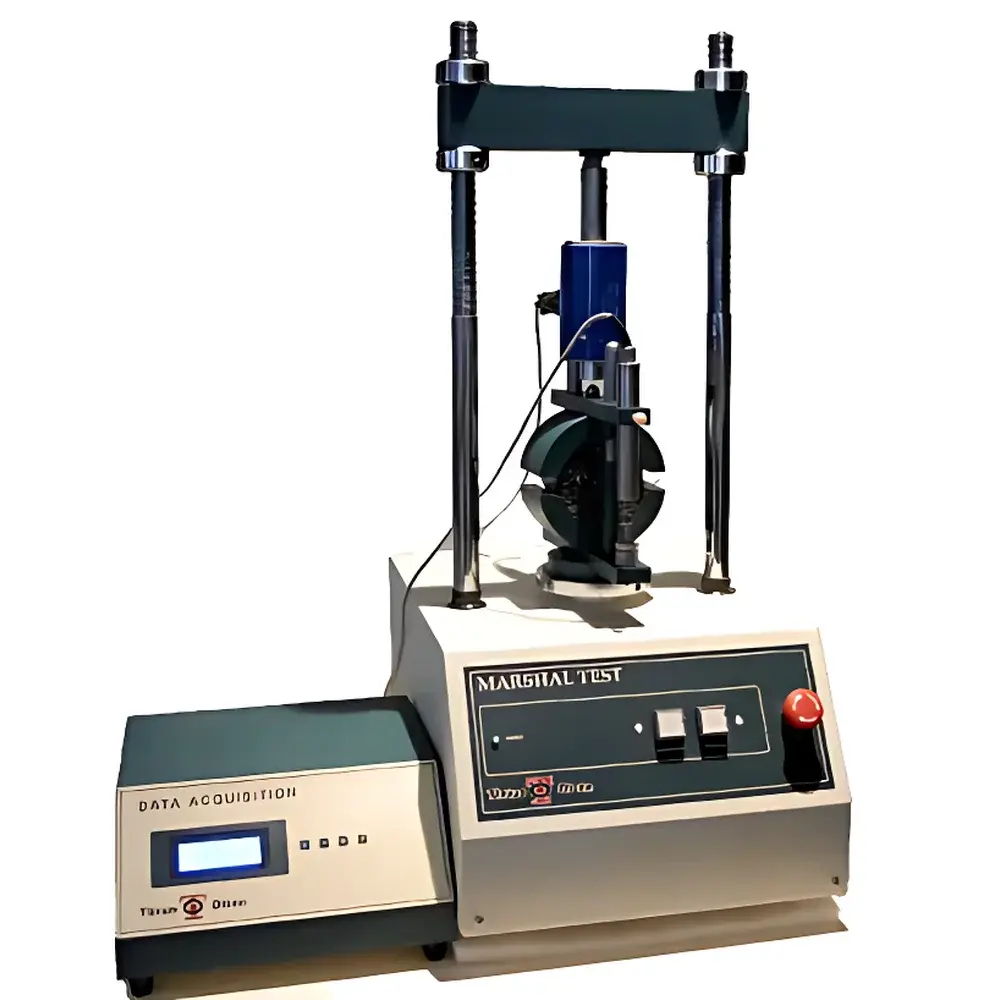
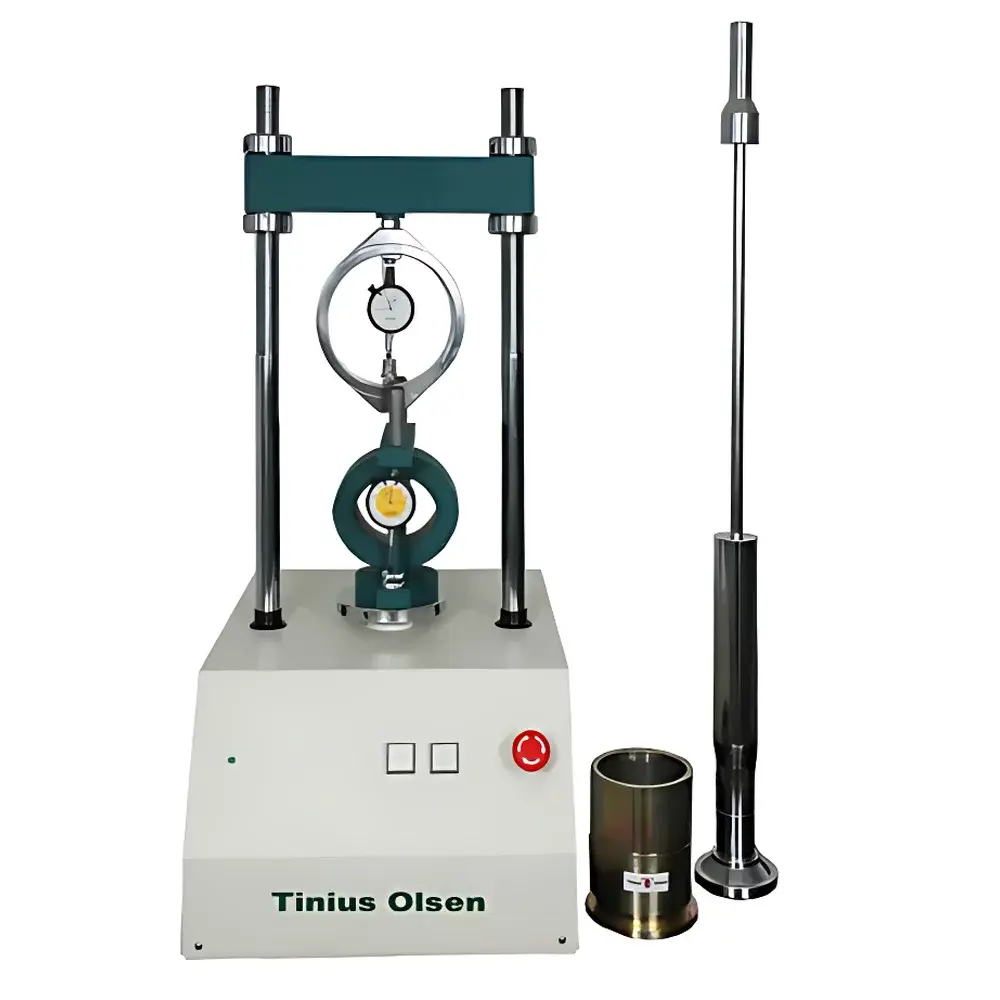
Tinius Olsen TO-550 Marshall Stability Tester
| Brand | Tinius Olsen |
|---|---|
| Origin | USA |
| Model | TO-550 |
| Max Load Capacity | 50 kN |
| Loading Rate | 50.8 mm/min |
| Vertical Travel Range | 250–470 mm |
| Horizontal Clearance | 265 mm |
| Platen Diameter | 133 mm |
| Platen Stroke | 25 mm |
| Motor Power | 375 W |
| Dimensions (L×W×H) | 550 × 400 × 870 mm |
| Weight | 60 kg |
| Standards Compliance | ASTM D1559, BS 598-107, EN 12697-34, AASHTO T 245 |
Overview
The Tinius Olsen TO-550 Marshall Stability Tester is a precision-engineered mechanical testing system designed specifically for evaluating the load-bearing capacity and deformation resistance of hot-mix asphalt (HMA) specimens under controlled compressive loading. Based on the classical Marshall test methodology, the instrument applies axial compression to cylindrical asphalt-aggregate specimens (typically 101.6 mm in diameter and 63.5 mm in height) at a constant crosshead speed of 50.8 mm/min. The test quantifies two primary parameters: Marshall Stability—the maximum load (in kN) sustained before specimen failure—and Flow Value—the corresponding plastic deformation (in 0.25-mm increments) at peak load. This dual-parameter output enables engineers to assess binder-aggregate compatibility, optimal asphalt content, and mix resilience under simulated traffic-induced stresses. The TO-550 implements a robust gear-driven screw jack actuation system with bidirectional motorized motion, integrated limit switches for overtravel protection, and rigid structural framing to ensure high reproducibility across repeated test cycles.
Key Features
- Motor-driven, gear-reduction screw jack mechanism delivering precise, repeatable 50.8 mm/min loading rate—fully compliant with ASTM D1559 and AASHTO T 245 requirements.
- Dual configuration options: analog version equipped with a calibrated 50 kN proving ring and digital dial indicator; digital version featuring a 50 kN load cell and LVDT displacement transducer (0–20 mm range) for high-resolution data acquisition.
- Adjustable top-loading yoke assembly with 133 mm-diameter platens and 25 mm stroke, accommodating standard Marshall specimens and enabling consistent stress distribution.
- Vertical travel range of 250–470 mm ensures compatibility with both compacted specimens and ancillary fixtures such as flow meters or temperature-controlled environmental enclosures.
- Integrated mechanical limit switches on both upward and downward motion paths prevent actuator overextension and protect load train integrity during operator error or software fault conditions.
- Compact footprint (550 × 400 × 870 mm) and 60 kg mass facilitate installation in accredited materials testing laboratories without requiring reinforced flooring or dedicated foundations.
Sample Compatibility & Compliance
The TO-550 is validated for use with cylindrical asphalt specimens prepared per ASTM D1559, AASHTO T 245, EN 12697-34, and BS 598-107 protocols. It accepts specimens containing aggregate up to 25.4 mm nominal maximum size, supporting both dense-graded and open-graded HMA formulations. The platen geometry and alignment tolerances are optimized to minimize eccentric loading and ensure uniform stress transmission—critical for minimizing inter-laboratory variability. All mechanical components conform to ISO 9001 manufacturing controls, and calibration traceability follows NIST-traceable standards. The instrument supports GLP-compliant operation when paired with validated data acquisition software, including audit trail generation and electronic signature capability per FDA 21 CFR Part 11 requirements.
Software & Data Management
While the base TO-550 operates as a standalone mechanical tester, its digital variants interface seamlessly with Tinius Olsen’s Horizon™ Materials Testing Software. Horizon™ provides real-time load-displacement curve plotting, automatic detection of peak stability and flow points, customizable report templates (PDF/Excel), and secure user-access controls. Raw data files are stored in vendor-neutral CSV format with embedded metadata (test ID, operator, date/time, calibration certificate ID). Software validation packages—including IQ/OQ documentation, cybersecurity assessments, and 21 CFR Part 11 compliance modules—are available for regulated environments such as DOT-certified labs and third-party accreditation bodies (e.g., A2LA, UKAS).
Applications
- Optimization of asphalt binder content during mix design (e.g., determining optimum asphalt content via stability-flow-voids relationships).
- Quality assurance testing of production batches in asphalt plants and paving contractors’ field labs.
- Performance evaluation of polymer-modified binders, recycled asphalt pavement (RAP), and warm-mix asphalt additives.
- Research investigations into temperature susceptibility, moisture damage resistance, and fatigue behavior using modified Marshall conditioning protocols.
- Training and certification programs for asphalt technicians under ASTM D1559 and EN 12697-34 competency frameworks.
FAQ
What standards does the TO-550 comply with?
ASTM D1559, AASHTO T 245, EN 12697-34, and BS 598-107—all explicitly referenced in the instrument’s type examination report and factory calibration certificate.
Can the TO-550 be used for testing cold-mix or emulsion-based specimens?
No. The TO-550 is engineered exclusively for hot-compacted asphalt specimens tested at 60 °C per standard protocols; it does not include thermal conditioning capabilities.
Is calibration verification required before each test series?
Per ASTM E4 and ISO/IEC 17025, daily verification using certified reference load cells and displacement standards is recommended; full recalibration is required annually or after maintenance affecting force/displacement metrology.
Does the TO-550 support automated pass/fail evaluation against specification limits?
Yes—when operated with Horizon™ software, users can define upper/lower specification thresholds for stability and flow; the system flags nonconforming results in real time and logs decision logic for audit purposes.
What electrical supply is required for international deployment?
Standard configuration is 220 V, 50 Hz; optional 110 V, 60 Hz versions are available upon order—both include CE-marked power supplies meeting IEC 61000-6-3 EMC requirements.




