
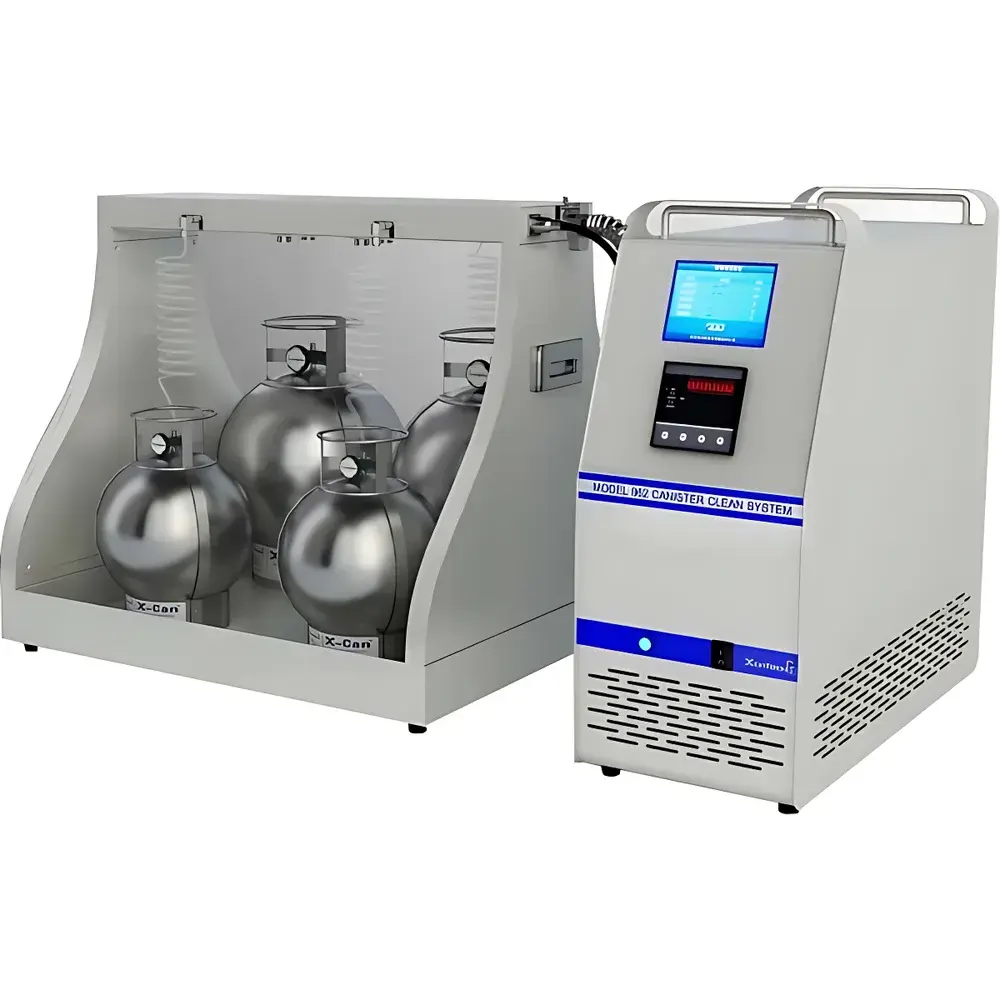
Xonteck 960 Series Automated Canister Cleaning System
| Brand | Xonteck |
|---|---|
| Origin | USA |
| Model | 960 |
| Instrument Type | Automated Whole-Air Canister Purge and Bakeout System |
| Configuration Options | Benchtop Split-Unit or Integrated Oven-Type |
| Maximum Simultaneous Canisters | 4 × 6-L or 2 × 15-L (Oven-Type) |
| Vacuum Base Pressure | < 50 mTorr (≤ 6.7 Pa) |
| Heating Temperature Range | Ambient to 100 °C |
| Vacuum Pump | Integrated High-Capacity Scroll Vacuum Pump |
| Ultimate Pumping Speed | ≥ 100 L/min (at atmospheric inlet) |
| Pressure Sensing | Dual-Range Absolute Pressure Transducers (0–300 kPa, resolution 0.1 kPa |
| Flow Control | Programmable Mass Flow Controllers for Inert Gas Purge (N₂ or Zero Air) |
| Humidification Capability | Integrated Saturated Moisture Delivery Module (optional, for hydrophobic surface conditioning) |
| Flow Stability | ±5% over full operational cycle |
| Flowmeter Accuracy | ±2.5% FS |
| Pump Service Life at Max Load | ≥ 5,000 hours |
| Continuous Bakeout Runtime at Max Flow & Backpressure | 8 hours |
| Construction Materials | 316L Stainless Steel Tubing & Fittings, PTFE-Sealed Valves, Electropolished Internal Surfaces |
| Control System | Microprocessor-Based Embedded Controller with Real-Time Cycle Monitoring, Audible End-of-Cycle Alert, and Non-Volatile Parameter Storage |
| Acoustic Noise Level | < 65 dB(A) |
| Dimensions (Oven-Type) | 860 mm (H) × 945 mm (W) × 680 mm (D) |
| Dimensions (Split-Unit Host) | 665 mm (H) × 640 mm (W) × 270 mm (D) |
| Stand | 830 mm (H) × 770 mm (W) × 750 mm (D) |
| Weight (Oven-Type) | 75 kg |
| Weight (Split-Unit) | 50 kg |
Overview
The Xonteck 960 Series Automated Canister Cleaning System is an engineered solution designed specifically for the rigorous preparation of electropolished stainless steel SUMMA®-type canisters used in EPA Method TO-14A and TO-15 compliant volatile organic compound (VOC) monitoring programs. It performs fully automated, trace-level cleaning cycles comprising high-vacuum evacuation, inert gas purging (N₂ or zero air), controlled thermal bakeout (up to 100 °C), and optional humidity-assisted surface conditioning—ensuring residual VOCs are reduced to sub-parts-per-quadrillion (ppq) levels while maintaining canister integrity and minimizing memory effects. Unlike manual or semi-automated systems, the 960 integrates vacuum generation, pressure metrology, thermal control, and gas handling into a single validated platform, enabling reproducible canister conditioning essential for regulatory-grade ambient air monitoring, calibration standard preparation, and laboratory method validation.
Key Features
- Integrated high-capacity scroll vacuum pump capable of direct atmospheric start-up and achieving ≤ 50 mTorr base pressure without auxiliary roughing stages—eliminating oil contamination risk and reducing maintenance intervals.
- Dual configuration architecture: oven-integrated unit (optimized for lab space efficiency and uniform thermal profiles) and split-unit design (modular host + heated stand, supporting flexible deployment for 15-L canisters).
- Precision dual-range absolute pressure sensing: primary transducer (0–300 kPa, 0.1 kPa resolution) for purge and fill phases; secondary ultra-low-range transducer (0–100 kPa, 0.01 Pa resolution) for real-time vacuum decay monitoring during hold phases.
- Electropolished 316L stainless steel fluidic path with PTFE-sealed diaphragm valves and zero-dead-volume fittings—minimizing adsorption/desorption artifacts and ensuring compatibility with reactive sulfur compounds and polar oxygenates.
- Programmable multi-step cleaning protocol: user-defined sequences of evacuation duration, purge gas flow rate and volume, bake temperature ramp/soak profiles, and optional humidified purge cycles for hydrophobic surface passivation.
- Embedded microcontroller with non-volatile cycle storage, timestamped event logging, and audible end-of-cycle alert—supporting GLP-compliant documentation without external PC dependency.
Sample Compatibility & Compliance
The 960 system is validated for use with standard 6-L and 15-L electropolished stainless steel canisters (e.g., Entech, Restek, and Markes SUMMA® variants). Its cleaning performance meets or exceeds the residual contamination requirements specified in U.S. EPA Compendium Method TO-15 Appendix B and ASTM D6196-22 for canister preconditioning. All pressure and temperature control subsystems are calibrated traceable to NIST standards. The system supports audit-ready operation under FDA 21 CFR Part 11 when paired with optional electronic log export functionality (CSV/Excel), and its deterministic cleaning logic aligns with ISO/IEC 17025 clause 7.2.2 for equipment suitability verification.
Software & Data Management
No external software is required for basic operation—the embedded controller provides intuitive front-panel navigation, parameter entry, and real-time status display (vacuum level, temperature, elapsed time, step progress). Optional USB data export enables transfer of complete cycle logs—including timestamps, setpoints, actual readings, and fault codes—to laboratory information management systems (LIMS) or electronic lab notebooks (ELN). Cycle parameters are stored in write-protected memory, preventing accidental overwrites. Firmware updates are performed via secure USB key, with version rollback capability and SHA-256 integrity verification.
Applications
- Pre-conditioning of SUMMA® canisters prior to field sampling in ambient air VOC monitoring networks (e.g., EPA Photochemical Assessment Monitoring Stations, PAMS).
- Preparation of certified calibration standards in canisters for GC/MS-based TO-15 analysis—ensuring linearity, accuracy, and long-term stability of multi-point calibration curves.
- Reconditioning of canisters after high-concentration exposure (e.g., industrial fence-line monitoring, landfill emissions) to restore baseline integrity.
- Method development and validation studies requiring quantifiable canister blank characterization per EPA guidance document QA/G-5S.
- Supporting ISO 16000-6 indoor air quality investigations where low-level terpene and aldehyde detection demands ultra-clean sampling media.
FAQ
What vacuum level does the 960 achieve, and how is it verified?
The system achieves a base pressure of ≤ 50 mTorr (< 6.7 Pa) using its integrated scroll pump. Vacuum performance is continuously monitored by a dual-range absolute pressure transducer calibrated to NIST-traceable standards.
Can the 960 clean 15-L canisters in the split-unit configuration?
Yes—the split-unit configuration accommodates up to four 15-L canisters simultaneously using the dedicated heated stand, whereas the oven-type unit supports two 15-L canisters due to internal chamber constraints.
Is humidification mandatory for all cleaning protocols?
No—humidification is an optional module used primarily for conditioning canisters intended for polar compound analysis (e.g., formaldehyde, acetaldehyde). Most routine TO-15 applications use dry purge/bake cycles.
How is compliance with EPA TO-15 Appendix B demonstrated?
Each 960 unit ships with a factory-verified Performance Qualification Report documenting residual blank levels (measured via GC/MS on representative canisters), vacuum decay rates, and thermal uniformity across the heating zone—aligned with TO-15 Appendix B acceptance criteria.
Does the system support remote monitoring or integration with facility SCADA?
The base configuration includes only local control and logging. Optional analog 4–20 mA or Modbus RTU outputs are available for integration into centralized building management or process control systems.







