
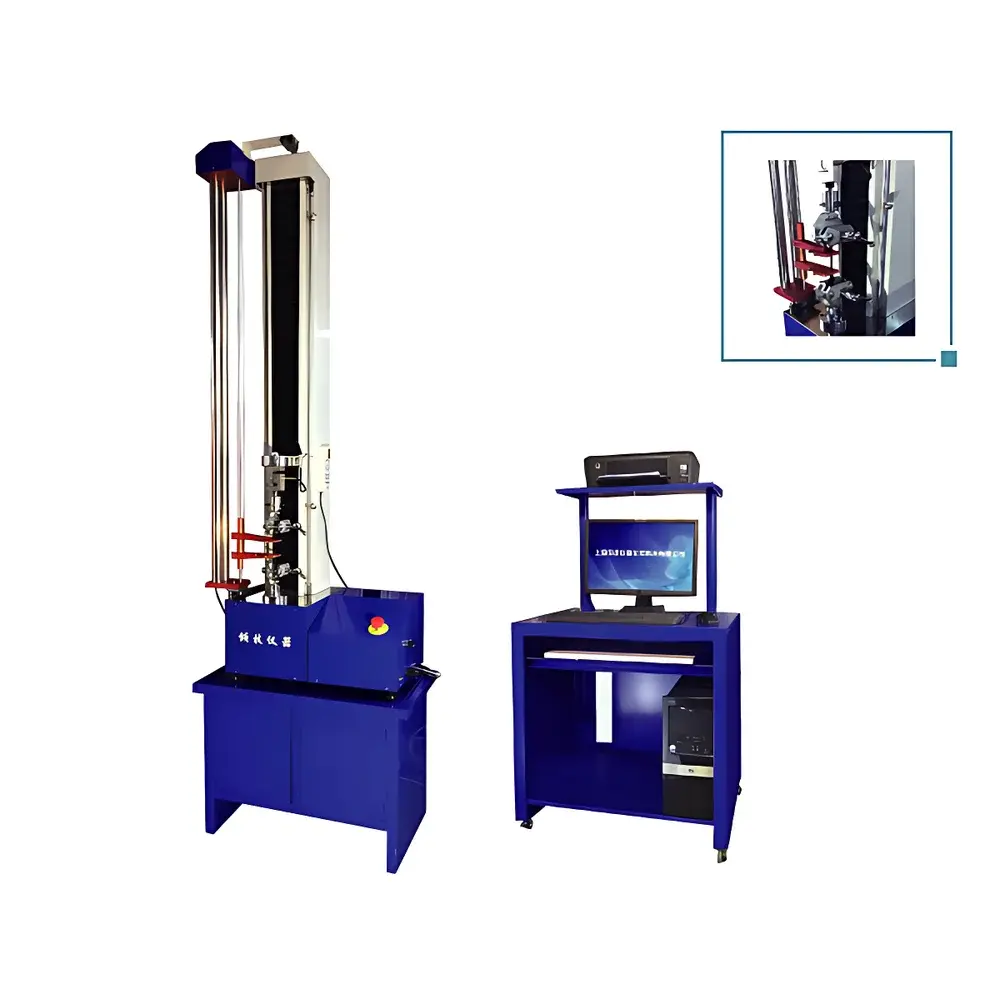
QJ210A Leather Tensile Testing Machine
| Origin | Shanghai, China |
|---|---|
| Manufacturer Type | Authorized Distributor |
| Origin Category | Domestic (PRC) |
| Model | QJ210A |
| Instrument Type | Electromechanical Tensile Testing Machine |
| Maximum Load Capacity | 5 kN |
| Force Measurement Range | 0.2%–100% of Full Scale (FS) |
| Force Accuracy | ±0.5% of reading |
| Crosshead Travel | 150 mm |
| Displacement Resolution | ±0.5% of indicated value |
| Effective Test Width | 150 mm |
| Effective Tensile Stroke | 800 mm |
| Test Speed Range | 0.01–500 mm/min (adjustable) |
| Speed Accuracy | ±0.5% of set value |
| Displacement Measurement Accuracy | ±0.5% of reading |
| Strain Measurement Accuracy | ±0.5% of reading |
| Load Cell | High-precision imported strain-gauge sensor (USA-made) |
| Control System | Panasonic full-digital AC servo controller (Japan) |
| Drive System | Imported servo motor + Taiwan-made precision gear reducer + preloaded ball screw |
| Power Supply | 200 V AC, 400 W |
| Dimensions (L×W×H) | 590 × 355 × 1640 mm |
| Net Weight | ~85 kg |
Overview
The QJ210A Leather Tensile Testing Machine is a high-precision electromechanical universal testing system engineered for the mechanical characterization of flexible and semi-rigid materials—particularly leather, textiles, thin films, paperboard, nonwovens, and polymer sheets. It operates on the principle of controlled uniaxial force application via a servo-driven crosshead, enabling standardized tensile, peel, tear, puncture, and shear measurements in accordance with internationally recognized mechanical test methodologies. Designed to meet the rigorous repeatability and traceability requirements of quality control laboratories, R&D departments, and third-party certification bodies, the QJ210A delivers consistent load-displacement data acquisition across its full 5 kN capacity range. Its modular architecture supports interchangeable grips and fixtures, allowing seamless adaptation to diverse specimen geometries and industry-specific test protocols.
Key Features
- 0.5-class accuracy per ISO 7500-1 and ASTM E4, certified for force measurement across 0.2%–100% FS without range switching
- Full-scale 5 kN load cell with USA-sourced strain-gauge technology, offering long-term stability and thermal drift compensation
- Panasonic digital AC servo control system ensures precise speed regulation (0.01–500 mm/min) with ±0.5% speed fidelity
- Preloaded ball screw transmission coupled with Taiwan-made precision gearbox guarantees smooth, backlash-free motion and extended service life
- Integrated dual-mode positioning: manual fine adjustment and programmable auto-return to origin post-test
- Real-time dynamic display of force (N, kN, kgf, lbf), displacement (mm), strain (%), and stress–strain curves on high-contrast LCD interface
- Comprehensive hardware safety: electronic limit switches, software-based overload protection (>110% FS), and automatic diagnostic self-check at power-on
- Modular fixture platform compatible with pneumatic, wedge, roller, and custom-designed clamps per ISO 527, ASTM D638, and QB/T 2715 standards
Sample Compatibility & Compliance
The QJ210A accommodates specimens up to 150 mm wide and 800 mm effective gauge length—sufficient for full-width leather strip tests, coated fabric laminates, and composite sheeting. Its calibrated force and displacement systems are validated against national metrological standards (JJG 475–2008) and aligned with international regulatory frameworks including ISO 1798 (flexible cellular polymeric materials), ISO 2411 (rubber and plastics – determination of indentation hardness), ASTM D2209 (tensile properties of leather), QB/T 2715–2005 (leather physical and mechanical testing methods), and GB/T 3923.1–2013 (textiles – tensile properties). Data integrity complies with GLP audit requirements through timestamped, non-editable raw data logs; optional PC integration enables 21 CFR Part 11–compliant electronic signatures and audit trails when paired with validated software.
Software & Data Management
The system supports both standalone operation via embedded firmware and full PC-based control using Windows-compatible test management software. The software provides real-time graphical plotting, multi-curve overlay, automatic yield point detection, modulus calculation (secant/tangent), and customizable report generation in PDF or Excel formats—including header fields for operator ID, sample ID, environmental conditions (optional hygrothermal logging), and calibration certificate references. All raw data files (.dat) are stored in ASCII format for third-party analysis compatibility. Firmware updates and calibration coefficient loading are performed via USB interface with version-controlled firmware archives maintained per ISO/IEC 17025 documentation requirements.
Applications
- Leather industry: Tensile strength, elongation at break, and tear resistance evaluation per QB/T 2715 and ISO 2419
- Footwear and upholstery QA: Bond strength of laminated hides, seam pull-out resistance, and coating adhesion testing
- Packaging materials: Burst strength of corrugated board, seal integrity of flexible pouches, and puncture resistance of barrier films
- Medical device manufacturing: Tensile behavior of synthetic grafts, suture retention force, and biodegradable film degradation profiling
- Automotive interiors: Durability assessment of seat cover fabrics, headliner substrates, and door panel composites under cyclic loading
- Academic research: Stress–strain modeling of viscoelastic biomaterials and structure–property correlation studies in tanned collagen matrices
FAQ
What standards does the QJ210A support out-of-the-box?
It natively supports test method templates for ASTM D638, ISO 527, QB/T 2715, GB/T 3923.1, ISO 1421, and JIS L1096—with user-definable parameters for strain rate, preload, and break criteria.
Can the system be integrated into an existing LIMS or MES environment?
Yes—via TCP/IP or RS232 communication protocols; optional OPC UA server module enables bidirectional data exchange with enterprise lab informatics platforms.
Is calibration traceability provided with the instrument?
Each unit ships with a factory calibration certificate traceable to NIM (National Institute of Metrology, China) and includes documented uncertainty budgets per ISO/IEC 17025 Annex A.
What maintenance intervals are recommended for long-term accuracy?
Biannual verification of force and displacement systems is advised; annual recalibration is required for ISO/IEC 17025–accredited operations.
Are custom fixtures available for non-standard leather specimens?
Yes—fixture design services are offered based on customer-supplied dimensional drawings and loading configuration requirements (e.g., trouser tear, grain-side vs. flesh-side grip geometry).



