
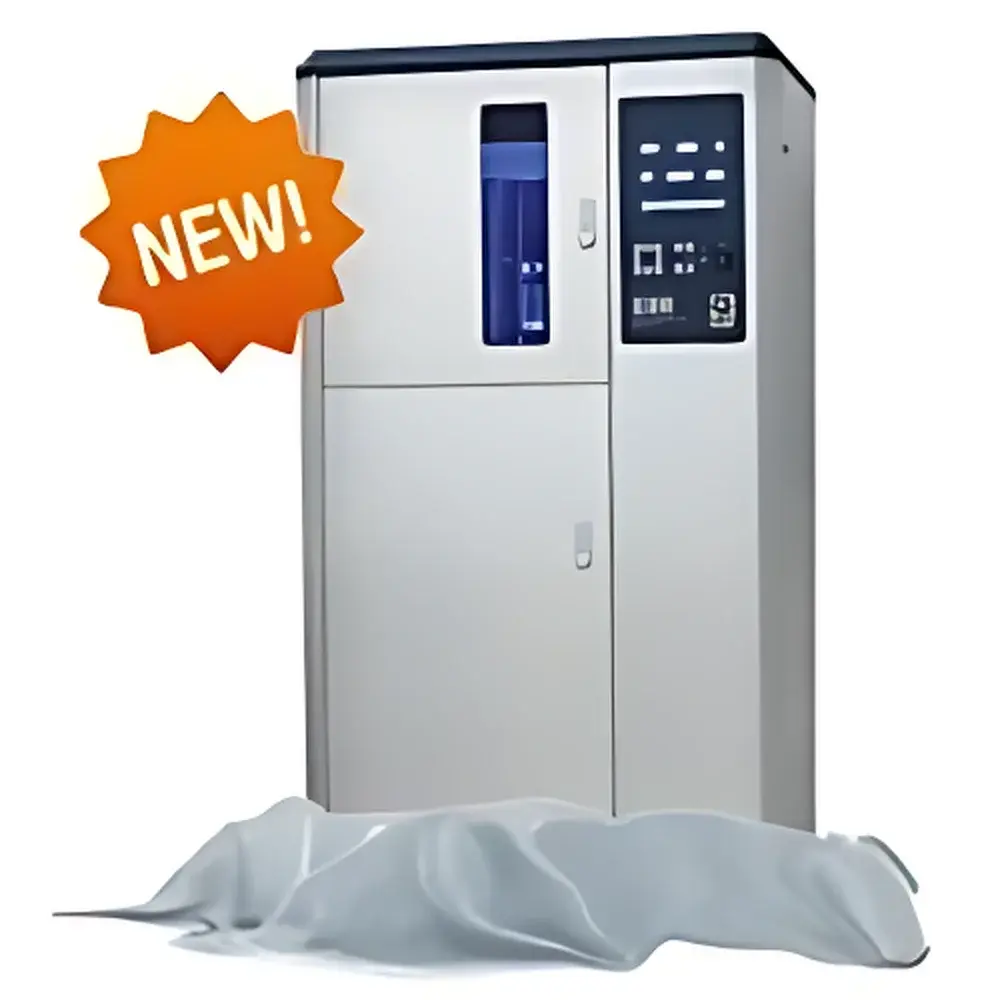
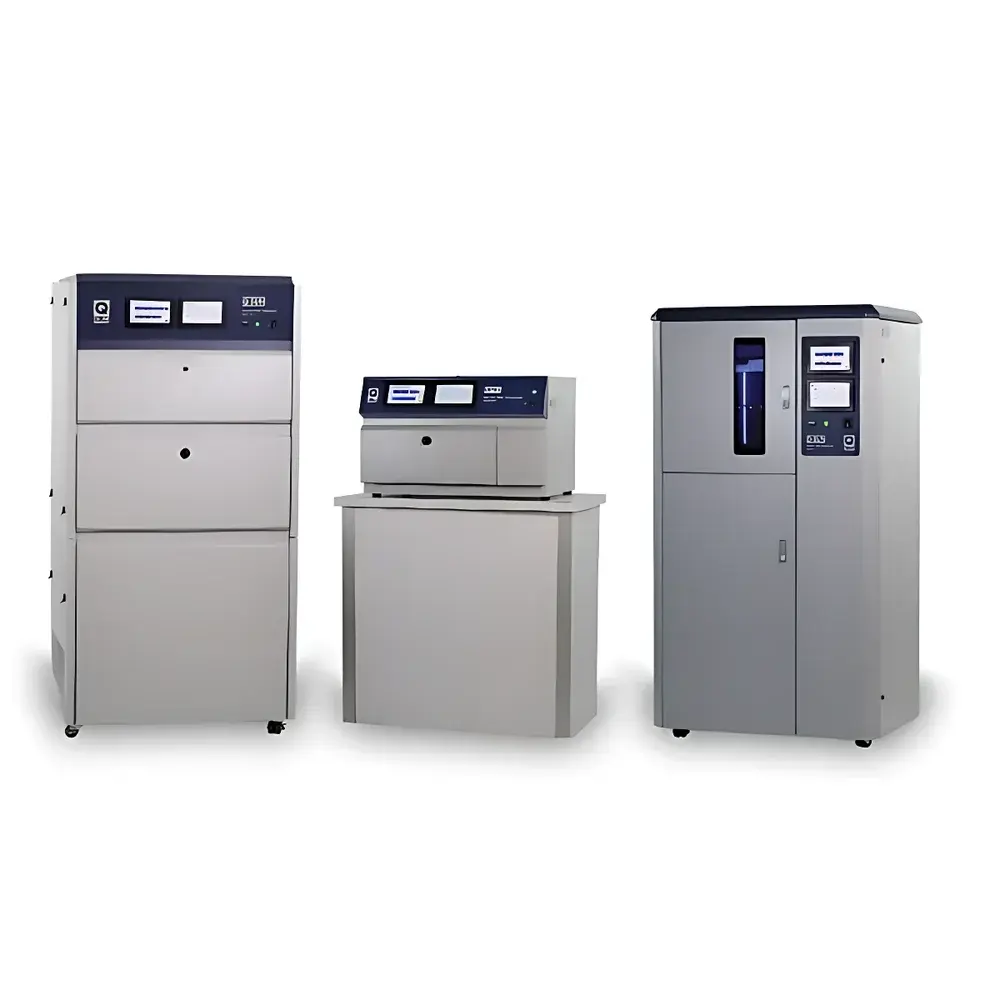
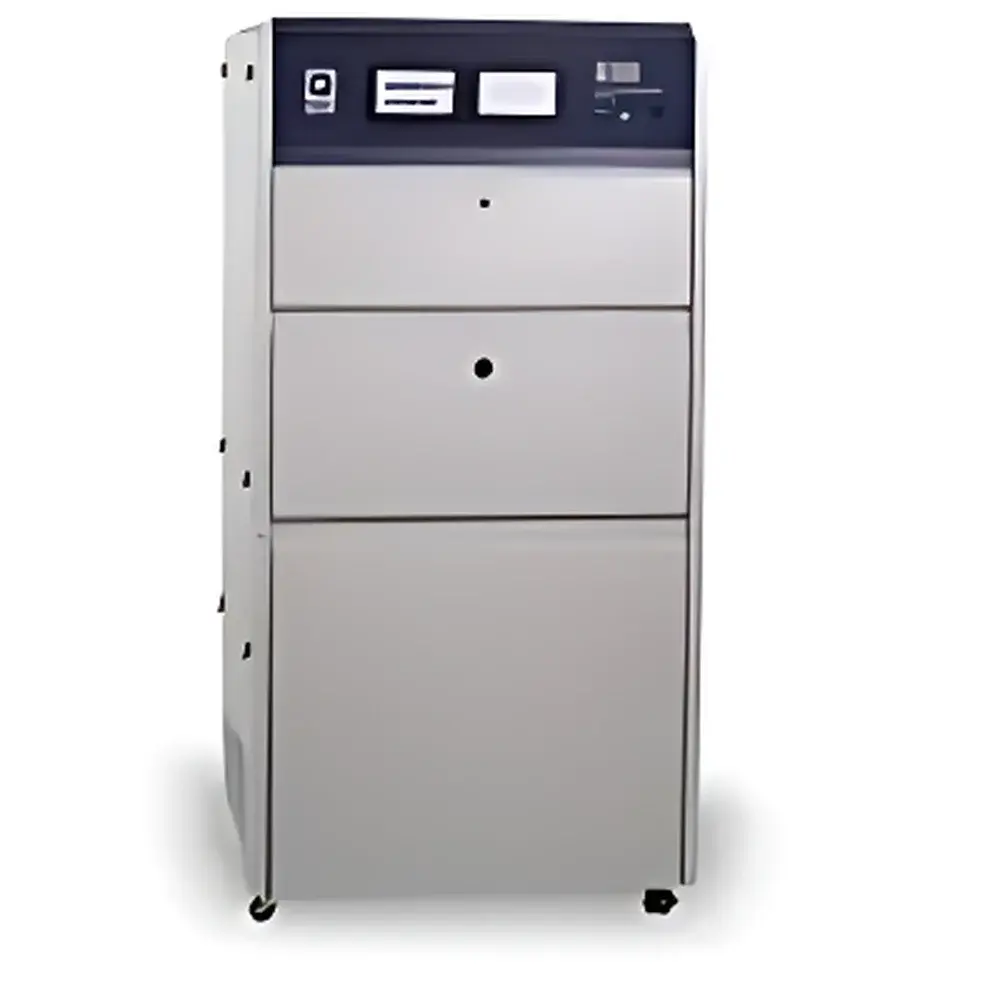
Q-Lab Q-SUN Xe-3 Xenon Arc Weathering Test Chamber
| Brand | Q-Lab |
|---|---|
| Origin | USA |
| Model | Q-SUN Xe-3 Series |
| Cooling Method | Air-cooled |
| Lamp Configuration | Three independent xenon arc lamps |
| Filter Options | Daylight, Window Glass, Extended UV |
| Irradiance Control | SOLAR EYE® broadband or narrowband (340 nm, 420 nm, TUV) |
| Black Panel Temperature Range | 42–120 °C |
| Chamber Air Temperature Range | 25–45 °C (dark cycle), 35–65 °C (light cycle) |
| Relative Humidity Control | Standard, 10–95% RH |
| Sample Tray Dimensions | 451 mm × 718 mm |
| Spray Options | Front spray, back spray, dual-fluid spray (e.g., acid rain, detergent solution) |
| Compliance | ASTM G155, ISO 4892-2, SAE J2527, AATCC TM16, ISO 11341, IEC 60068-2-9 |
| Calibration Traceability | NIST-traceable, ISO/IEC 17025 accredited (A2LA Cert. #2382-01, #2383-02, #2383-03) |
Overview
The Q-Lab Q-SUN Xe-3 Xenon Arc Weathering Test Chamber is an air-cooled, full-spectrum accelerated weathering instrument engineered for reproducible simulation of solar radiation, temperature, and moisture stress on polymeric, coated, textile, and automotive materials. It employs three independently controlled xenon arc lamps to generate spectral power distributions closely matching natural sunlight—spanning ultraviolet (290–400 nm), visible (400–700 nm), and near-infrared (700–1100 nm) regions—enabling correlation with outdoor exposure per international standards including ASTM G155, ISO 4892-2, and SAE J2527. Unlike water-cooled systems, the Xe-3’s air-cooled architecture reduces operational complexity, maintenance frequency, and total cost of ownership while maintaining high irradiance stability and long-term spectral fidelity. Its flat-bed sample tray (451 mm × 718 mm) accommodates irregularly shaped components—including molded parts, packaging, cosmetics containers, and printed media—without requiring custom fixtures. The chamber operates under programmable light/dark cycles with synchronized control of black panel temperature, chamber air temperature, and relative humidity—critical parameters governing photochemical degradation kinetics.
Key Features
- Air-Cooled Triple-Lamp Architecture: Three replaceable xenon arc lamps (typical service life: 1500 hours) deliver uniform irradiance across the test plane; lamp replacement requires only disconnection of a single plug and removal of two retaining screws.
- SOLAR EYE® Irradiance Control System: Real-time monitoring and feedback regulation of irradiance at user-selectable wavelengths—340 nm (UV-B critical band), 420 nm (visible edge), or TUV (total UV, 300–400 nm)—ensuring test repeatability across laboratories and time.
- Multi-Mode Spray Capability: Standard front spray simulates natural rainfall; optional back spray meets SAE J2527 requirements for bi-directional wetting; dual-fluid spray enables introduction of secondary agents (e.g., synthetic acid rain, surfactant solutions) via external reservoir and centrifugal pump.
- Advanced Environmental Control: Independent regulation of black panel temperature (42–120 °C), chamber air temperature (25–45 °C dark / 35–65 °C light), and relative humidity (10–95% RH) with integrated purification-water dependency for all moisture-related functions.
- Modular Filter System: Interchangeable optical filters—Daylight-F/Q/B, Window-Q/B/SL/SF-5/IR, and Extended UV-Q/B—allow precise spectral tailoring to match outdoor, indoor through-glass, or accelerated UV-rich exposure conditions.
- NIST-Traceable Calibration Infrastructure: Factory-installed black panel sensors and SOLAR EYE irradiance detectors are calibrated against National Institute of Standards and Technology (NIST) references; annual recalibration services provided by Q-Lab’s ISO/IEC 17025-accredited laboratories (A2LA Cert. #2382-01, #2383-02, #2383-03).
Sample Compatibility & Compliance
The Q-SUN Xe-3 supports flat, curved, and three-dimensional specimens up to 50 mm in height when mounted on adjustable-height carriers. Its horizontal sample plane ensures prolonged water retention—critical for evaluating hydrolytic degradation, pigment leaching, or coating blistering. Common applications include automotive interior trim (ISO 11341, SAE J2412), architectural coatings (ASTM D4587), textile colorfastness (AATCC TM16), and medical device packaging (ISO 10993-12). All configurations comply with GLP documentation requirements: Ethernet-enabled controllers log timestamped irradiance, temperature, humidity, and spray events with audit-trail capability. Optional “Virtual Strip Chart” software exports data directly to Windows-based LIMS or QA databases, supporting FDA 21 CFR Part 11 compliance when configured with electronic signatures and role-based access control.
Software & Data Management
The embedded controller features multilingual interface support (English, French, Spanish, Italian, German), self-diagnostic routines, and configurable alarm thresholds for irradiance deviation, temperature excursion, or low-purity water detection. Ethernet connectivity enables remote monitoring, firmware updates, and secure data export. The optional Virtual Strip Chart PC application provides real-time graphical trending, automated report generation (PDF/CSV), and scheduled email transmission of test logs to Q-Lab Technical Support for proactive diagnostics. All data files include metadata compliant with ISO/IEC 17025 Clause 7.5.2—ensuring traceability of measurement uncertainty, calibration status, and environmental boundary conditions throughout test execution.
Applications
The Q-SUN Xe-3 serves as a primary tool for predictive durability assessment across regulated and industrial sectors. In automotive R&D, it validates dashboard material resistance to UV-induced cracking and gloss loss per GMW14124 and Ford CETP 00.00-L-467. In pharmaceutical packaging development, the optional refrigerated model (Xe-3-HSCE) maintains stable 31–50 °C exposure profiles required for light-sensitive formulations under ICH Q1B guidelines. For consumer electronics, it evaluates display film yellowing and adhesive delamination under combined thermal cycling and humidity ingress. Aerospace suppliers use extended-UV filter configurations to screen composite resins for outgassing and matrix embrittlement per ASTM E595. Textile labs rely on window-glass filtration to assess fade resistance of upholstery fabrics exposed to office lighting environments.
FAQ
What water purity is required for spray and humidity functions?
Deionized or reverse-osmosis water with conductivity ≤5 µS/cm is mandatory for all spray modes and RH control to prevent nozzle clogging and mineral deposition on samples and optics.
Can the Xe-3 replicate coastal salt-spray conditions?
No—salt fog simulation requires dedicated corrosion chambers (e.g., Q-FOG CCT). However, dual-fluid spray permits sequential or simultaneous application of saline solutions if externally prepared and filtered to ≤1 µm particle size.
Is ISO/IEC 17025 calibration documentation included with shipment?
Yes—each unit ships with a Certificate of Conformance listing initial calibration dates, NIST-traceable reference standards used, and uncertainty budgets for black panel temperature and irradiance sensors.
How often must irradiance and temperature sensors be recalibrated?
Annual recalibration is recommended per Q-Lab’s Quality Assurance Protocol; field verification using supplied check standards is advised before each critical test campaign.
Does the Xe-3 meet FDA 21 CFR Part 11 requirements for electronic records?
When deployed with Virtual Strip Chart v5.2+ and configured with user authentication, audit trail logging, and digital signature modules, the system satisfies predicate rule requirements for regulated biopharma and medical device testing environments.



