
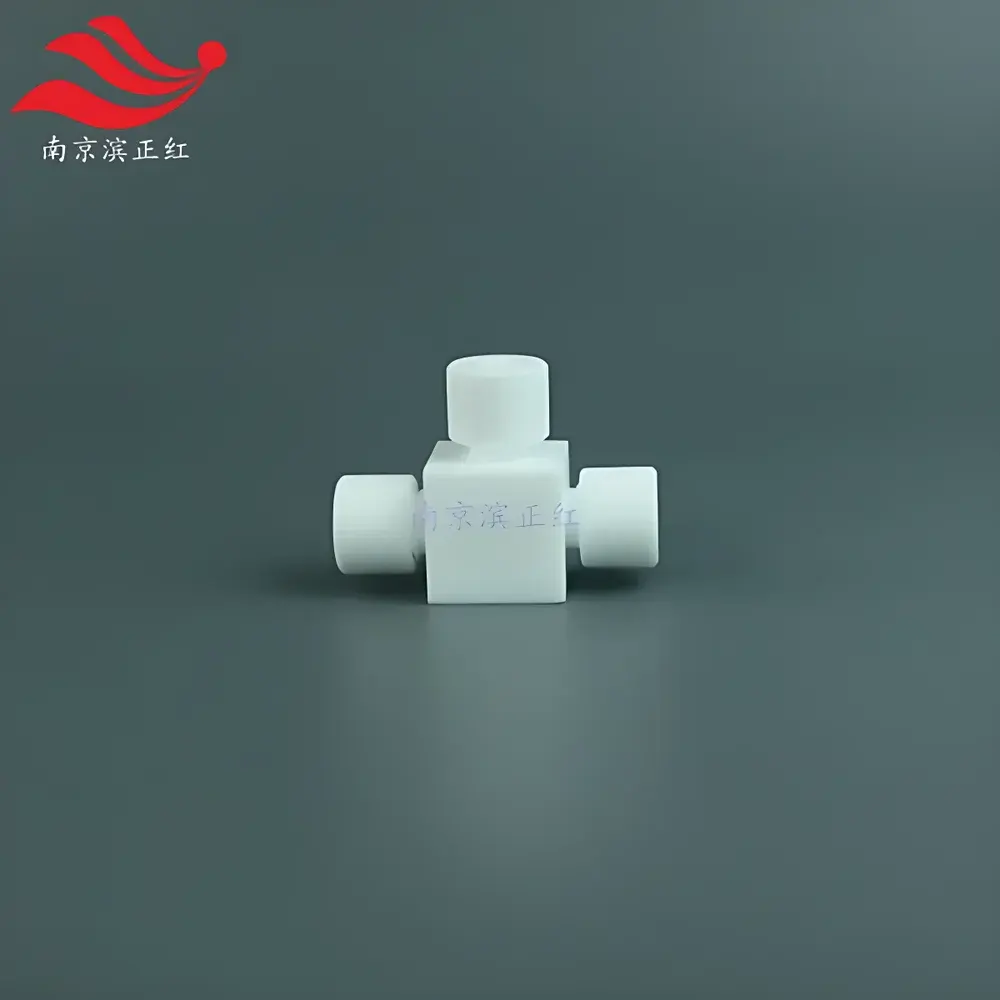
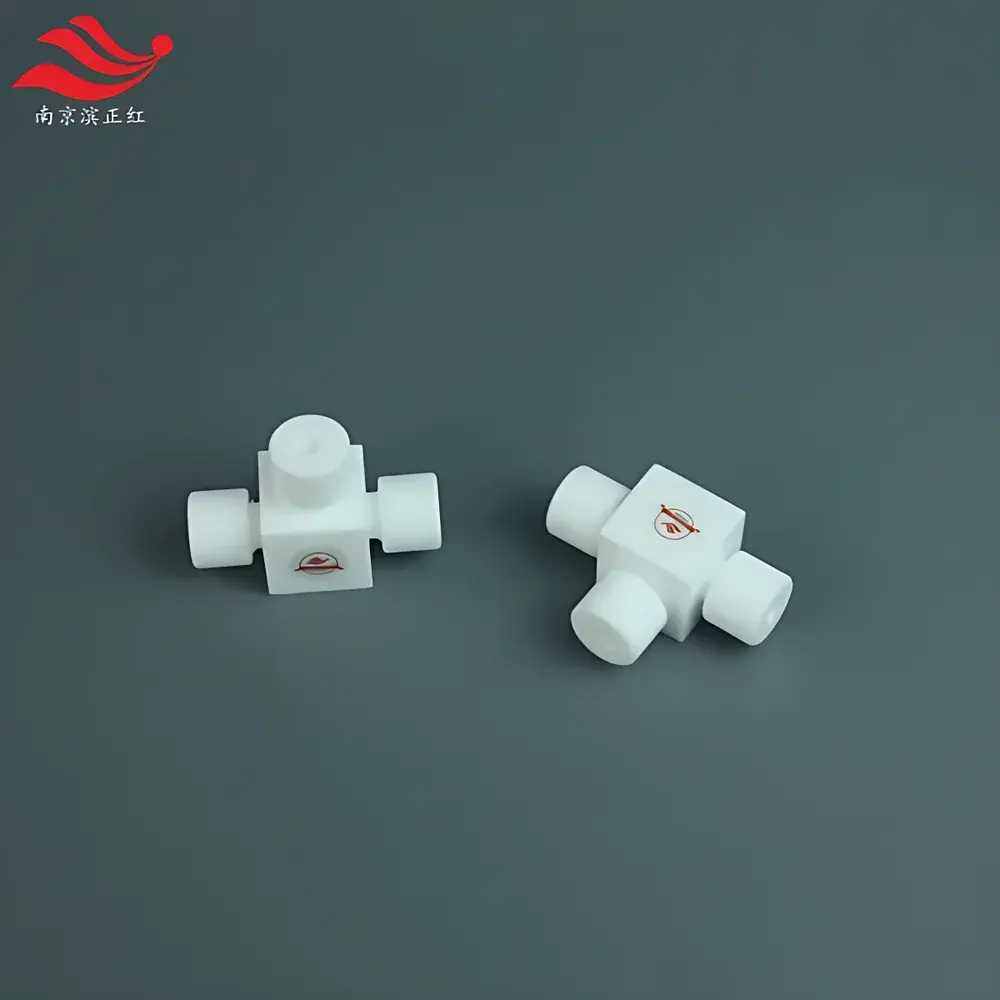
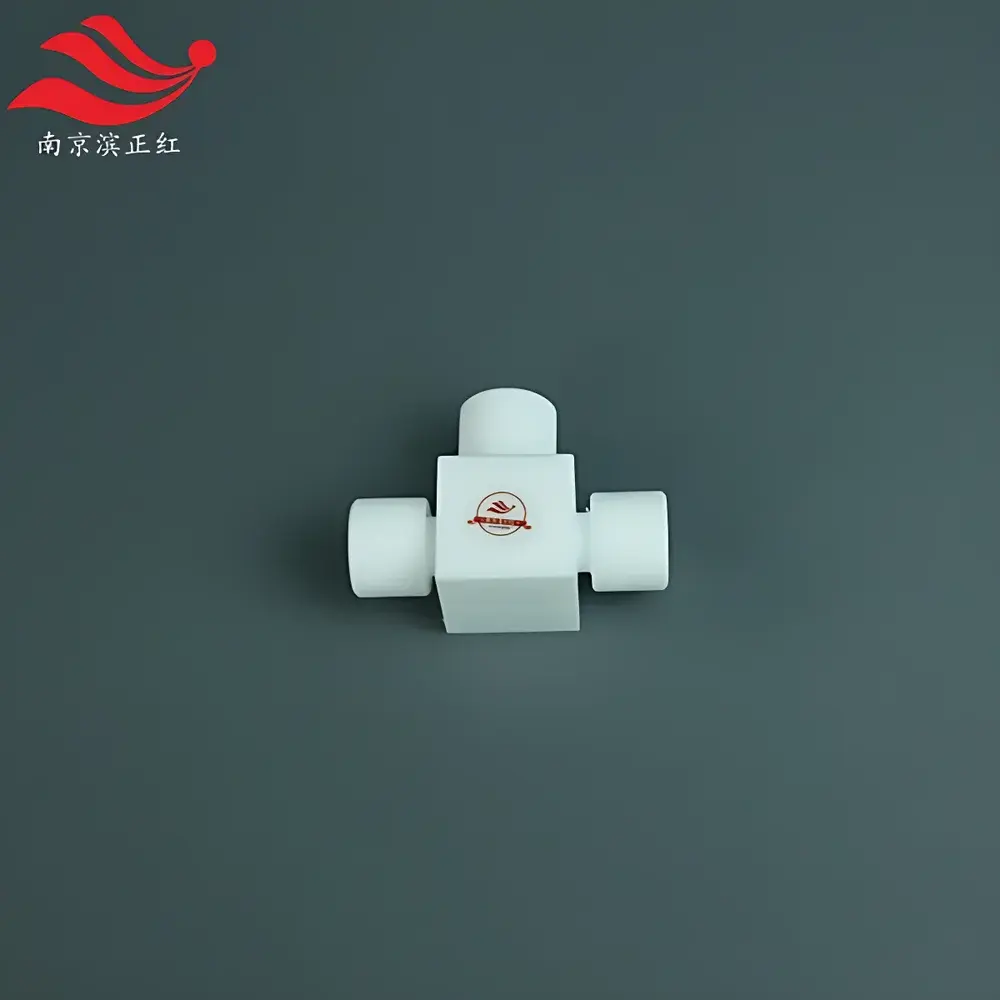
PTFE Corrosion-Resistant 3-Way Tee Fitting for Fluid Handling Systems
| Brand | Binzhenghong |
|---|---|
| Origin | Jiangsu, China |
| Manufacturer Type | Direct Producer |
| Country of Origin | China |
| Model | NJ-PTFE-JT-1/4 |
| Pricing | Upon Request |
Overview
The Binzhenghong NJ-PTFE-JT-1/4 is a precision-engineered 3-way tee fitting designed for demanding fluid handling applications where chemical inertness, thermal stability, and long-term sealing integrity are critical. Constructed entirely from high-purity polytetrafluoroethylene (PTFE), this fitting leverages the intrinsic material properties of PTFE—including near-universal chemical resistance, low coefficient of friction, non-stick surface behavior, and operational stability across a broad temperature range (–200 °C to +260 °C)—to ensure reliable performance in aggressive environments. Unlike metallic or composite fittings subject to galvanic corrosion or hydrolytic degradation, the all-PTFE architecture eliminates leaching, ion exchange, or surface passivation failure modes. It is intended for use in low-to-medium pressure fluidic subsystems—such as sampling manifolds, reagent distribution networks, chromatographic flow paths, and analytical instrument interconnects—where compatibility with strong acids (e.g., HF, HNO₃, aqua regia), alkalis, oxidizers, and organic solvents must be guaranteed without compromise.
Key Features
- Monolithic PTFE construction—no bonded seals, inserts, or metal reinforcements—to eliminate delamination, outgassing, and extractable contamination.
- Standard 1/4-inch (6.35 mm) tubing interface with precision-machined, dimensionally stable bore geometry ensuring repeatable insertion depth and leak-tight compression sealing when used with compatible ferrules and nuts.
- Triple-port configuration (one inlet, two outlets or vice versa) enabling flexible flow routing, split-stream operation, or pressure-equalization setups in modular fluidic assemblies.
- USP Class VI and FDA 21 CFR §177.1550 compliant PTFE resin—certified for use in pharmaceutical, bioprocessing, and diagnostic instrumentation requiring material traceability and biocompatibility documentation.
- Non-reactive internal surface finish (Ra ≤ 0.8 µm) minimizes particle generation, adsorption, and carryover—critical for ultra-trace analysis and high-purity process streams.
Sample Compatibility & Compliance
This fitting is compatible with fluoropolymer-compatible tubing (e.g., PTFE, FEP, PFA) and standard 1/4-inch compression-style tube fittings. It is not rated for high-pressure service (>1.0 MPa at 23 °C) or dynamic vacuum applications beyond 10⁻³ mbar due to PTFE’s viscoelastic creep behavior under sustained load. The NJ-PTFE-JT-1/4 conforms to ISO 8536-4 (infusion equipment—part 4: connectors) dimensional tolerances for interchangeability and supports GLP/GMP-aligned installation protocols when documented as part of a validated fluid path. Material certification (including lot-specific FTIR verification and extractables testing reports) is available upon request to support regulatory submissions under ICH Q5, USP , and ISO 10993-1 frameworks.
Software & Data Management
As a passive mechanical component, the NJ-PTFE-JT-1/4 does not incorporate embedded electronics, sensors, or firmware. Its integration into automated systems relies on external instrumentation control software (e.g., LabVIEW, DeltaV, or custom SCADA platforms) that manages upstream/downstream flow logic. However, its consistent dimensional repeatability and chemical fidelity contribute directly to data integrity in regulated workflows—reducing baseline drift, calibration frequency, and false-positive events attributable to system contamination. Batch-level material traceability (via engraved model/lot marking) enables full audit trail linkage within electronic lab notebooks (ELNs) and quality management systems (QMS) compliant with 21 CFR Part 11 requirements.
Applications
- Gas and liquid chromatography sample introduction manifolds, particularly in IC, HPLC, and GC-MS systems exposed to acidic mobile phases or corrosive derivatization reagents.
- In-line sparging and degassing junctions for ultrapure water (UPW) and semiconductor process chemicals (SEMI C12 grade).
- Reagent dispensing modules in clinical analyzers and automated ELISA platforms handling hydrogen peroxide, sodium hypochlorite, or concentrated phosphoric acid.
- Modular microfluidic interconnects in electrochemical sensors and fuel cell test stands where electrode poisoning from metal ions must be avoided.
- Calibration gas distribution headers in environmental monitoring stations operating in coastal or industrial stack-gas sampling environments.
FAQ
Is this fitting suitable for use with hydrogen fluoride (HF) solutions?
Yes—PTFE exhibits exceptional resistance to anhydrous and aqueous HF across its full concentration and temperature operating envelope.
Can it be sterilized using autoclaving?
No—autoclaving (121 °C, saturated steam) exceeds PTFE’s continuous-use thermal limit and induces irreversible sintering-induced embrittlement; alternative methods such as gamma irradiation (≤ 50 kGy) or ethylene oxide are recommended.
Does it comply with RoHS and REACH directives?
Yes—the base PTFE resin contains no restricted substances under Annex XIV or XVII; full compliance documentation is supplied with each shipment.
What torque value should be applied when tightening the compression nut?
Apply hand-tight plus one-quarter turn only; overtightening accelerates cold flow deformation and compromises seal longevity.
Is custom port geometry or threading available?
Yes—Binzhenghong offers OEM machining services for non-standard configurations, including NPT, BSPP, or metric thread variants, subject to minimum order quantities and lead-time validation.



