
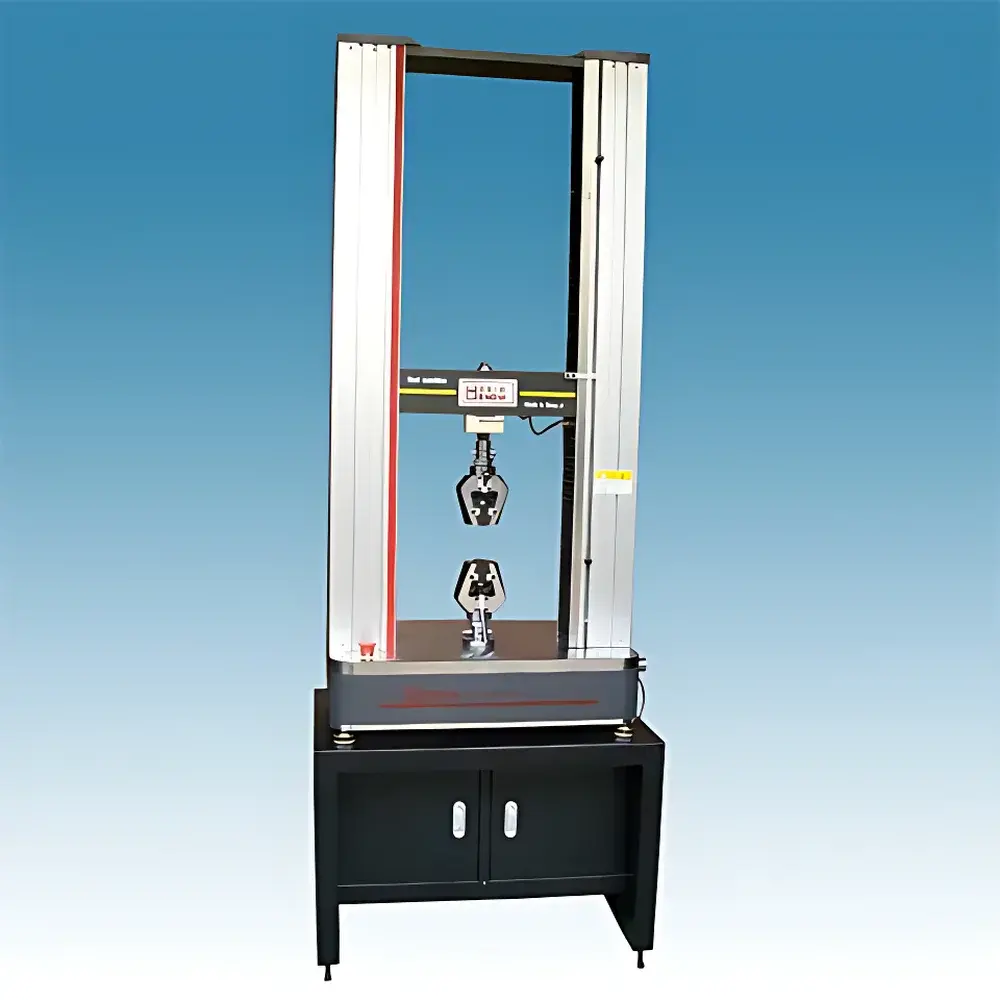
Hengyi HY-1080 Universal Testing Machine for Biomechanical Bone Bending Strength Evaluation
| Brand | Hengyi |
|---|---|
| Origin | Shanghai, China |
| Manufacturer Type | Direct Manufacturer |
| Country of Origin | China |
| Model | HY-1080UI |
| Instrument Type | Electromechanical Universal Testing Machine |
| Load Capacity Options | 1 N to 10 kN (multi-sensor configurable) |
| Accuracy Class | ≤0.5% FS |
| Effective Test Width | 380 mm (expandable) |
| Effective Test Height | 800 mm (extendable) |
| Speed Range | 0.001–500 mm/min |
| Speed Accuracy | ±0.5% of indicated value |
| Force Resolution | ±500,000 counts (full-scale, no range switching) |
| Displacement & Strain Measurement Accuracy | ±0.5% of indicated value |
| Stress/Strain Control Rate Range | 0.002–6% FS/s |
| Power Supply | 220 V AC, 750 W |
| Host Dimensions | 700 × 420 × 1510 mm |
| Net Weight | 180 kg |
Overview
The Hengyi HY-1080UI is a high-precision electromechanical universal testing machine engineered for static mechanical characterization of biological and synthetic materials under tension, compression, flexure, shear, peel, tear, and cyclic loading conditions. Designed specifically for biomechanical evaluation—including cortical and trabecular bone bending strength assessment—the system complies with core principles outlined in ASTM F2183 (Standard Test Method for Flexural Properties of Cortical Bone), ISO 527-2 (Plastics – Tensile Properties), and ISO 178 (Plastics – Determination of Flexural Properties). Its dual-column, rigid frame architecture ensures minimal deflection during high-fidelity load application, while the integrated closed-loop control system maintains consistent strain rate and force ramping across multi-phase test protocols required for regulatory-grade orthopedic implant validation and biomaterial qualification.
Key Features
- Heavy-duty dual-column structural frame with preloaded high-accuracy ball screws (imported), delivering long-term dimensional stability and minimal axial play during high-cycle fatigue or creep testing.
- Industrial-grade Panasonic AC servo motor and drive system—maintenance-free, low-noise, and thermally stable for continuous operation over extended test durations.
- U.S.-sourced bidirectional load cell with automatic sensor recognition and digital calibration traceability—supporting seamless interchange between 1 N and 10 kN transducers without manual reconfiguration.
- Multi-language, multi-unit digital controller (SI, imperial, CGS) offering both open-loop speed control and closed-loop stress/strain/displacement regulation modes per ISO 5893 and ASTM E4 standards.
- Ergonomic handheld remote control enabling rapid jog, start/stop, and safety-trigger activation—critical for lab environments where operator proximity to moving crossheads must be minimized during specimen setup.
- Integrated electronic limit protection, overload cutoff (110% FS), real-time self-diagnostic routines for drive, load, and position subsystems, and programmable auto-return functionality.
Sample Compatibility & Compliance
The HY-1080UI accommodates a broad spectrum of specimen geometries and mechanical behaviors common in biomedical R&D and quality assurance laboratories. Validated use cases include: human and animal cortical bone beams (3-point/4-point bending per ASTM F2183), polymer-based surgical meshes, absorbable sutures, orthopedic fixation plates, dental composites, hydrogel scaffolds, vascular grafts, and pharmaceutical tablet hardness testing. All mechanical outputs—including flexural modulus, yield offset (0.2% strain), ultimate bending moment, and fracture toughness proxies—are traceable to national metrology institutes via optional Shanghai Institute of Measurement and Testing calibration certification (CNAS-accredited, ISO/IEC 17025 compliant). The system supports GLP-compliant data integrity through audit-trail-enabled software logging, aligning with FDA 21 CFR Part 11 requirements when paired with validated PC configurations.
Software & Data Management
Bundled with HengyiTest Pro v4.x software, the HY-1080UI provides ISO 17025-aligned test method templates, real-time curve overlay, automatic peak detection, and customizable report generation (PDF, Excel, XML). Raw data streams are timestamped and digitally signed at acquisition—enabling full chain-of-custody documentation for regulatory submissions. Software modules support ASTM D790 (flexural properties of plastics), ISO 604 (rigid plastics), and USP <1207> (package seal strength) test sequences. Optional integration with LIMS platforms via TCP/IP or OPC UA ensures interoperability within centralized laboratory informatics ecosystems. All firmware and software updates are delivered through secure, version-controlled channels with revision history logs.
Applications
- Biomechanical evaluation of harvested bone specimens in orthopedic research and preclinical device testing.
- Flexural strength and stiffness quantification of biodegradable polymer implants (e.g., PLLA, PCL) per ISO 10993-12.
- Mechanical screening of tissue-engineered constructs under simulated physiological loading regimes.
- Quality control of medical device components—including bone screws, spinal cages, and dental abutments—against ISO 14801 and ISO 22674 specifications.
- Regulatory submission support for FDA 510(k), CE Marking (MDR Annex I), and PMDA dossier preparation requiring standardized mechanical performance data.
- Academic and industrial materials science labs conducting comparative studies on natural vs. synthetic scaffold systems.
FAQ
Is the HY-1080UI compliant with ISO/IEC 17025 for accredited testing laboratories?
Yes—when configured with certified load cells, calibrated displacement encoders, and operated under documented SOPs, the system meets the technical requirements of ISO/IEC 17025:2017 Clause 6.4 (Equipment) and Clause 7.7 (Ensuring Validity of Results).
Can the system perform dynamic fatigue testing?
The base configuration supports quasi-static loading only. High-frequency cyclic testing (≥1 Hz) requires optional servo-hydraulic upgrade kits and dedicated waveform generator modules.
What third-party certifications are available for this instrument?
Shanghai Institute of Measurement and Testing (SIMT) calibration certificates (CNAS-accredited), CE marking (per Machinery Directive 2006/42/EC), and RoHS 3 compliance documentation are standard upon request.
Does the controller support ASTM E23-22-compliant impact test mode?
No—impact testing requires pendulum-based Charpy/Izod hardware. The HY-1080UI is strictly a quasi-static electromechanical tester.
Are test method templates pre-loaded for bone-specific standards like ASTM F2183?
Yes—HengyiTest Pro includes validated templates for ASTM F2183 (cortical bone flexure), ASTM F2118 (cancellous bone compression), and ISO 5832-3 (titanium alloy implants), all with built-in pass/fail logic and statistical reporting.



