
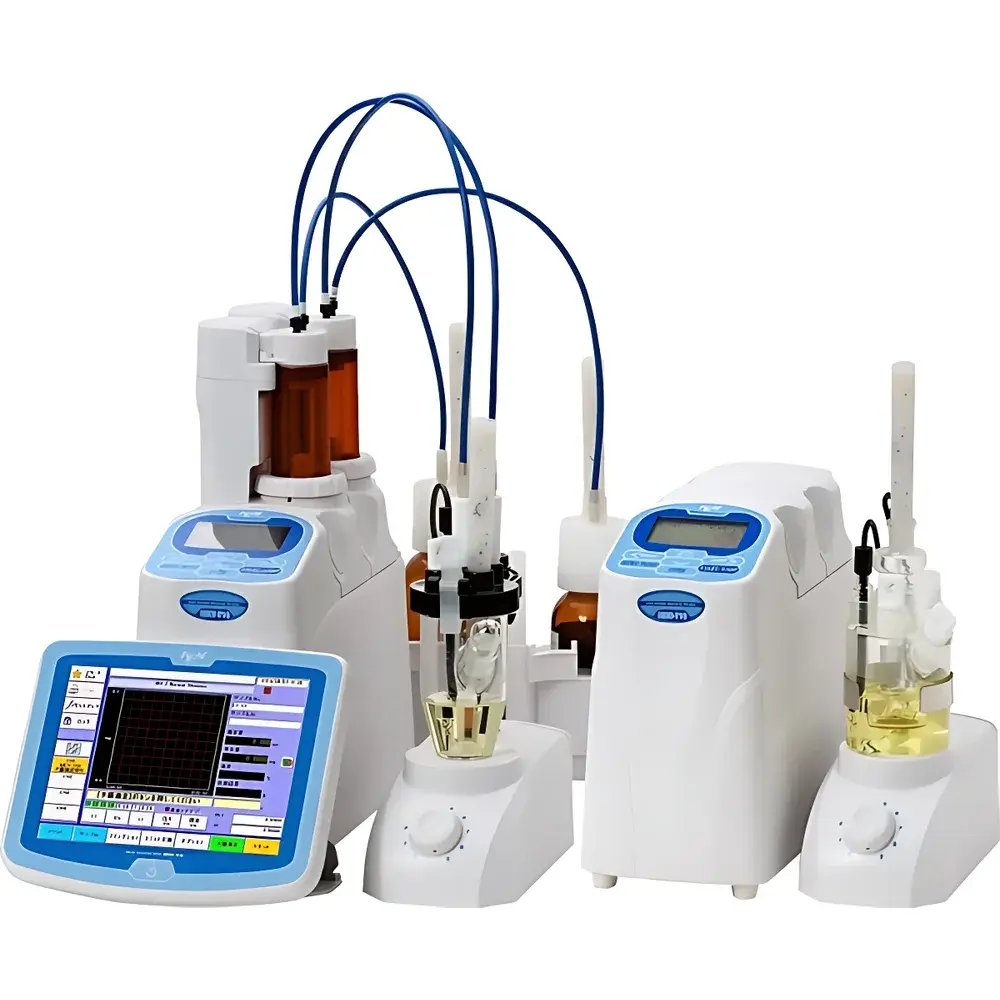
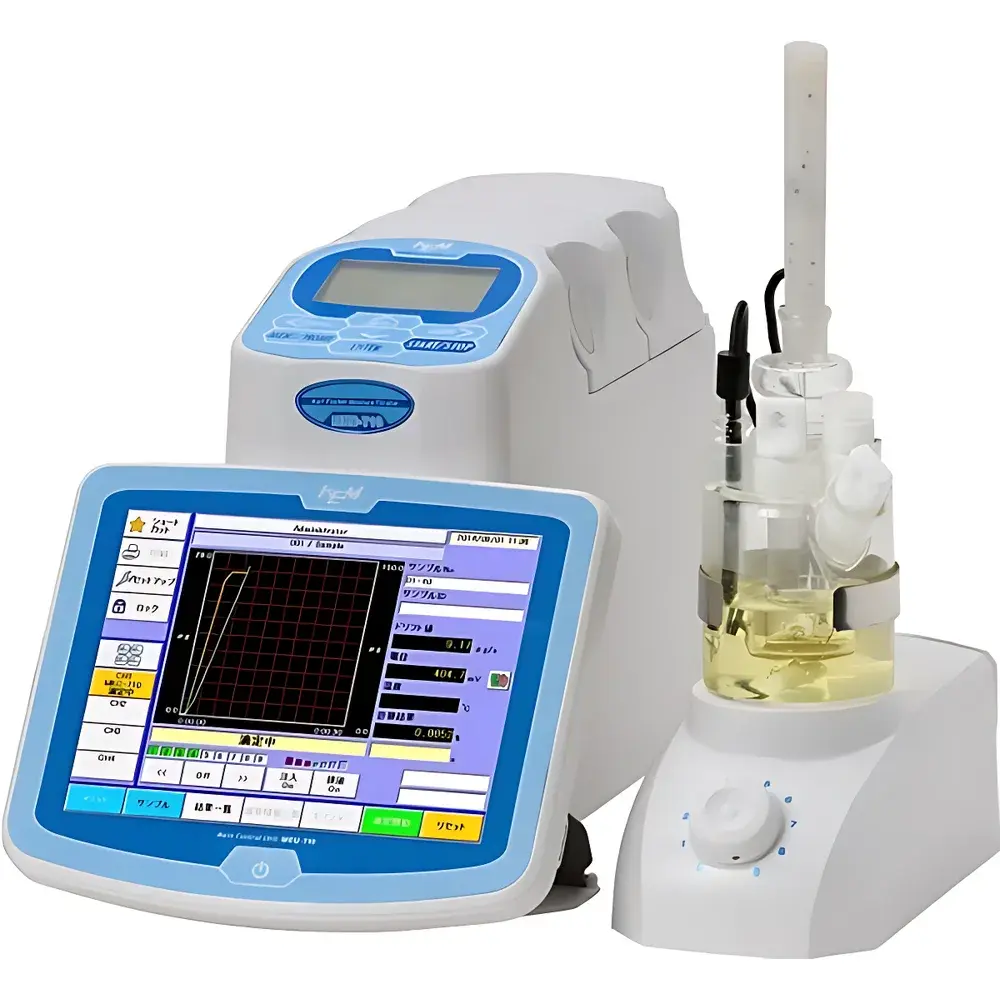
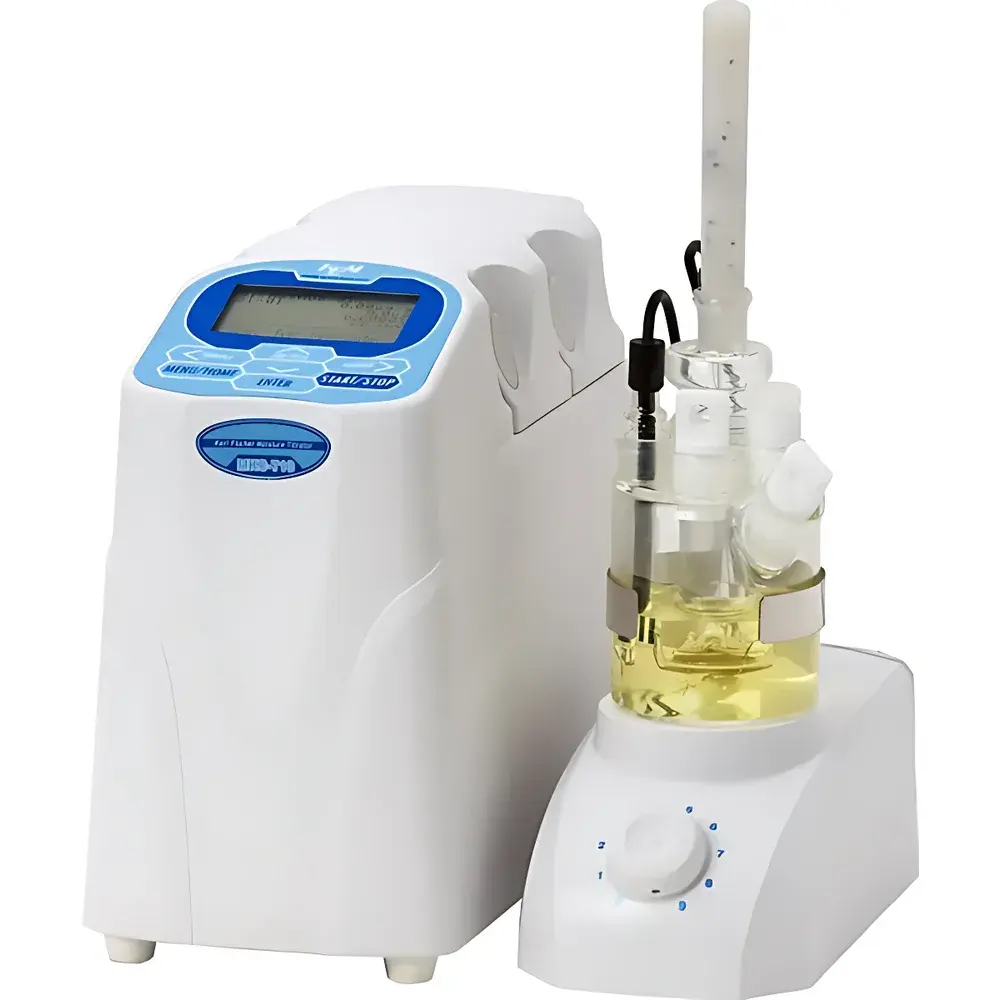
KEM MKC-710 Coulometric Karl Fischer Moisture Titrator
| Brand | KEM (Kyoto Electronics Manufacturing) |
|---|---|
| Origin | Japan |
| Manufacturer | Kyoto Electronics Manufacturing Co., Ltd. |
| Model | MKC-710 |
| Measurement Principle | Coulometric Karl Fischer Titration |
| Moisture Range | 1 µg – 300 mg H₂O (up to 1000 mg with extended range) |
| Precision | RSD < 0.3% (n = 10, per certified reference materials and ASTM E203) |
| Electrode System | Dual-platinum detection electrodes with AC polarization |
| Cell Type | Membrane-separated or membrane-free electrolytic cell |
| Resolution | 0.1 µg H₂O |
| Max. Electrolysis Rate | 2.6 mg H₂O/min |
| Display | 8.4″ color LCD (800 × 600), multilingual UI (English, Japanese, Chinese, Korean, Russian, Spanish, German, French) |
| Data Storage | 500 sample results (MKC-710M), GLP-compliant audit trail, operator/group management, reagent lifetime tracking, scheduled performance verification |
| Interface | RS-232C × 4, USB × 1, SS-BUS, APBLAN |
| Environmental Operating Range | 5–35 °C, ≤85% RH |
| Power | AC 100–240 V ±10%, 50/60 Hz |
| Power Consumption | ~30 W (main unit), ~7 W (printer) |
Overview
The KEM MKC-710 Coulometric Karl Fischer Moisture Titrator is an advanced, fully automated analytical instrument engineered for trace-level water quantification in samples where high sensitivity, repeatability, and regulatory compliance are critical. Based on the coulometric variant of the Karl Fischer (KF) titration principle—where iodine is electrogenerated in situ at the anode via controlled current application—the MKC-710 delivers precise stoichiometric determination of water content without manual reagent dispensing. This method eliminates volumetric uncertainty inherent in volumetric KF systems and enables direct measurement down to 1 µg H₂O, making it ideal for low-moisture matrices such as pharmaceutical excipients, lithium battery electrolytes, polymers, solvents, and high-purity chemicals. The system complies with international standard methods including ASTM E203, ISO 760, and USP , and supports full traceability requirements under FDA 21 CFR Part 11 when used with validated SOFT-CAP data management software.
Key Features
- Wireless operational architecture: MKC-710M variant integrates Bluetooth-enabled communication between the 8.4″ touchscreen control unit and up to four independent titration modules—enabling safe remote operation inside fume hoods during analysis of volatile, toxic, or corrosive samples.
- High-speed coulometric electrolysis: Achieves a maximum generation rate of 2.6 mg H₂O/min, significantly reducing pre-titration stabilization time and total assay duration without compromising endpoint accuracy.
- Dual-electrode AC polarization detection: Provides robust, drift-resistant endpoint recognition by monitoring real-time polarization behavior across two platinum working electrodes—minimizing false endpoints caused by electrode passivation or sample matrix interference.
- Flexible cell configuration: Supports both membrane-separated and membrane-free electrolytic cells to accommodate diverse sample types—from non-aqueous organic solvents to viscous oils and hygroscopic solids—while maintaining optimal anolyte/catholyte separation where required.
- Comprehensive GLP functionality: Built-in operator authentication, group-based access control, scheduled calibration/verification prompts, reagent activity monitoring, and automatic blank correction ensure adherence to laboratory quality management systems (ISO/IEC 17025, GMP, and pharmacopeial guidelines).
Sample Compatibility & Compliance
The MKC-710 is validated for use across a broad spectrum of sample categories, including but not limited to: active pharmaceutical ingredients (APIs), tablet coatings, lyophilized biologics, silicone oils, epoxy resins, fuel-grade alcohols, and lithium hexafluorophosphate (LiPF₆) solutions. Its coulometric design ensures minimal reagent consumption—typically ≤100 mL anolyte and only 5 mL catholyte per full analytical cycle—reducing chemical waste and cost-of-ownership. All firmware and hardware configurations meet electromagnetic compatibility (EMC) standards IEC 61326-1 and safety requirements IEC 61010-1. When deployed with SOFT-CAP software and configured for electronic signatures, the system satisfies FDA 21 CFR Part 11 requirements for electronic records and signatures in regulated environments.
Software & Data Management
Data acquisition, processing, and reporting are managed through KEM’s SOFT-CAP software suite—a Windows-based application supporting bidirectional communication via RS-232C or USB. The software provides full audit trail logging (user actions, method changes, result modifications), statistical analysis (mean, SD, RSD, confidence intervals), customizable report templates (PDF/CSV/XLS export), and integration with LIMS via configurable ASCII or XML output protocols. Up to 120 user-defined measurement methods can be stored onboard the MKC-710M, each with independent parameters for current setting, endpoint threshold, drift compensation, and post-measurement blank subtraction. Internal memory retains 500 complete sample records with timestamps, operator ID, method name, and raw electrode signal traces.
Applications
- Pharmaceutical QC labs: Quantification of residual moisture in freeze-dried products per USP and EP 2.5.12, supporting stability-indicating release testing.
- Battery material R&D: Accurate water determination in Li-ion cathode precursors and electrolyte formulations—critical for preventing HF formation and cell degradation.
- Polymer manufacturing: Monitoring moisture in polyamide, polycarbonate, and PET resin pellets prior to extrusion or injection molding.
- Chemical synthesis: Verification of dryness in Grignard reagents, organolithium compounds, and catalyst-grade solvents (e.g., THF, DMF, acetonitrile).
- Fuel and lubricant testing: Detection of trace water in aviation turbine fuels (ASTM D6304) and transformer oils (IEC 60814) to prevent corrosion and dielectric failure.
FAQ
What is the difference between coulometric and volumetric Karl Fischer titration?
Coulometric KF generates iodine electrochemically within the titration cell using a constant current, enabling sub-microgram water detection without manual reagent addition. Volumetric KF dispenses standardized iodine solution from a burette and is better suited for samples containing >100 µg water.
Can the MKC-710 measure bromine value or bromine index?
Yes—the MKC-710 platform supports bromine value/bromine index determination using the same coulometric cell and dual-platinum electrode configuration, following ASTM D1159 or IP 127 protocols.
Is external sample automation supported?
Yes—via RS-232C or USB interfaces, the MKC-710 integrates seamlessly with KEM’s ADP-611 moisture evaporator and third-party autosamplers, enabling unattended batch analysis of solid or semi-solid samples.
How does the system handle high-drift samples?
The MKC-710 employs adaptive drift compensation algorithms and allows user-defined drift stabilization thresholds, ensuring reliable endpoint detection even in challenging matrices such as ketones or aldehydes that exhibit slow background reactions.
What validation documentation is available?
KEM provides IQ/OQ documentation packages, including factory calibration certificates traceable to NIST standards, performance verification reports, and SOP templates aligned with ISO/IEC 17025 and GxP expectations.




