
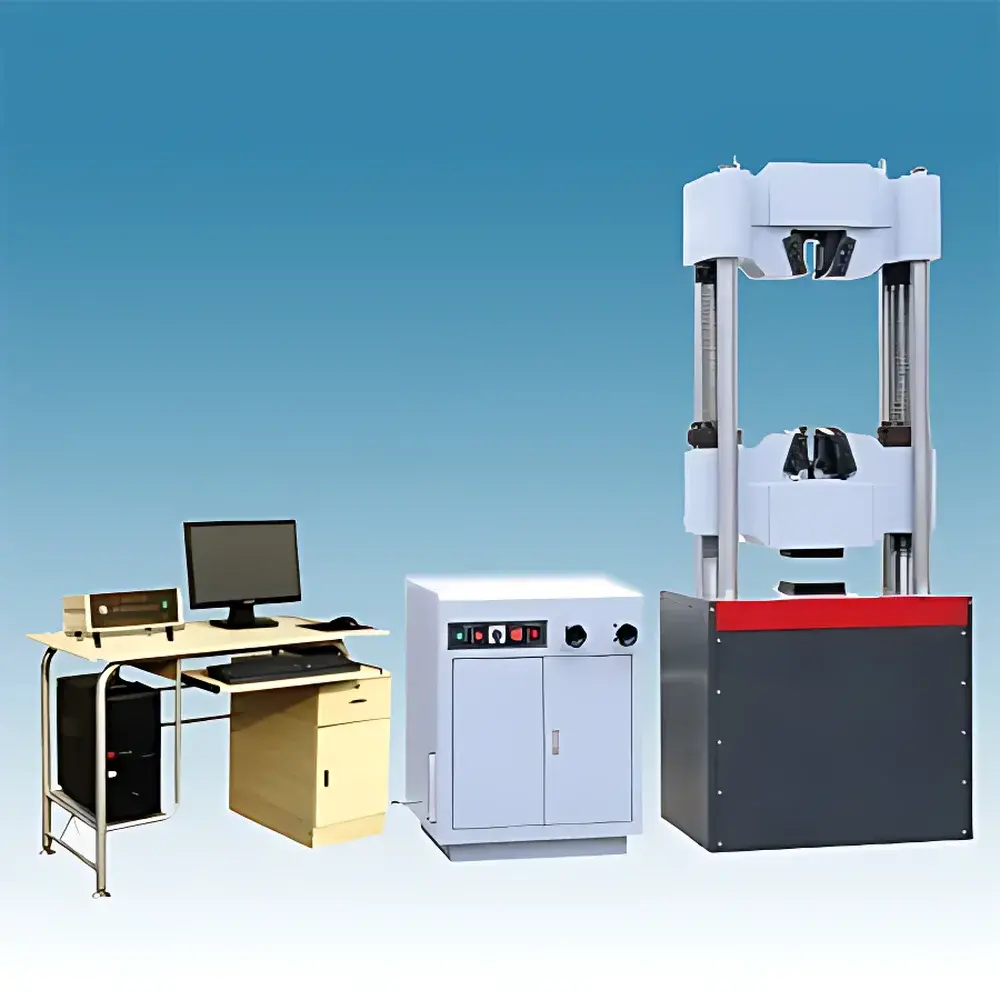
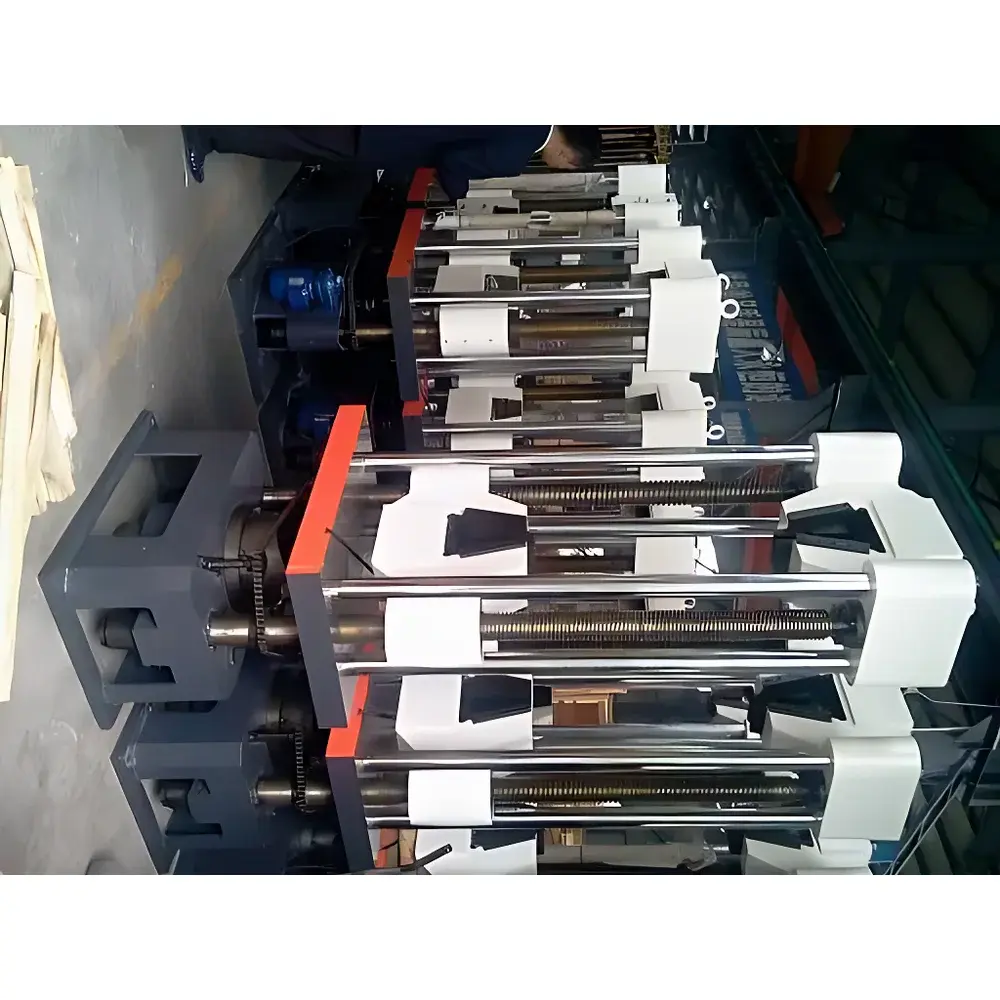
Hengyi HY(WE)100060 Electro-Hydraulic Servo Universal Testing Machine
| Brand | Hengyi |
|---|---|
| Origin | Shanghai, China |
| Manufacturer Type | Direct Manufacturer |
| Regional Category | Domestic (China) |
| Model | HY(WE)100060QRTGV |
| Instrument Type | Electro-Hydraulic Servo Universal Testing Machine |
| Max Load Capacity | 1000 kN |
| Load Measurement Accuracy | ±0.5% FS |
| Displacement Resolution | ≤0.5% FS |
| Compression Space | 600 mm |
| Tensile Space | 600 mm |
| Round Specimen Clamping Range | Φ20–Φ60 mm |
| Flat Specimen Clamping Thickness | 0–40 mm |
| Piston Stroke | 150 mm |
| Bend Support Span Adjustment | 100–600 mm |
| Shear Specimen Diameter | Φ10 mm |
| Deformation Measurement Accuracy | ±0.5% of reading |
| Displacement Measurement Error | ±0.5% of reading |
| Stress Rate Control Range | 1–60 N/mm²/s |
| Strain Rate Control Range | 0.00025–0.0025 s⁻¹ |
| Closed-Loop Control Accuracy (Force/Displacement/Strain) | ±1% of setpoint |
| Overall Dimensions (W×D×H) | 880 × 580 × 2860 mm |
| Motor Power | 1.5 kW, 3-phase |
| Weight | 3500 kg |
Overview
The Hengyi HY(WE)100060 Electro-Hydraulic Servo Universal Testing Machine is a high-capacity, precision-engineered mechanical testing system designed for static mechanical property evaluation of metallic and non-metallic materials under controlled loading conditions. Based on electro-hydraulic servo actuation and closed-loop proportional control architecture, the system delivers stable, repeatable force application across tension, compression, bending, and shear test modes. Its load frame employs a bottom-mounted hydraulic cylinder configuration—optimized for rigidity, thermal stability, and long-term calibration retention—while integrating high-fidelity load cells (±0.5% FS accuracy), linear variable differential transformers (LVDTs), and optical encoder-based displacement feedback. The machine complies with core structural and metrological requirements defined in ISO 7500-1 (Class 1 verification), ASTM E4 (force verification), and ASTM E8/E9 (tensile/compression testing of metals), supporting both routine QC workflows and R&D-grade material characterization.
Key Features
- Electro-hydraulic servo control system with proportional valve regulation, enabling precise stress- and strain-rate programming per ASTM E2309 and ISO 6892-1
- Integrated 1000 kN capacity load frame with rigid C-frame construction, reinforced crosshead guidance, and dual-column vertical alignment for minimal parasitic moments
- Automatic range switching and auto-calibration of load and deformation channels via embedded firmware and PC-based software interface
- Dual-mode clamping system: wedge-action hydraulic grips for round specimens (Φ20–Φ60 mm) and adjustable mechanical grips for flat specimens (0–40 mm thickness)
- Adjustable bending support span (100–600 mm) with standardized roller geometry conforming to ISO 178 and ASTM D790
- Real-time closed-loop control of force, displacement, or strain with ±1% setpoint accuracy over full dynamic range
- High-resolution data acquisition: 100 kHz sampling rate, 24-bit ADC, and timestamped raw channel logging for post-test reanalysis
Sample Compatibility & Compliance
The HY(WE)100060 accommodates standard and custom specimen geometries per ISO 6892-1 (metal tensile), ISO 15630-1 (reinforcing steel), ISO 7438 (bend testing), and ASTM C39/C469 (concrete compression and modulus). It supports flat sheet, rod, bar, wire, cast, and extruded samples up to 600 mm in active gauge length. For polymer composites and cementitious materials, optional environmental enclosures (not included) may be integrated for temperature-controlled testing per ISO 6721 or ASTM D695. All measurement subsystems are traceably calibrated to national standards (CNAS-accredited reference laboratories), and the system supports audit-ready documentation required under GLP and ISO/IEC 17025 quality management frameworks.
Software & Data Management
The system operates with Hengyi’s proprietary Windows-based testing software, featuring bilingual (English/Chinese) UI, role-based user access control, and configurable test method templates aligned with ASTM, ISO, and GB/T standards. Software capabilities include automatic derivation of key mechanical parameters—Rm, ReH, ReL, Rp0.2, E-modulus, yield point elongation, and fracture energy—as well as interactive curve traversal, overlay comparison of up to eight datasets, and localized zooming of stress–strain regions. Raw data export is supported in CSV, XML, and universal .tdms formats; PDF report generation includes digital signatures, instrument ID, calibration status, operator ID, and timestamped metadata. The software architecture conforms to FDA 21 CFR Part 11 requirements for electronic records and signatures when deployed with validated configuration and audit trail activation.
Applications
This testing machine serves metallurgical labs, civil engineering material centers, aerospace component suppliers, and automotive Tier-1 manufacturers performing standardized mechanical qualification. Typical use cases include tensile strength validation of structural steels (Q345, S355JR), compressive strength assessment of concrete cylinders (C20–C80), flexural modulus determination of fiber-reinforced polymers, shear strength evaluation of bolted joints, and cyclic pre-load verification for fastener systems. Its robust control fidelity also supports quasi-static fatigue precursor studies and creep compliance measurements under sustained loading protocols.
FAQ
What standards does the HY(WE)100060 comply with for force calibration?
It meets ISO 7500-1 Class 1 and ASTM E4 requirements for static force verification, with annual recalibration traceable to CNAS-accredited primary standards.
Can the system perform strain-controlled tests on aluminum alloys?
Yes—closed-loop strain control is supported across the full range of 0.00025 s⁻¹ to 0.0025 s⁻¹, compliant with ISO 6892-1 Annex G for rate-sensitive materials.
Is third-party software integration possible?
The system provides TCP/IP and RS-232 APIs for integration with LIMS, MES, or custom Python/Matlab automation environments.
What maintenance intervals are recommended for the hydraulic power unit?
Oil filtration and pressure relief valve inspection every 1,000 operational hours; full hydraulic fluid replacement every 5,000 hours or biannually, whichever occurs first.
Does the machine support multi-step test sequences with automatic mode switching?
Yes—programmable test sequences can combine tension-to-fracture, hold-at-load, unloading, and compression phases within a single script, with automatic grip repositioning and sensor range switching.
Related Products



