
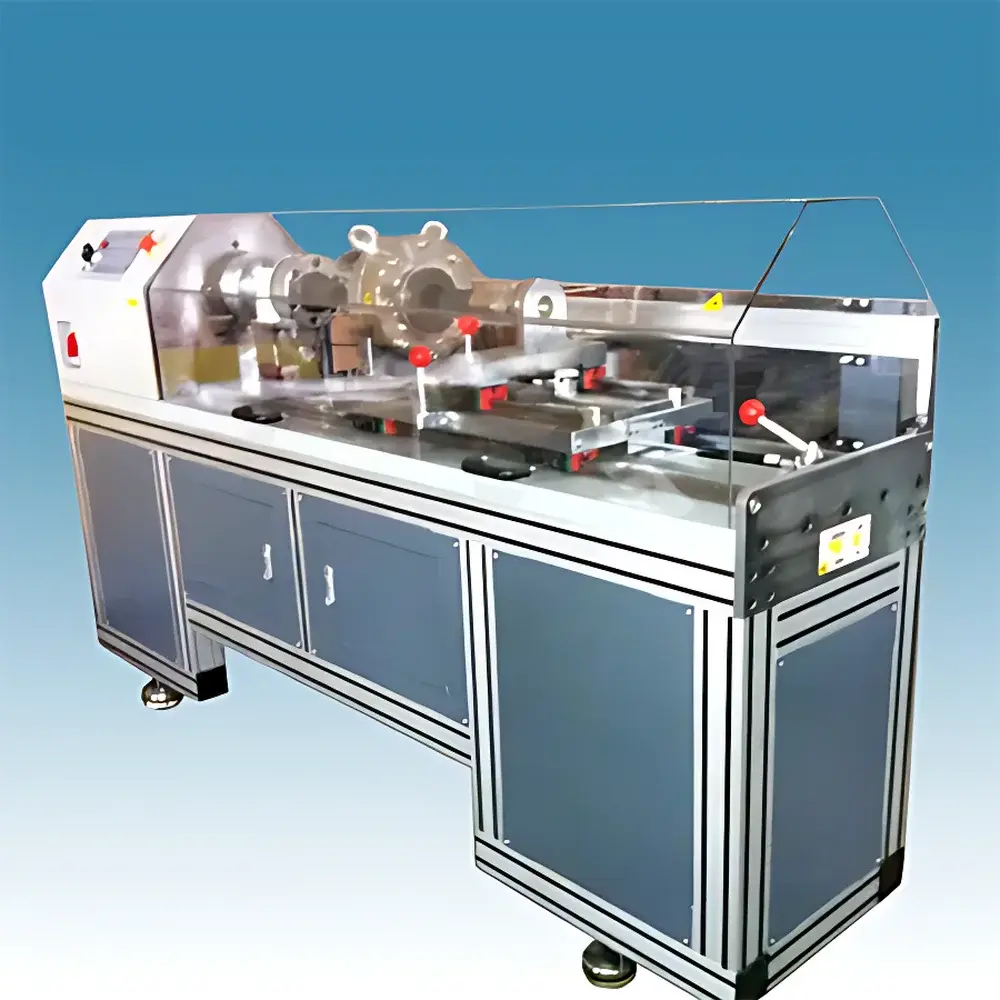
Hengyi HY-2000N.M Advanced Fastener Friction Coefficient & Torsional Testing System
| Brand | Hengyi |
|---|---|
| Origin | Shanghai, China |
| Manufacturer Type | OEM Manufacturer |
| Product Category | Domestic |
| Model | HY-2000N.MWE |
| Max Torque | 2000 N·m |
| Torque Measurement Range | 2–2000 N·m |
| Torque Resolution | 0.001 N·m |
| Torsion Angle Range | 10000° |
| Motor Power | 5 kW |
Overview
The Hengyi HY-2000N.M Advanced Fastener Friction Coefficient & Torsional Testing System is a precision-engineered dual-sensor torsion testing platform designed for quantitative mechanical characterization of bolt-nut assemblies and threaded fasteners under controlled preload and tightening conditions. It operates on the principle of simultaneous, synchronized measurement of axial clamping force (via integrated load cell) and three distinct torque components—total torque, thread torque, and bearing surface torque—enabling calculation of frictional parameters in accordance with ISO 16047, GB/T 3098.9–2010, GB/T 16823.3–2010, and ISO 2320. This system supports full-cycle analysis of tightening behavior, including elastic-to-plastic transition, yield point detection, ultimate failure, and multi-cycle loosening sequences (e.g., 1st insertion, 1st removal, 5th removal, 15th removal), making it essential for R&D validation, quality assurance, and process qualification in high-integrity fastening applications across aerospace, automotive, rail, energy, and shipbuilding sectors.
Key Features
- Dual-axis high-fidelity sensor architecture: Independent, co-aligned axial load cell (5–500 kN range) and composite torque transducer (2–2000 N·m, resolution 0.001 N·m) ensure traceable, low-crosstalk measurement of clamping force and torque components.
- Multi-stage friction coefficient derivation: Automated computation of total coefficient of friction (µtot), thread coefficient (µth), and bearing surface coefficient (µb) using standardized equations per ISO 16047 Annex A.
- Precision torsional actuation: Brushless servo motor (5 kW) enables stable, noise-free operation from 5 to 40 rpm (extendable to 200 rpm), with <±0.5% accuracy in torque, angle, and speed control.
- Modular gripping system: Adjustable jaw spacing (up to 1000 mm) and interchangeable chucks accommodate threaded fasteners from M10 to M30; custom tooling available for non-standard geometries (e.g., flanged nuts, serrated washers).
- Robust mechanical frame: Heavy-duty cast-iron base (1800 kg total mass) and rigid column assembly minimize deflection during high-torque testing, ensuring repeatability and long-term metrological stability.
Sample Compatibility & Compliance
The HY-2000N.M is validated for testing structural bolts, wheel nuts, locking nuts (e.g., M10/M12 Class 8.8 yellow-zinc plated), studs, and screw-nut assemblies. It supports both single-use and repeated tightening/loosening protocols per EN 14399-1:2005 (HR/HV systems) and ASTM F2281 (for prevailing torque locknuts). All measurement algorithms and calibration procedures comply with ISO/IEC 17025 requirements for testing laboratories. The system meets mechanical safety standards IEC 61000-6-2 (EMC immunity) and ISO 12100 (risk assessment), and its data acquisition architecture supports audit-ready documentation for GLP/GMP environments.
Software & Data Management
Controlled by the HYtest v5.x modular software suite, the system provides real-time visualization of torque-angle curves, clamping force progression, and friction coefficient evolution. Test methods are preconfigured to match ISO 16047 Clauses 6–8 (static/dynamic friction measurement) and GB/T 16823.3 Annex B (K-factor determination). Raw data export is supported in CSV, XML, and PDF formats; all test records include embedded metadata (operator ID, calibration certificate IDs, environmental conditions). The software supports 21 CFR Part 11-compliant user access control, electronic signatures, and immutable audit trails for regulatory submissions.
Applications
- Quantification of µtot, µth, and µb for specification compliance and supplier qualification.
- Evaluation of lubricant efficacy, coating performance (e.g., zinc flake, PTFE), and surface treatment durability over multiple cycles.
- Yield torque and clamp force mapping for torque-controlled and angle-controlled tightening processes.
- Validation of self-locking mechanisms (e.g., nylon insert, distorted thread) per ISO 2320 Annex C.
- Calibration and verification of torque wrenches, tension control tools, and automated assembly systems.
- Root cause analysis of joint relaxation, galling, or premature failure in field-representative test conditions.
FAQ
What international standards does this system directly support?
ISO 16047, ISO 2320, GB/T 3098.9–2010, GB/T 16823.3–2010, EN 14399-1:2005, EN 14399-3:2006, and ASTM F2281.
Can the system measure K-factor (torque coefficient)?
Yes—K-factor is calculated automatically as K = T / (F × d), where T is total torque (N·m), F is clamping force (N), and d is nominal bolt diameter (m), per ISO 16047 Clause 7.3.
Is multi-cycle loosening testing programmable?
Yes—the software allows definition of sequential tightening/loosening steps (e.g., up to 15 cycles), with independent pass/fail thresholds for torque decay, clamp loss, and friction drift.
What is the maximum specimen length accommodated?
The standard jaw separation is adjustable up to 1000 mm; extended configurations are available upon request.
Does the system provide traceable calibration documentation?
Each unit ships with factory calibration certificates traceable to CNAS-accredited standards, including torque, force, and angular displacement verification reports.



