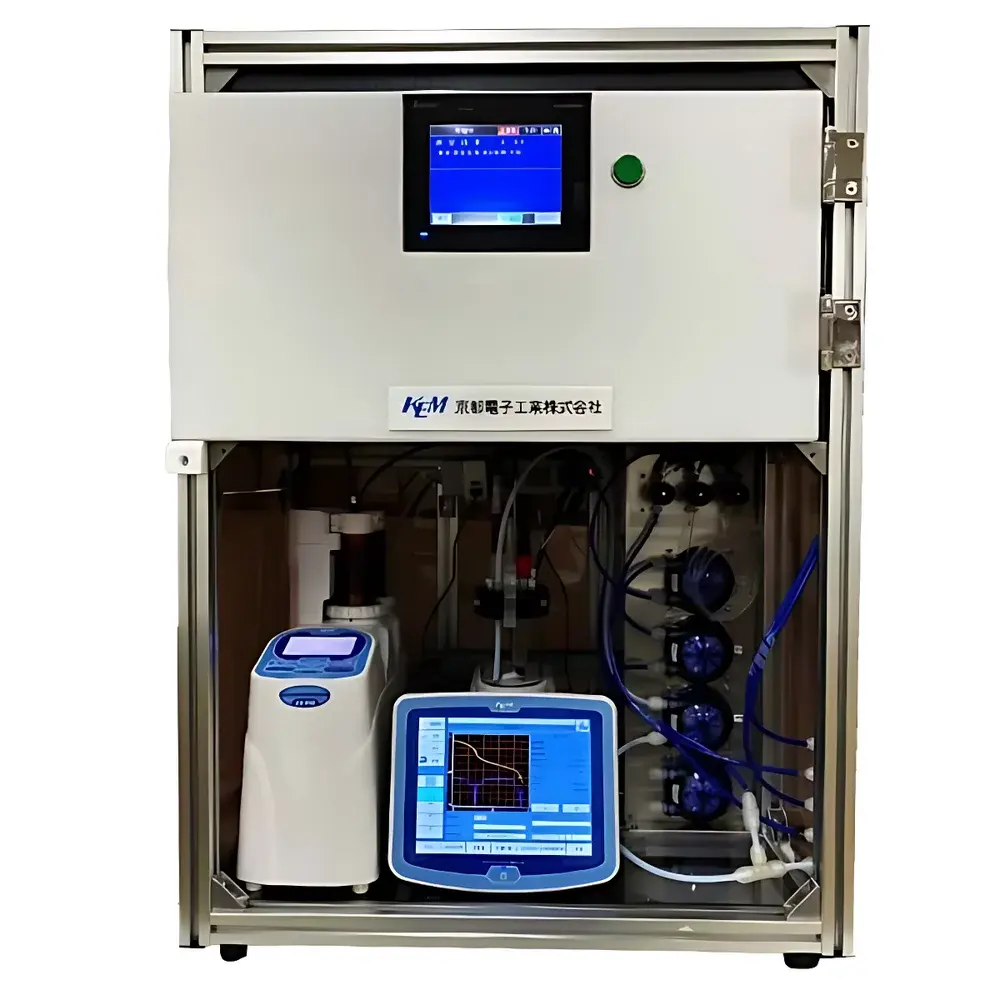
KEM ATP Online Automatic Potentiometric Titrator
| Brand | Kyoto Electronics Manufacturing (KEM) |
|---|---|
| Origin | Japan |
| Manufacturer Type | Original Equipment Manufacturer (OEM) |
| Product Origin | Imported |
| Model | ATP |
| Pricing | Available upon Request |
Overview
The KEM ATP Online Automatic Potentiometric Titrator is an industrial-grade, fully automated in-line analytical instrument engineered for continuous, unattended potentiometric titration in process environments. Based on the fundamental principle of potentiometric endpoint detection—measuring the potential difference between a reference electrode and an indicator electrode as titrant is incrementally added—the ATP system delivers precise, traceable quantitative analysis of analytes such as total acidity, free SO₂, chloride, calcium hardness, or chelatable metal ions. Designed for integration into production lines, it performs complete analytical cycles—including sample aspiration, volumetric dosing (0.5–10 mL), optional dilution, reagent addition, endpoint determination, waste discharge, and system rinsing—without operator intervention. With over 55 years of heritage in potentiometric titration instrumentation, KEM has optimized the ATP platform for robustness, long-term stability, and compliance-ready operation in regulated manufacturing settings.
Key Features
- Fully autonomous titration cycle: integrated peristaltic sampling, piston-driven burette dispensing, and programmable rinse sequences ensure repeatability across shifts.
- Multi-mode titration capability: supports acid-base, redox, precipitation, and complexometric (chelation) titrations via configurable electrode sets and reagent protocols.
- Real-time visualization and diagnostics: 7-inch capacitive touchscreen interface displays titration curves, equivalence point calculations, status flags (e.g., low reagent, electrode drift warning), and system health metrics.
- Industrial enclosure: powder-coated steel chassis (650 × 500 × 800 mm) rated for NEMA 4X-equivalent environmental protection; suitable for installation in chemical processing rooms or beverage plant wet zones.
- Modular connectivity: dual-output architecture enables simultaneous analog transmission (4–20 mA DC for concentration values) and digital communication via CC-Link industrial fieldbus or Ethernet TCP/IP for SCADA/MES integration.
Sample Compatibility & Compliance
The ATP accommodates liquid samples with viscosity ≤ 50 mPa·s and suspended solids content < 50 ppm—making it suitable for applications in soft drink formulation, pharmaceutical intermediate synthesis, wastewater neutralization control, and edible oil refining. Sample introduction is compatible with pressurized or gravity-fed inlet lines (1/4" NPT ports). Electrode compatibility includes standard Ag/AgCl double-junction reference electrodes, pH glass electrodes, platinum redox sensors, and ion-selective electrodes (e.g., for Cl⁻ or F⁻). The system supports audit-trail-enabled operation per FDA 21 CFR Part 11 when paired with KEM’s optional TitraMaster software suite. All titration methods may be validated against ISO 8655-6 (burette calibration), ASTM D1126 (hardness), or USP (acid/base assays), facilitating GLP/GMP-aligned deployment.
Software & Data Management
While the ATP operates stand-alone via its embedded controller, full data governance is achieved through optional integration with KEM TitraMaster v4.x—a Windows-based application compliant with electronic record and signature requirements. TitraMaster provides method templates, user-level access control (administrator/operator modes), electronic signatures, automatic PDF report generation (including raw mV vs. volume plots), and CSV export for LIMS ingestion. All measurement events—including reagent batch IDs, electrode calibration timestamps, and outlier flagging—are time-stamped and stored locally with configurable retention policies. Networked units support remote firmware updates and centralized method distribution across multi-site facilities.
Applications
- Beverage industry: real-time monitoring of titratable acidity (TA) in fruit juices, CO₂ alkalinity in carbonated drinks, and sulfite residuals in wine must.
- Chemical manufacturing: closed-loop control of neutralization reactors, HCl/NH₃ concentration verification in scrubber effluents, and catalyst activity assessment via iodometric titration.
- Food & dairy: quantification of lactic acid in fermented products, citric acid in jams, and free fatty acids in refined oils.
- Environmental labs: automated BOD/COD surrogate testing, chloride determination in brine streams, and alkalinity profiling in municipal water treatment.
FAQ
What sample preparation is required prior to online analysis?
No manual pretreatment is needed—samples are drawn directly from process lines. However, particulate filtration (≤ 5 µm) upstream of the ATP inlet is recommended to prevent tubing occlusion.
Can the ATP perform back-titrations or multi-step titrations?
Yes—method programming supports sequential reagent additions, conditional endpoint detection, and post-titration blank corrections via user-defined logic scripts.
Is electrode maintenance automated?
The system includes scheduled automatic electrode cleaning cycles using ultrapure water or mild detergent solutions, with configurable frequency and duration.
How is calibration traceability ensured?
All volumetric components (syringe pumps, burettes) are factory-calibrated per ISO/IEC 17025-accredited procedures; certificates include uncertainty budgets and are supplied with each unit.
Does the ATP support hazardous area installation?
Standard units are rated for general-purpose environments; ATEX/IECEx-certified variants (Zone 2/22) are available upon request with explosion-proof enclosures and intrinsically safe signal interfaces.