
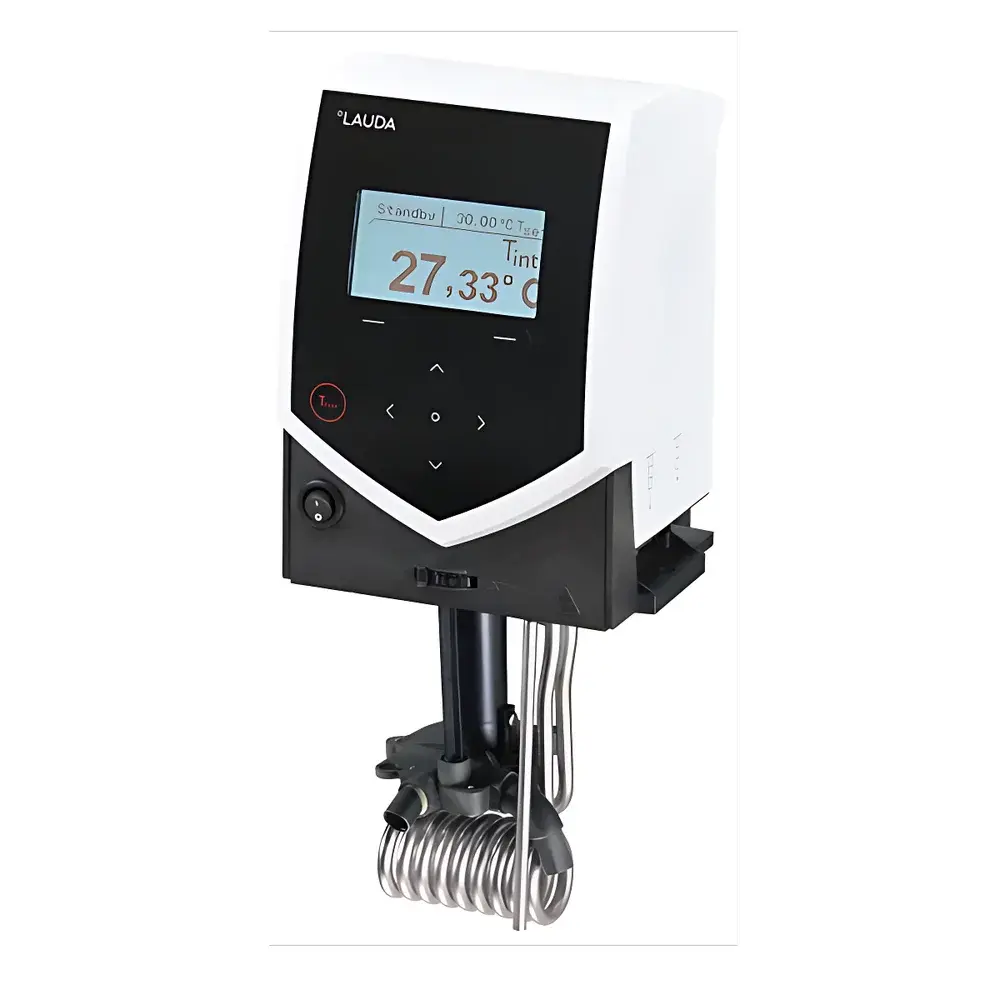
LAUDA ECO Silver Immersion Circulator Thermostat
| Brand | LAUDA |
|---|---|
| Origin | Germany |
| Model | ECO Silver |
| Temperature Range | 20–200 °C |
| Temperature Stability | ±0.01 °C |
| Heating Power | 2.0 kW |
| Max. Power Consumption | 2.1 kW |
| Current Draw | 10 A |
| Pump Flow Rate | 22 L/min |
| Dimensions (W×D×H) | 130 × 135 × 325 mm |
| Power Supply | 230 V, 50/60 Hz |
| Safety Class | III |
| Max. Bath Wall Thickness | 25 mm |
| Min. Immersion Depth | 150 mm |
| Pump Speed | 6-step adjustable |
| Control Type | Full-electronic PID controller with integrated programmer (1 program, up to 20 segments) |
| Display | Monochrome LCD showing setpoint & actual value simultaneously |
| Interface | Standard USB |
| Protection | Adjustable overtemperature cutoff (Tmax key), menu-configurable safety limit |
Overview
The LAUDA ECO Silver Immersion Circulator Thermostat is an engineered solution for precise, stable, and reproducible temperature control in open-bath laboratory applications. Designed for immersion into external liquid baths—including water, silicone oil, and glycol-based heat transfer media—it operates on the principle of forced convection via an integrated high-efficiency circulation pump. Its core architecture supports continuous thermal regulation across a wide operational range—from 20 °C to 200 °C—with a documented temperature stability of ±0.01 °C under steady-state conditions. This level of precision meets stringent requirements for calibration procedures, material testing (e.g., viscosity measurements per ASTM D445 or ISO 3104), enzymatic assays, and long-duration stability studies where thermal drift must remain below detectable thresholds. The device complies with IEC 61010-1 for electrical safety in laboratory environments and carries Safety Class III certification, permitting safe operation with both flammable and non-flammable heat transfer fluids.
Key Features
- Full-electronic PID temperature controller with auto-tuning capability and real-time deviation compensation
- Monochrome LCD display showing simultaneous setpoint and actual temperature values with 0.01 °C resolution
- Intuitive menu navigation via cursor keys and soft-touch function buttons—including dedicated Tmax key for immediate overtemperature override
- 6-stage adjustable circulation pump enabling fine-tuned flow rate control (up to 22 L/min) to match bath geometry and thermal load
- Integrated programmable timer supporting one multi-segment protocol (up to 20 steps) for automated ramp-hold-cool sequences
- Standard USB interface for firmware updates and data logging; expandable via optional Pt 100/LiBus interface module for integration into centralized lab automation systems
- Mechanically robust screw-clamp mounting system compatible with bath walls up to 25 mm thick and minimum immersion depth of 150 mm
- Configurable overtemperature protection with user-defined threshold and audible/visual alarm activation
- Energy-efficient 2.0 kW heating element with thermal cut-off redundancy and low-thermal-mass design for rapid response
Sample Compatibility & Compliance
The ECO Silver is validated for use with a broad spectrum of heat transfer media—ranging from aqueous solutions and ethylene glycol mixtures to silicone oils and mineral oils—provided vapor pressure and flash point align with Class III safety parameters. Its stainless-steel immersion housing and corrosion-resistant internal wetted parts ensure compatibility with mildly aggressive solvents and buffered saline solutions commonly employed in biological incubation workflows. Regulatory alignment includes conformity with EU Directive 2014/30/EU (EMC), 2014/35/EU (LVD), and RoHS 2011/65/EU. While not inherently 21 CFR Part 11 compliant, audit-ready operation is achievable when paired with validated third-party software platforms that enforce electronic signature, change control, and audit trail functionality—common practice in GLP- and GMP-regulated QC laboratories.
Software & Data Management
Out-of-the-box functionality includes local parameter configuration and real-time monitoring via the front-panel interface. For extended data capture, the standard USB port supports connection to host PCs running LAUDA’s proprietary LabSoft software (or generic terminal emulators), enabling periodic temperature logging, export to CSV/Excel, and remote setpoint adjustment. Optional LiBus-enabled configurations allow integration into distributed control networks using Modbus RTU or ASCII protocols—facilitating synchronization with chromatography systems, rheometers, or environmental chambers in multi-instrument test setups. All firmware revisions are digitally signed and traceable, supporting version-controlled validation documentation required for ISO/IEC 17025 accreditation.
Applications
- Calibration of thermometers, RTDs, and thermocouples per ISO/IEC 17025 Annex A.3
- Temperature conditioning of samples prior to mechanical testing (tensile, impact, creep) per ASTM D638 or ISO 527
- Stabilization of reaction vessels in synthetic chemistry workflows requiring narrow thermal windows
- Pre-conditioning of viscometer baths per ASTM D445 methodology
- Controlled thawing and warming of cryopreserved cell cultures in biopharma QC labs
- Thermal aging studies of polymer films and coatings under accelerated conditions
- Supporting differential scanning calorimetry (DSC) reference bath stability requirements
FAQ
What is the minimum immersion depth required for safe and stable operation?
The unit requires a minimum immersion depth of 150 mm to ensure full coverage of the heating element and temperature sensor, preventing dry-run damage and ensuring accurate feedback control.
Can the ECO Silver be used with flammable liquids such as ethanol or acetone?
Yes—its Safety Class III rating certifies suitability for use with flammable liquids, provided ambient ventilation meets local hazardous area classification standards and bath containment prevents overflow or vapor accumulation.
Is external temperature sensing supported?
Yes—via the optional Pt 100/LiBus interface module, users may connect external probe inputs for cascade control or dual-point monitoring, enabling chamber-wall or sample-core temperature referencing.
Does the device support password-protected parameter locking for regulated environments?
While not built-in, parameter access restrictions can be enforced at the system level through LabSoft software configuration or via PLC-level interlocks when integrated into larger automation frameworks.
What maintenance intervals are recommended for optimal long-term stability?
Annual verification of temperature accuracy against a NIST-traceable reference thermometer is advised; pump impeller inspection and cleaning every 6 months in high-particulate media; and routine visual checks of clamp integrity and cable insulation before each use.



