
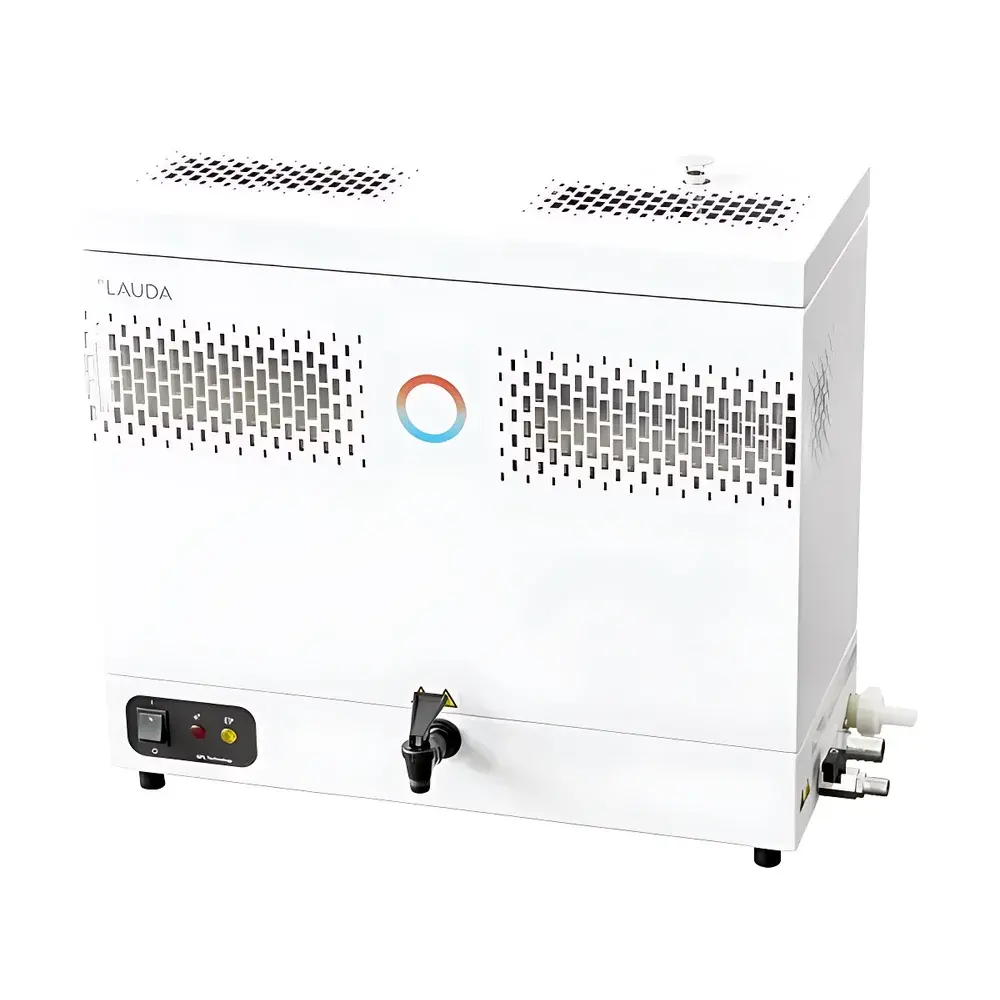
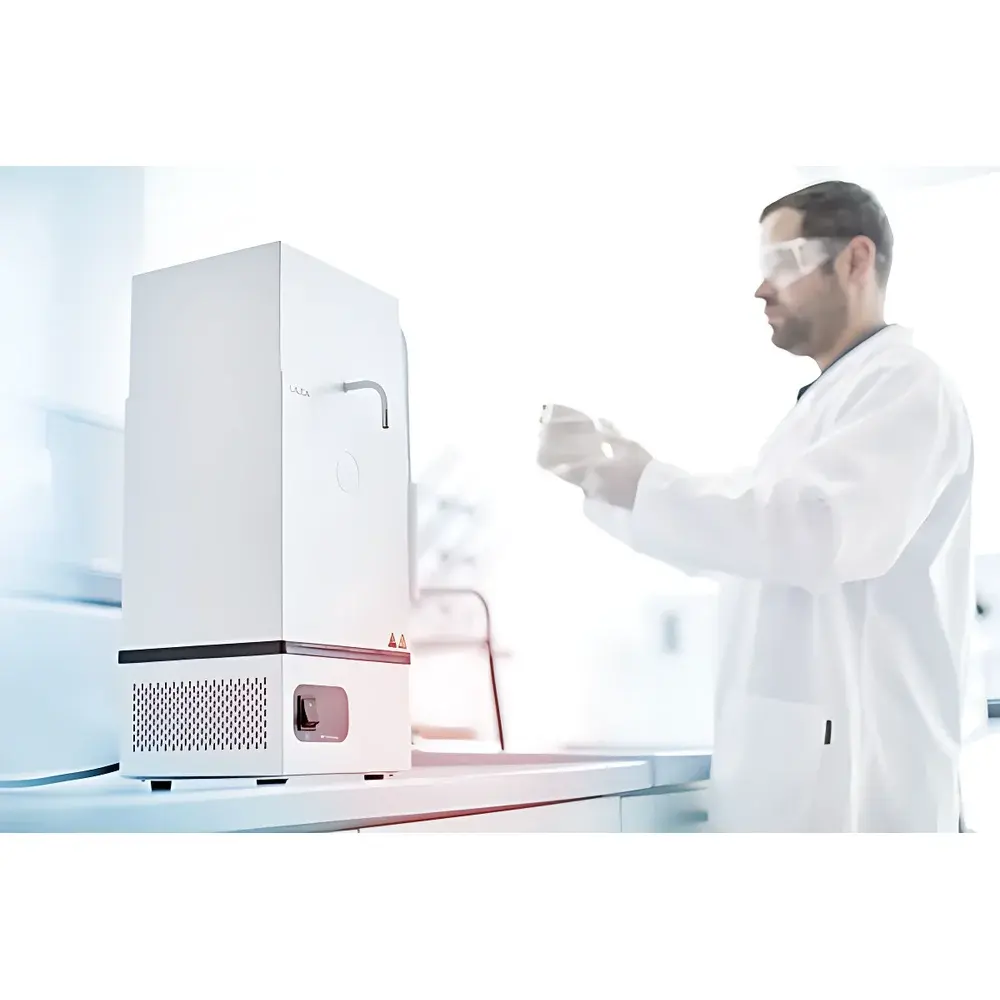
LAUDA Puridest Series Benchtop Distillation Apparatus
| Brand | LAUDA |
|---|---|
| Origin | Germany |
| Construction | Borosilicate Glass (Type I) or Electropolished Stainless Steel 316L |
| Distillation Type | Single-Stage or Dual-Stage |
| Output Rate | 2–12 L/h |
| Feed Water Requirement | Tap water or softened municipal supply |
| Conductivity of Distillate | ≤1.6 µS/cm (at 25 °C) |
| Compliance | DAB 10, Ph. Eur., USP <1231>, JP XVII |
| Sterility & Pyrogen Control | Validated vapor-phase separation and condenser cooling design ensures endotoxin-free, microbiologically controlled output |
| Power Supply | 230 V AC, 50/60 Hz |
| Safety Certifications | CE, UL/CSA listed |
| Dimensions (W×D×H) | Model-dependent |
| Weight | 35–75 kg (varies by configuration) |
Overview
The LAUDA Puridest Series is a line of laboratory-grade benchtop distillation apparatus engineered for the reliable, continuous production of high-purity distilled water from standard municipal or softened feed water. Utilizing time-proven thermal phase-separation principles—boiling, vapor generation, condensation, and collection—the Puridest systems operate on a simple yet robust thermodynamic cycle without reliance on consumable media such as ion-exchange resins, activated carbon filters, or reverse osmosis membranes. Each unit integrates a precisely temperature-controlled boiling chamber, a high-efficiency reflux condenser, and a sterile collection path designed to minimize recontamination. The core architecture supports both single-stage (for general lab use) and dual-stage (for ultra-low conductivity and pyrogen-sensitive applications) configurations. All models are constructed either from Class A borosilicate glass (DIN ISO 3585 compliant) or electropolished stainless steel 316L, ensuring chemical inertness, thermal stability, and long-term resistance to scaling and corrosion.
Key Features
- Media-free operation: Eliminates recurring costs and downtime associated with cartridge replacement, resin regeneration, or membrane cleaning.
- Automated self-cleaning cycle: Integrated boil-dry protection and periodic thermal descaling reduce manual maintenance to annual visual inspection only.
- Modular scalability: Four base platforms support 14 distinct configurations—including vertical/horizontal condenser layouts, integrated storage tanks (5–20 L), and optional UV sterilization modules (254 nm).
- Real-time process monitoring: Digital display shows operating status, accumulated runtime, distillate volume, and temperature setpoint; alarm outputs interface with building management systems via dry-contact relays.
- GFL-certified manufacturing: Built to GFL Technology standards—traceable material certifications, ASME Section VIII Div. 1 pressure vessel compliance (where applicable), and full factory performance validation per ISO 9001:2015.
Sample Compatibility & Compliance
The Puridest system accepts feed water meeting local potable water specifications (e.g., WHO Guidelines, EPA 810-B-02-001). It effectively removes non-volatile contaminants—including heavy metals, silica, nitrates, endotoxins, spores, and viruses—through selective volatilization and physical barrier separation. Distillate quality conforms to pharmacopoeial requirements for purified water: DAB 10 (German Pharmacopoeia), Ph. Eur. 10.0 (European Pharmacopoeia), USP (United States Pharmacopeia), and JP XVII (Japanese Pharmacopoeia). For cell culture, molecular biology, and diagnostic reagent preparation, optional dual-stage units achieve consistent conductivity ≤0.5 µS/cm and endotoxin levels <0.03 EU/mL when operated under validated conditions per ISO 13485 and FDA 21 CFR Part 11-compliant data logging.
Software & Data Management
While the base Puridest models operate via intuitive front-panel controls, optional LAUDA AquaLog™ software enables PC-based supervision, remote start/stop, and audit-trail generation. All digital interfaces comply with ALCOA+ principles (Attributable, Legible, Contemporaneous, Original, Accurate, Complete, Consistent, Enduring, Available). Electronic records include timestamped batch logs, alarm history, and calibration event tracking—fully exportable in CSV or PDF format. Systems equipped with Ethernet or RS-485 ports support integration into centralized laboratory information management systems (LIMS) and meet GLP/GMP documentation requirements for regulated environments.
Applications
- Preparation of buffers, standards, and diluents for HPLC, GC, ICP-MS, and ELISA workflows.
- Feed water for autoclaves, glassware washers, and ultrapure water polishing systems (e.g., as pre-treatment for Type I water generation).
- Cell and tissue culture media formulation where low endotoxin and trace metal content are critical.
- Bacteriological testing, sterility assays, and pharmaceutical QC laboratories requiring pharmacopoeial-grade water.
- Teaching laboratories requiring reproducible, hands-on demonstration of phase-change purification principles.
FAQ
What feed water quality is required?
Municipal tap water or softened water with total hardness <15°dH and free chlorine <1 mg/L is recommended. Pre-filtration (5 µm particulate filter) is advised if sediment or iron content exceeds local utility specifications.
Can Puridest produce water suitable for LC-MS applications?
Not directly: While Puridest distillate meets purified water monographs, LC-MS requires further treatment (e.g., deionization, organic scavenging, and 0.22 µm filtration) to achieve sub-ppt organic and ionic contamination levels.
Is validation support provided?
Yes—LAUDA supplies IQ/OQ documentation templates, installation checklists, and protocol-ready test methods aligned with ISO 14644-1 (cleanroom classification), ASTM D1193 (Type II water), and EU GMP Annex 15.
How often does the glass chamber require cleaning?
Under normal operation with softened feed water, visual inspection every 12 months suffices; automated thermal descaling occurs during each shutdown cycle, preventing scale accumulation.
Does the system require a dedicated drain or ventilation?
No external venting is needed—the condenser uses closed-loop recirculating cooling (integrated chiller optional); drain connection is only required for overflow safety—not continuous discharge.



