
Polymer Char CFC Composition and Fractionation Analyzer
| Brand | Polymer Char |
|---|---|
| Origin | Spain |
| Model | CFC |
| Type | Cross-Fractionation Chromatography System |
| Application | Polyolefin Microstructure Characterization |
Overview
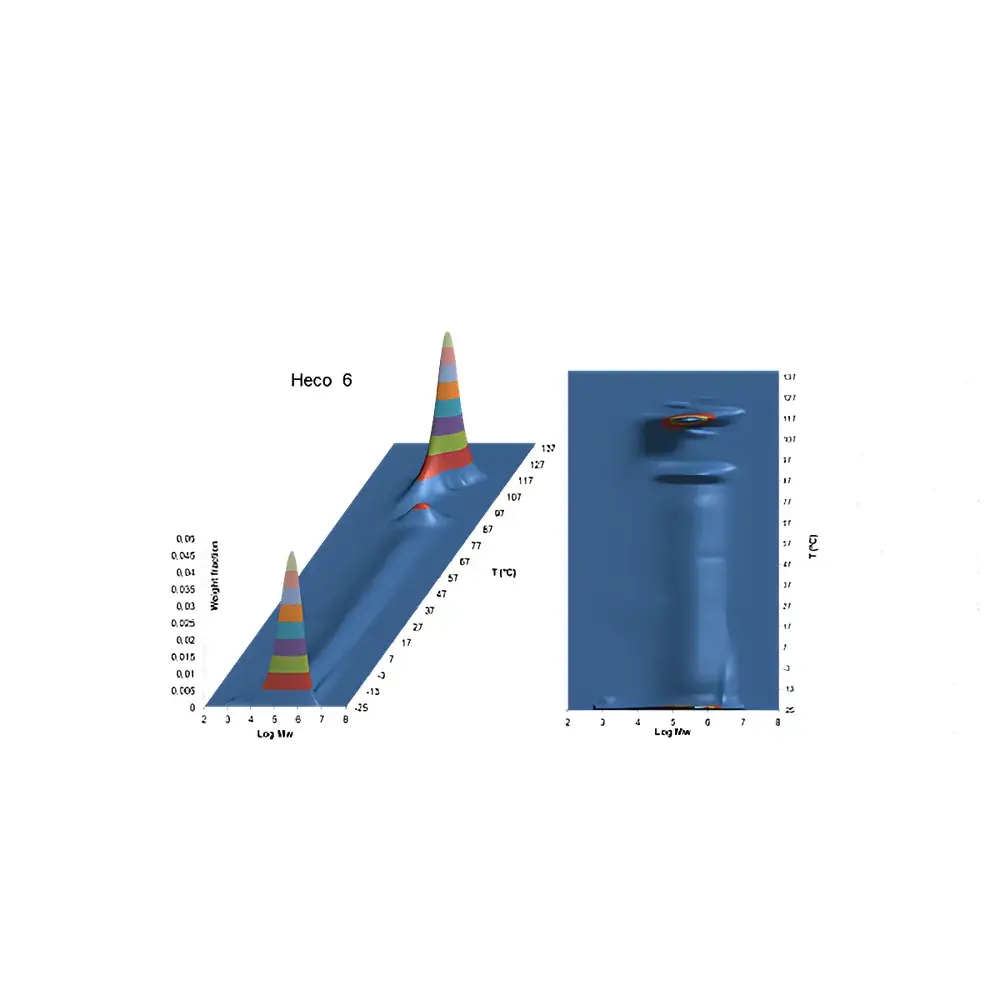
The Polymer Char CFC Composition and Fractionation Analyzer is a high-resolution, two-dimensional liquid chromatography platform engineered for comprehensive microstructural characterization of complex polyolefin blends and copolymers. It integrates temperature rising elution fractionation (TREF) and crystallization analysis fractionation (CRYSTAF) with high-temperature gel permeation chromatography (HT-GPC) in a single automated system, enabling simultaneous separation by both chemical composition distribution (CCD) and molecular weight distribution (MWD). This orthogonal separation principle—based on crystallizability (governed by comonomer content and sequence distribution) and hydrodynamic volume (governed by chain length and branching)—provides unambiguous, quantitative insight into heterogeneity across multiple structural dimensions. Unlike conventional single-dimension techniques, the CFC delivers true 2D contour maps where each pixel represents a unique microstructural “fingerprint,” making it indispensable for R&D labs developing next-generation polyethylene (PE), polypropylene (PP), and ethylene–propylene copolymers with tailored mechanical, thermal, and rheological behavior.
Key Features
- Automated dual-detection workflow: In-line infrared (FTIR) and differential refractometry (DRI) detectors enable real-time, calibration-free quantification of comonomer content (e.g., ethylene in PP, butene in PE) and concentration across all fractions.
- Programmable thermal gradient control: Precise ±0.1 °C temperature stability over 30–140 °C range ensures reproducible crystallization kinetics and elution selectivity for broad-composition polyolefins.
- High-temperature compatibility: Fully stainless-steel fluidic path rated to 160 °C and compatible with 1,2,4-trichlorobenzene (TCB) and o-dichlorobenzene (o-DCB) solvents under inert atmosphere.
- Integrated fraction collection: Optional robotic fraction collector enables offline NMR, DSC, or rheology testing of isolated sub-populations for structure–property correlation studies.
- Modular architecture: Supports field-upgradable modules including high-resolution TREF columns, cryogenic injection systems, and multi-angle light scattering (MALS) coupling for absolute molar mass determination.
Sample Compatibility & Compliance
The CFC system is validated for analysis of all major polyolefin classes—including linear low-density polyethylene (LLDPE), metallocene-catalyzed PE/PP, plastomers, elastomers, and reactor-blend multiphase systems—with sample mass requirements as low as 5 mg per run. All hardware and software comply with ISO 16014-4:2019 (GPC of polymers), ASTM D6474 (TREF of polyolefins), and ASTM D7282 (CRYSTAF of polyolefins). Data acquisition and processing meet ALCOA+ principles for data integrity; audit trails, electronic signatures, and user-access controls are fully configurable to satisfy FDA 21 CFR Part 11 and EU Annex 11 requirements for regulated environments. Method validation packages—including specificity, linearity, precision (intra- and inter-day), and robustness—are available upon request for GLP/GMP-compliant laboratories.
Software & Data Management
ChromaSolve™ CFC Software provides unified control, acquisition, and multidimensional deconvolution. Its proprietary 2D peak-fitting algorithm resolves overlapping populations using constrained non-negative matrix factorization (cNMF), delivering quantitative CCD–MWD co-distributions with statistical confidence intervals. Raw chromatograms, contour plots, and sliced 1D profiles export natively to ASTM E1382-compliant .cdf format. Integrated LIMS connectivity supports automated result transfer to enterprise quality databases. All raw data files are SHA-256 hashed and timestamped; version-controlled method templates ensure analytical consistency across global R&D sites.
Applications
- Root-cause analysis of batch-to-batch property variation in catalytic polyolefin production
- Quantification of short-chain branching (SCB) heterogeneity in LLDPE used for film extrusion
- Differentiation of reactor-grade versus post-reactor blended PP impact copolymers
- Correlation of compositional drift with melt fracture onset in high-speed blow molding
- Supporting patent claims with spatially resolved microstructural evidence in polymer litigation
- Accelerating catalyst screening by mapping CCD breadth vs. MWD skew in single-run catalyst evaluation
FAQ
What solvents are compatible with the CFC system?
TCB (1,2,4-trichlorobenzene) is the primary solvent for high-temperature operation; o-DCB is supported for lower-temperature applications requiring faster dissolution kinetics.
Can the CFC analyze filled or pigmented polyolefins?
Yes—samples containing up to 40 wt% calcium carbonate, talc, or TiO₂ can be analyzed after optimized filtration protocols; particulate removal must occur prior to injection to prevent column clogging.
Is method transfer possible between different CFC instruments?
Yes—chromatographic methods include instrument-specific compensation parameters (e.g., dwell volume, detector lag time); ChromaSolve™ includes a built-in method migration wizard validated per ICH Q5C guidelines.
Does Polymer Char offer application support for new polyolefin chemistries?
Yes—application scientists provide remote method development assistance, including custom calibration standards, reference materials, and SOP documentation aligned with internal QA requirements.





