
Polymer Char HT-GPC System with IR5, Viscometer & Composition Detectors
| Brand | Polymer Char |
|---|---|
| Origin | Spain |
| Model | HT-GPC System for Molecular Weight, Long-Chain Branching (LCB), and Short-Chain Branching (SCB) Distribution Analysis |
| Detection Modes | Infrared (IR5), Differential Viscometry, Composition-Sensitive Detection |
| Temperature Range | Up to 160 °C |
| Solvent Compatibility | 1,2,4-Trichlorobenzene (TCB), ODCB |
| Calibration Standards | Narrow-MWD PE/PP Reference Standards |
| Data Output | Mw, Mn, Mz, Đ, LCB frequency (λ), SCB density (branches/1000C), Branch Length Distribution, Compositional Heterogeneity Index (CHI) |
Overview
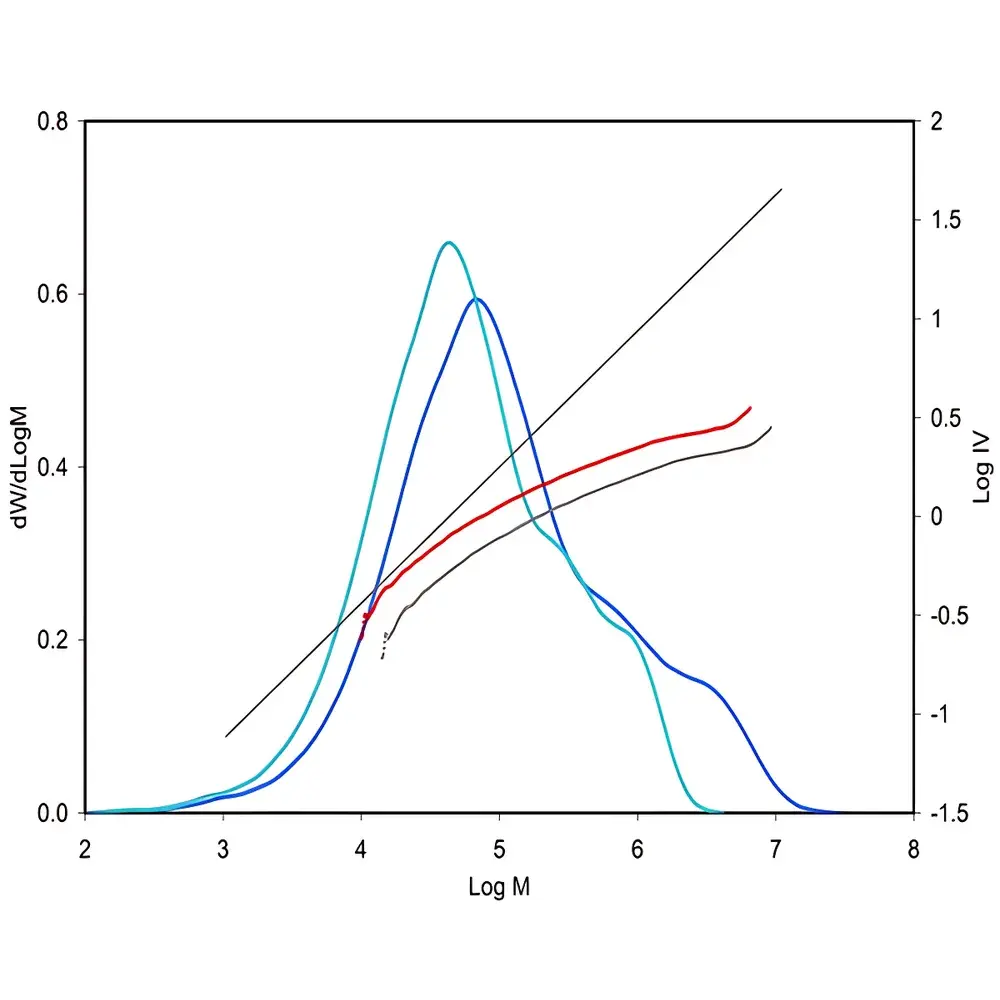
The Polymer Char HT-GPC System is a high-temperature gel permeation chromatography (HT-GPC) platform engineered for comprehensive macromolecular characterization of polyolefins—including polyethylene (PE), polypropylene (PP), and their copolymers—under thermally stable elution conditions. Operating at temperatures up to 160 °C in high-boiling solvents such as 1,2,4-trichlorobenzene (TCB), this system enables true dissolution of high-melting, high-crystallinity, and high-molecular-weight polyolefin samples without degradation or incomplete solvation. Unlike ambient or low-temperature GPC systems, the HT-GPC platform resolves structural heterogeneity across multiple orthogonal dimensions: absolute molecular weight distribution (MWD), long-chain branching (LCB) topology, short-chain branching (SCB) density and distribution, and compositional heterogeneity. These parameters are intrinsically linked to melt rheology—particularly melt strength, strain hardening, and extensional viscosity—and thus constitute essential inputs for process modeling, reactor design, and product performance prediction.
Key Features
- Triple-detection architecture integrating Polymer Char’s IR5 infrared detector (for CH₂/CH₃ ratio quantification), differential viscometer (for intrinsic viscosity [η] and branching-sensitive hydrodynamic volume), and composition-sensitive detector (e.g., FTIR or dual-wavelength UV-Vis for comonomer content mapping)
- High-temperature autosampler and column oven (up to 160 °C) with precise ±0.1 °C thermal stability, ensuring reproducible retention time alignment and detector response
- Chemically inert flow path constructed from Hastelloy and sapphire components, compatible with aggressive chlorinated solvents and elevated temperatures
- Pre-packed, high-resolution mixed-bed SEC columns optimized for polyolefin separation in TCB (e.g., Polymer Char IC-PO series), delivering baseline resolution across Mw = 10³–10⁷ g/mol
- Integrated calibration module supporting universal calibration (via Mark–Houwink parameters) and multi-detector absolute calibration protocols compliant with ISO 16014-4 and ASTM D6474
Sample Compatibility & Compliance
The system accommodates solid granules, pellets, films, and injection-molded specimens—requiring only 5–20 mg per injection after dissolution in hot TCB under nitrogen atmosphere. It supports characterization of linear LDPE, LLDPE, HDPE, metallocene-catalyzed PE/PP, ethylene–octene copolymers, and impact-resistant PP blends. All analytical procedures adhere to internationally recognized standards including ISO 16014 (Gel Permeation Chromatography), ASTM D6474 (Standard Test Method for Determination of Molecular Weight Distribution of Polyolefins by High-Temperature Gel Permeation Chromatography), and ASTM D7282 (Standard Practice for Determination of Long Chain Branching in Polyethylene Using High Temperature GPC). Data acquisition and reporting workflows support audit-ready documentation aligned with GLP and 21 CFR Part 11 requirements when configured with compliant software modules.
Software & Data Management
ChromCal™ software provides unified control, real-time detector synchronization, and automated multi-parameter calculation. It computes absolute molecular weight averages (Mn, Mw, Mz), dispersity (Đ), intrinsic viscosity profiles, LCB frequency (λ, branches per 10,000 carbon atoms), SCB density (branches per 1000 carbon atoms), branch length distribution (via co-elution analysis), and compositional heterogeneity index (CHI). All raw data are stored in vendor-neutral HDF5 format with embedded metadata (sample ID, operator, instrument log, calibration history). Export options include CSV, PDF analytical reports, and direct integration with LIMS via ASTM E1384-compliant interfaces. Audit trails record all parameter modifications, peak integration decisions, and calibration updates—ensuring full traceability for regulatory submissions.
Applications
- Correlating LCB architecture with extensional rheological behavior in blow molding and film blowing processes
- Differentiating reactor-grade resins based on branching topology rather than MWD alone
- Validating catalyst performance (e.g., single-site vs. Ziegler–Natta) through SCB distribution breadth and comonomer incorporation uniformity
- Failure analysis of extrusion instabilities or die swell anomalies via melt elasticity proxies ([η] × Mw)
- Supporting polymer grade development for rotational molding, thermoforming, and pipe extrusion where melt strength governs sag resistance and dimensional stability
FAQ
What distinguishes this HT-GPC system from conventional room-temperature GPC instruments?
Conventional GPC lacks solvent compatibility and thermal stability required for complete polyolefin dissolution; HT-GPC eliminates aggregation artifacts and delivers true solution-state conformation data.
Can the system quantify both long-chain and short-chain branching simultaneously?
Yes—via combined viscometer/IR5/composition detection, enabling decoupled calculation of λ (LCB) and SCB density (e.g., butyl/hexyl/octyl branches per 1000C) without prior fractionation.
Is method transfer possible between different Polymer Char HT-GPC installations?
Yes—standardized column sets, universal calibration protocols, and identical detector response functions ensure inter-laboratory reproducibility within ±3% for Mw and ±0.05 branches/1000C for SCB density.
Does the system support regulatory submissions for pharmaceutical or medical device polymers?
When deployed with 21 CFR Part 11-compliant software configuration and validated SOPs, it meets analytical method validation requirements per ICH Q5E and USP .
How is column fouling mitigated during extended polyolefin analysis?
The system includes an in-line filtration module (0.2 µm PTFE), solvent pre-purge cycles, and automated column backflush routines—extending column lifetime beyond 500 injections under routine use.




