
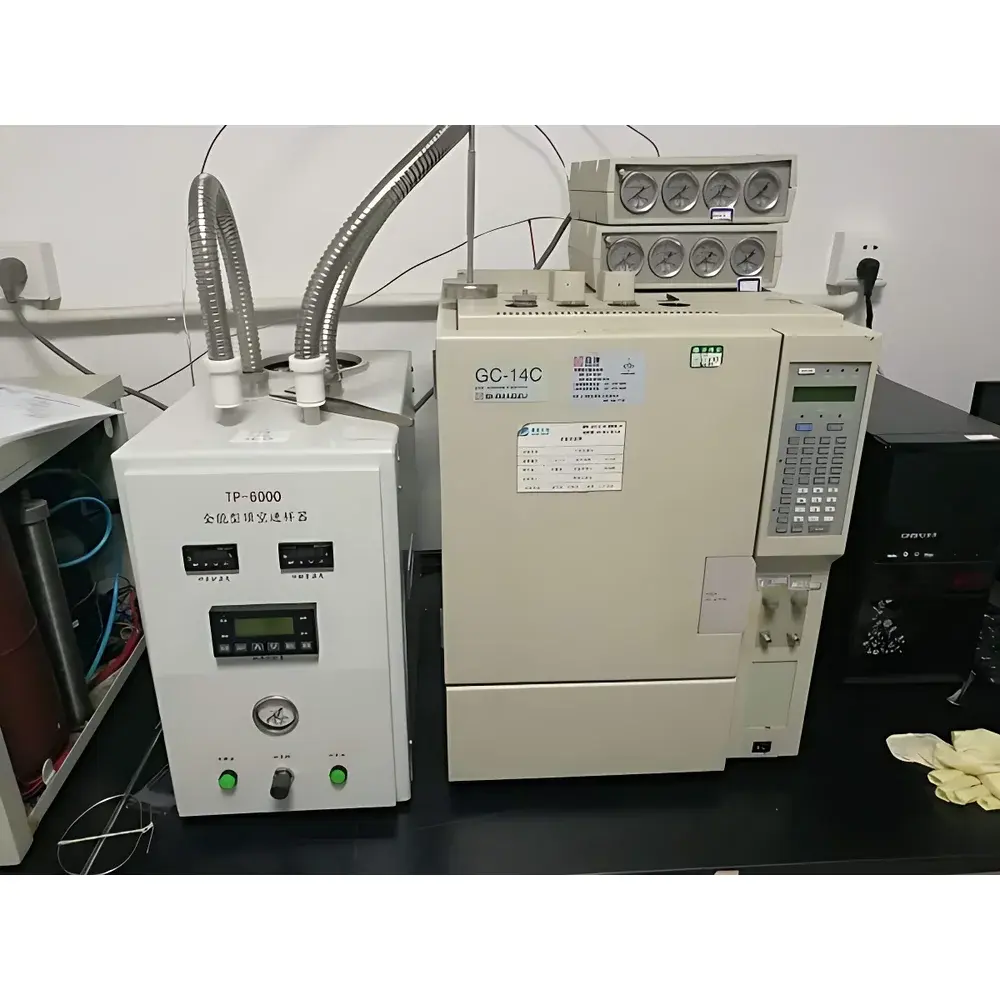
Shimadzu GC-14C Used Gas Chromatograph
| Brand | Shimadzu |
|---|---|
| Origin | Japan |
| Model | GC-14C |
| Instrument Type | Laboratory Gas Chromatograph |
| Application Field | General-Purpose |
| Temperature Control Range | Ambient + 4 °C to 450 °C |
| Oven Ramp Rate | 0.1–40 °C/min |
| Oven Cool-Down | 450 °C to 50 °C in ≤6 min |
| Carrier Gas Pressure Range | 0–970 kPa |
| Carrier Gas Flow Range | 0–1200 mL/min |
| Injector Maximum Temperature | 450 °C |
| Injector Pressure Setting Range | 0–970 kPa |
| Injector Total Flow Setting Range | 0–1200 mL/min |
Overview
The Shimadzu GC-14C is a robust, benchtop gas chromatograph originally engineered for routine and method-developed separations in industrial QC laboratories, environmental testing facilities, and academic research settings. Built upon Shimadzu’s proven dual-beam thermal conductivity detector (TCD) and flame ionization detector (FID) architecture—common across the GC-14 series—the instrument employs packed and capillary column configurations with precise oven temperature programming, pressure-controlled carrier gas delivery, and reproducible split/splitless injection. Its modular design supports both manual and automated sample introduction via standard 10.5 mm OD glass liners and compatible syringe-based injectors. Though discontinued from new production, the GC-14C remains widely deployed globally due to its mechanical reliability, straightforward pneumatic control logic, and compatibility with legacy Shimadzu Class-GC software (v3.x) and third-party data systems via analog output or RS-232 interface.
Key Features
- Temperature-programmable oven with ±0.1 °C stability over full range (ambient + 4 °C to 450 °C), supporting multi-step ramping and isothermal holds
- High-resolution temperature ramp control (0.1–40 °C/min) and rapid cool-down capability (450 °C → 50 °C in ≤6 minutes), enabling high-throughput batch analysis
- Independent, digitally regulated pressure and flow control for carrier gas (N2, He, H2) across 0–970 kPa and 0–1200 mL/min ranges
- Injector capable of operation up to 450 °C with adjustable pressure and total flow settings—optimized for volatile organic compound (VOC) analysis and residual solvent quantification
- Dual-detector support: configurable TCD for universal detection or FID for hydrocarbon-selective response with sub-ppm sensitivity
- Front-panel keypad navigation and LCD display for real-time parameter monitoring; no embedded PC required for basic operation
Sample Compatibility & Compliance
The GC-14C accommodates standard 1/8″ and 1/4″ packed columns (e.g., Porapak Q, Chromosorb 101) as well as fused-silica capillary columns (0.2–0.53 mm ID) using appropriate adapters. It meets fundamental performance criteria outlined in ASTM D3606 (benzene/toluene in gasoline), EPA Method 8021B (halogenated organics), and USP for system suitability testing when operated under validated conditions. While not pre-certified for 21 CFR Part 11 compliance, its analog signal outputs and time-stamped run logs can be integrated into compliant LIMS environments with appropriate audit trail documentation and procedural controls per GLP/GMP requirements.
Software & Data Management
Data acquisition and reporting are supported via Shimadzu’s Class-GC software (Windows XP–7 compatible), offering peak integration, calibration curve generation, and report export in CSV/PDF formats. Raw chromatograms are stored as binary .DAT files; conversion utilities allow migration to modern platforms. For laboratories requiring electronic records integrity, the GC-14C may be interfaced with validated third-party chromatography data systems (CDS) that provide full 21 CFR Part 11 functionality—including user authentication, electronic signatures, and change history tracking—when paired with external analog-to-digital converters and secure network architecture.
Applications
- Residual solvent analysis in pharmaceutical intermediates per ICH Q3C guidelines
- VOC profiling in indoor air, soil headspace, and water purge-and-trap extracts
- Fatty acid methyl ester (FAME) analysis in biodiesel feedstocks and finished fuels
- Hydrocarbon group-type analysis (PIONA) in petroleum fractions
- Quality control of monomers, polymers, and specialty chemicals in R&D and manufacturing
- Educational training in separation science principles, retention indexing, and detector response characterization
FAQ
Is the GC-14C compatible with modern operating systems such as Windows 10 or 11?
No—Class-GC v3.x requires Windows XP SP3 or Windows 7 (32-bit). Operation on newer OS versions necessitates virtual machine emulation or hardware abstraction via USB-to-serial adapters and custom driver configuration.
Can capillary columns be used without modification?
Yes—capillary operation is supported with optional split/splitless injector kits and appropriate column nuts/ferrules. Column installation follows standard Agilent/SGE mechanical specifications.
What maintenance is critical prior to deployment?
Recommended refurbishment includes replacement of septa, O-rings, and liner; verification of detector baseline stability and flame ignition consistency (for FID); and recalibration of oven temperature sensors and pressure transducers against NIST-traceable references.
Does the unit include a detector?
Configuration varies—most units ship with either FID or TCD; some include both. Detector type and condition must be verified during pre-purchase inspection.
Is service documentation available?
Original Shimadzu service manuals (SM-GC14C-01, SM-GC14C-02) and parts catalogs are publicly archived and remain accessible through technical libraries and instrument reseller networks.






