
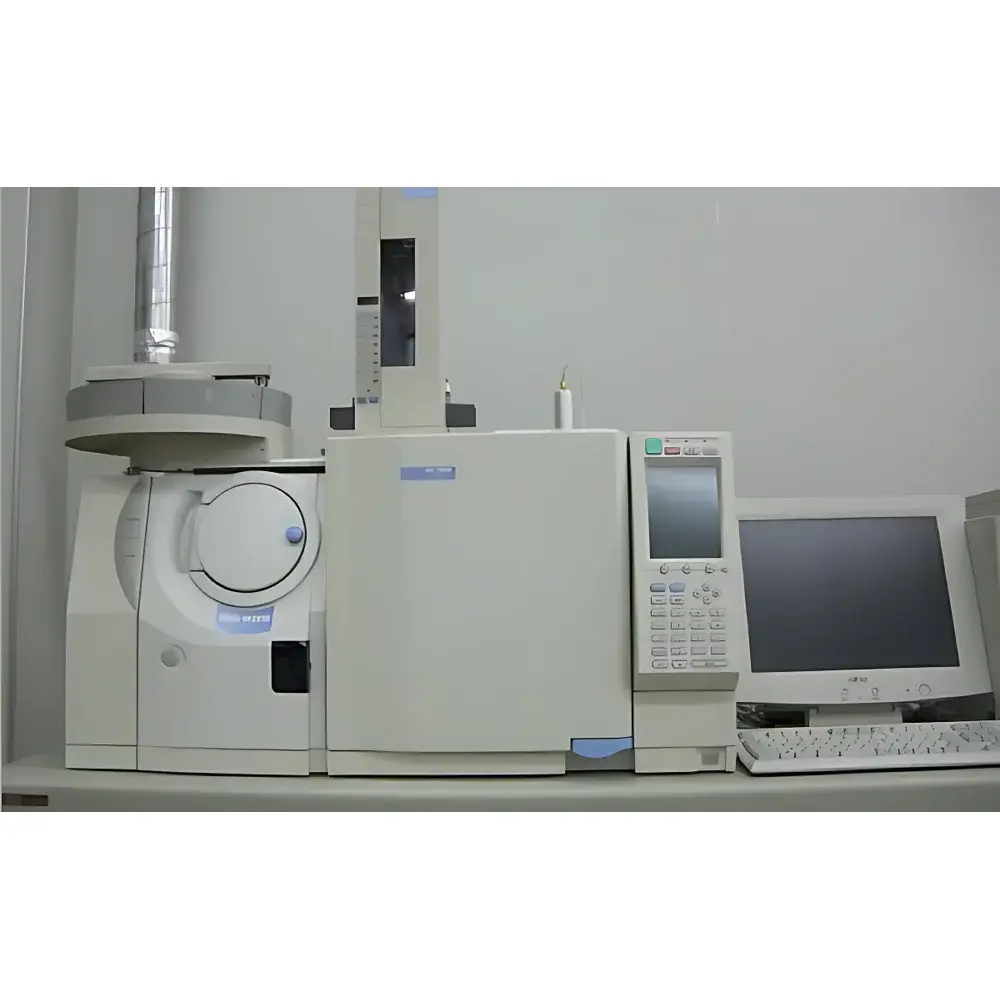
Shimadzu GCMS-QP2010SE Used Gas Chromatography Mass Spectrometry System
| Brand | Shimadzu |
|---|---|
| Origin | Japan |
| Model | QP2010SE |
| Instrument Type | Quadrupole GC-MS (not Orbitrap) |
| GC Type | Conventional Capillary GC-MS |
| Mass Range | m/z 1–1000 |
| Resolution | 1000–2000 (unit mass resolution at peak top) |
| Sensitivity | >300:1 (S/N, full-scan, 1 pg OFN) |
| Scan Speed | 15,000 u/s |
| Column Flow Capacity | Up to 4 mL/min He or N₂ |
| Ionization Mode | EI (electron ionization), optional CI |
| Detector | Electron multiplier |
| Data System | GCMSsolution v2.x or later |
Overview
The Shimadzu GCMS-QP2010SE is a robust, second-generation quadrupole-based gas chromatography mass spectrometry (GC-MS) system engineered for routine qualitative and quantitative analysis in environmental, pharmaceutical, food safety, and forensic laboratories. Unlike high-resolution Orbitrap or TOF platforms, the QP2010SE employs a temperature-stabilized, double-focusing quadrupole mass analyzer with electron ionization (EI) source—optimized for reproducible unit-mass resolution, high scan speed, and stable long-term performance under regulated QC/QA workflows. Its architecture integrates a dedicated GC oven with precise temperature ramp control (0.01 °C increments), a split/splitless injector, and a vacuum system featuring dual-stage rotary pump and turbo molecular pump (67 L/s), ensuring rapid pump-down (<90 s to 1×10⁻⁵ Pa) and stable operation during extended batch runs. The system is fully compliant with ISO/IEC 17025 method validation requirements and supports audit-ready data acquisition aligned with FDA 21 CFR Part 11 when configured with GCMSsolution’s electronic signature and audit trail modules.
Key Features
- Enhanced column flow capacity up to 4.0 mL/min (He or N₂), enabling broader compatibility with wide-bore, PLOT, and thick-film capillary columns—critical for high-boiling-point analytes and complex matrices.
- Backward-compatible method migration from GCMS-QP5000 series instruments, minimizing revalidation effort during lab upgrades or instrument replacement cycles.
- Integrated direct insertion probe (optional accessory) for rapid thermal desorption and EI-MS analysis of non-volatile, thermally labile, or high-molecular-weight compounds without prior derivatization or GC separation.
- Eco Mode functionality—automatically engages during idle periods or after batch completion—reducing filament power, detector voltage, and vacuum pump speed by up to 40% while maintaining system readiness; validated to cut annual helium consumption by ~18% and electrical load by ~22% in 24/7 operation scenarios.
- Dedicated EI source with adjustable emission current (10–300 µA), dual-lens ion optics, and automatic tune optimization routines ensuring consistent sensitivity across multi-day sequences.
Sample Compatibility & Compliance
The GCMS-QP2010SE accommodates liquid, solid, and gaseous samples via standard autosampler (AOC-20i/s), headspace (HS-20), or thermal desorption (TD-20) interfaces. It supports EPA Methods 8270D, 8260C, and 524.2 for semi-volatile and volatile organic compound (VOC) analysis; ASTM D5845 for gasoline oxygenates; and USP for residual solvent testing. All hardware and software components meet CE marking requirements per Directive 2014/30/EU (EMC) and 2014/35/EU (LVD). When operated with GCMSsolution v2.71+ and enabled audit trail, the system satisfies GLP/GMP data integrity expectations including secure user authentication, electronic signatures, and immutable raw data storage.
Software & Data Management
GCMSsolution software provides intuitive method building, real-time spectral monitoring, and automated library search against NIST MS Search 2.3g, Wiley Registry 11th Edition, and user-defined libraries. Peak integration uses adaptive baseline algorithms compliant with ASTM E260-18. Quantitative workflows support internal standard calibration, surrogate recovery correction, and multi-level calibration curves with weighting options (1/x, 1/x²). Raw data files (.qgd) are stored in vendor-neutral formats (mzXML export supported) and retain full metadata—including instrument configuration, tune parameters, and acquisition timestamps—for traceability in regulatory submissions.
Applications
- Environmental: Screening of PAHs, PCBs, organochlorine pesticides, and phthalates in soil, water, and air particulates.
- Pharmaceutical: Residual solvent profiling per ICH Q3C guidelines; extractables/leachables identification from packaging materials.
- Food & Agriculture: Mycotoxin confirmation (e.g., aflatoxins B₁/B₂/G₁/G₂), pesticide multiresidue analysis, and flavor compound profiling.
- Forensics: Drug metabolite identification in biological fluids; ignitable liquid residue (ILR) classification per ASTM E1618.
- Academic Research: Reaction monitoring, natural product dereplication, and small-molecule structural elucidation via EI spectral interpretation.
FAQ
Is the QP2010SE compatible with modern LIMS and ELN systems?
Yes—via ODBC-compliant database export (SQL Server, Oracle) and ASCII-based report templates supporting ASTM E1957 data exchange standards.
What maintenance intervals are recommended for optimal performance?
Source cleaning every 3 months (or after 500 injections), quadrupole bake-out quarterly, and turbomolecular pump oil replacement annually—per Shimadzu PM Guide Rev. 4.2.
Can this used system be validated for GxP use?
Yes—provided it undergoes full IQ/OQ/PQ per ASTM E2500-13, includes documented calibration history, and is installed with verified firmware (v3.50 or later) and GCMSsolution v2.80+.
Does Eco Mode affect analytical performance or data quality?
No—Eco Mode only modulates standby power and vacuum levels; all acquisition parameters (scan rate, dwell time, EM voltage) remain unchanged during active data collection.
Is NIST library licensing included with the system?
The base NIST MS Search engine is bundled; full NIST Chemistry WebBook access and updated spectral libraries require separate subscription through NIST or authorized resellers.
Related Products





