
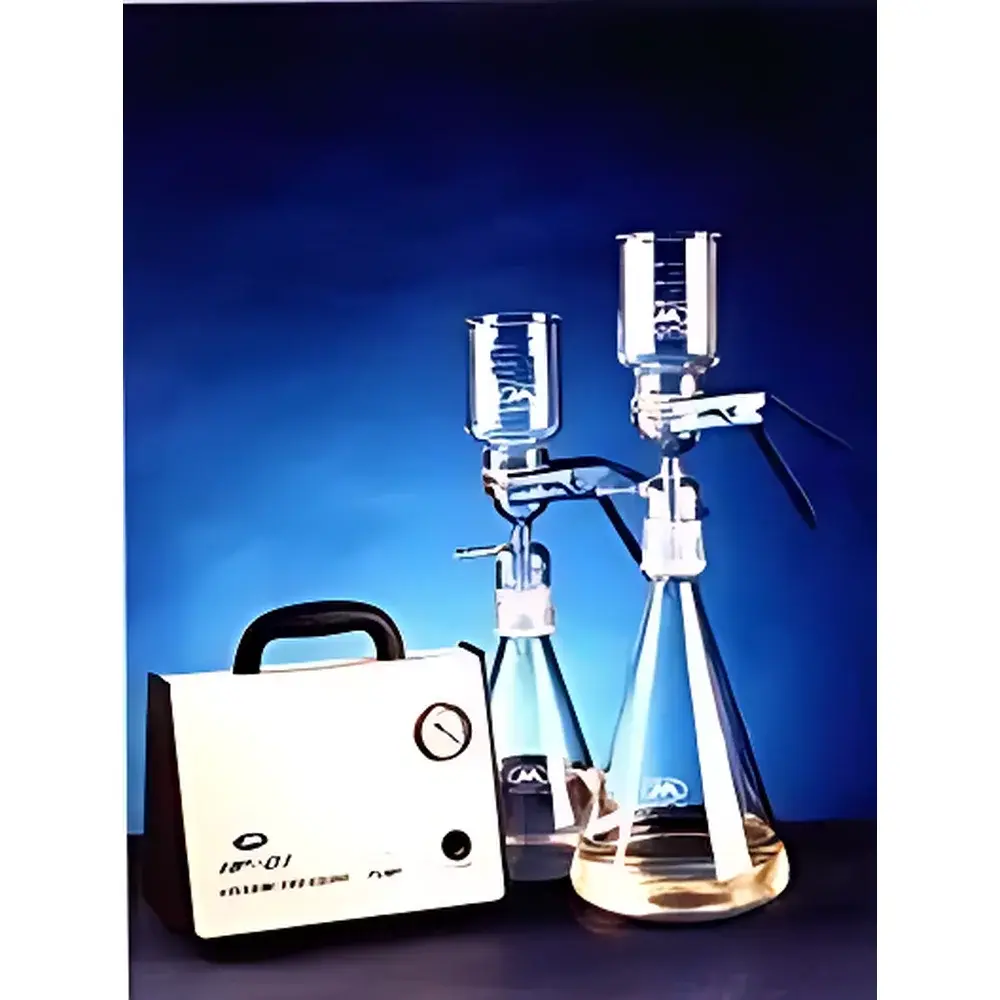
GM-0.50 Dual-Mode Diaphragm Vacuum Pump
| Origin | Tianjin, China |
|---|---|
| Manufacturer Type | Authorized Distributor |
| Origin Category | Domestic (China) |
| Model | GM-0.50 |
| Instrument Type | Circulating Water-Free Vacuum Pump |
| Product Type | Oil-Free Diaphragm Pump |
| Flow Rate | 30 L/min |
| Ultimate Vacuum Pressure | ≤ −0.08 MPa (≤ −80 kPa) |
| Positive Pressure Output | ≥ 0.03 MPa (≥ 30 psi) |
| Noise Level | < 55 dB(A) |
| Inlet/Outlet Port Diameter | Ø6 mm |
| Dimensions (W×D×H) | 215 × 165 × 270 mm |
| Motor Power | 120 W, Single-Phase |
| Operating Temperature Range | 7–40 °C |
| Weight | 8 kg |
| Cooling | Integrated Self-Cooling Exhaust System |
| Membrane Material | Fluoroelastomer (FKM) |
| Bearing | Imported High-Precision Ball Bearings |
| Compliance | CE-marked design principles |
Overview
The GM-0.50 Dual-Mode Diaphragm Vacuum Pump is an oil-free, maintenance-optimized laboratory vacuum system engineered for precision filtration, solvent evaporation, vacuum drying, and inert gas purging applications. Unlike rotary vane or water aspirator pumps, this unit operates on a positive-displacement diaphragm principle—utilizing a fluorocarbon elastomer (FKM) membrane actuated by an eccentric cam mechanism to generate vacuum without lubricants, hydrocarbons, or vapor backstreaming. Its dual-mode architecture enables seamless switching between negative pressure (vacuum) and positive pressure (blower) operation, making it suitable for both suction-based processes (e.g., Büchner funnel filtration, SPE cartridge conditioning) and pressure-driven tasks (e.g., sample transfer, membrane pressurization, or controlled inert gas displacement). Designed for continuous-duty operation under ambient conditions (7–40 °C), the pump maintains thermal stability via an integrated self-cooling exhaust pathway that dissipates heat generated during prolonged cycles—ensuring consistent performance over 24-hour unattended operation.
Key Features
- Oil-free, contaminant-free operation: No lubricating oil required; eliminates risk of sample cross-contamination, hydrocarbon carryover, or downstream condensation—critical for HPLC sample prep, pharmaceutical QA/QC, and analytical chemistry workflows.
- Dual-mode functionality: Independently selectable vacuum (−0.08 MPa) and positive pressure (≥0.03 MPa) modes via external valve configuration—enabling one instrument to support both filtration and pressurized delivery protocols.
- FKM diaphragm technology: Chemically resistant fluoroelastomer membrane withstands exposure to organic solvents (e.g., acetone, ethanol, dichloromethane), acids, and bases—extending service life and reducing replacement frequency in aggressive chemical environments.
- Low-noise, low-vibration architecture: Precision-machined housing, imported high-tolerance ball bearings, and balanced cam drive reduce operational noise to <55 dB(A) and mechanical resonance—ideal for shared lab spaces and noise-sensitive instrumentation suites.
- Compact footprint & portability: Weighing only 8 kg with dimensions of 215 × 165 × 270 mm, the unit integrates easily onto benchtops, fume hoods, or mobile carts without requiring dedicated utility infrastructure.
- Adjustable pressure regulation: Built-in pressure control allows fine-tuning of vacuum level across the operational range—supporting delicate filtration of fragile biological membranes or controlled evaporation of thermolabile compounds.
Sample Compatibility & Compliance
The GM-0.50 is routinely deployed in applications demanding ISO 15195:2018-compliant calibration traceability for vacuum measurement and ASTM D86–22–approved distillation support systems. Its oil-free construction aligns with USP and requirements for sterile compounding environments where hydrocarbon-free air supply is mandated. The internal particulate filter (standard-fitted in the gas exchange chamber) retains sub-5 µm airborne contaminants, ensuring clean exhaust air when used in biosafety cabinets or laminar flow hoods. While not intrinsically rated for hazardous location use (e.g., ATEX or IECEx), its Class II, Division 1 electrical rating and non-sparking diaphragm drive make it suitable for general-purpose laboratories handling non-explosive vapors. All materials contacting process gas meet FDA 21 CFR Part 177.2600 compliance for indirect food contact.
Software & Data Management
This analog-controlled vacuum pump does not incorporate embedded digital interfaces or firmware. However, it is fully compatible with third-party data acquisition systems via optional analog voltage output modules (0–5 V or 4–20 mA) for real-time vacuum/pressure logging. When integrated into GLP- or GMP-regulated environments, users may pair the GM-0.50 with validated pressure transducers and electronic recorders to satisfy 21 CFR Part 11 audit trail requirements—including user attribution, timestamped event logs, and change history for critical parameters such as operating duration and pressure setpoints. Calibration certificates for attached gauges (included: dual analog vacuum/positive pressure meters) are provided with NIST-traceable documentation upon request.
Applications
- Routine vacuum filtration using Büchner or Hirsch funnels in academic teaching labs and R&D settings
- Solid-phase extraction (SPE) manifold operation under controlled negative pressure
- Rotary evaporation auxiliary vacuum source for low-boiling-point solvent removal
- Vacuum desiccation of hygroscopic standards and reference materials
- Positive-pressure purging of GC autosampler vials or FTIR sample cells
- Gas-phase sample introduction in elemental analysis (e.g., mercury cold vapor generation)
- Controlled atmosphere chamber preconditioning prior to material testing per ASTM E104 or ISO 6270
FAQ
Is the GM-0.50 certified for use in cleanrooms or ISO Class 5 environments?
No—while its oil-free operation and internal filtration minimize particulate emission, it lacks HEPA-grade exhaust filtration or ISO 14644-1 certification. It may be used upstream of certified cleanroom systems but not inside classified zones without supplemental air treatment.
Can this pump handle corrosive gases such as chlorine or hydrogen sulfide?
Not recommended. Although the FKM diaphragm resists many organics and mild acids, continuous exposure to strong oxidizers or sulfur-containing compounds accelerates membrane degradation. For such applications, stainless-steel-bodied pumps with PTFE-coated components are advised.
What maintenance intervals are recommended for routine operation?
Under normal lab use (≤8 hrs/day), inspect the diaphragm and inlet filter every 6 months; replace the FKM membrane every 12–18 months depending on duty cycle and chemical exposure profile. Bearings require no scheduled lubrication due to sealed, pre-greased construction.
Does the pump include overload or thermal protection?
Yes—the motor incorporates a bimetallic thermal cut-off switch that interrupts power if internal temperature exceeds 60 °C, preventing coil damage during extended operation or blocked exhaust conditions.
Are replacement diaphragms and filters available as spare parts?
Yes—original-specification FKM diaphragms (Part #GM-DIA-050), inlet particulate filters (Part #GM-FIL-050), and calibrated pressure gauges are stocked and shipped globally with full technical documentation and RoHS/REACH declarations.
Related Products



