
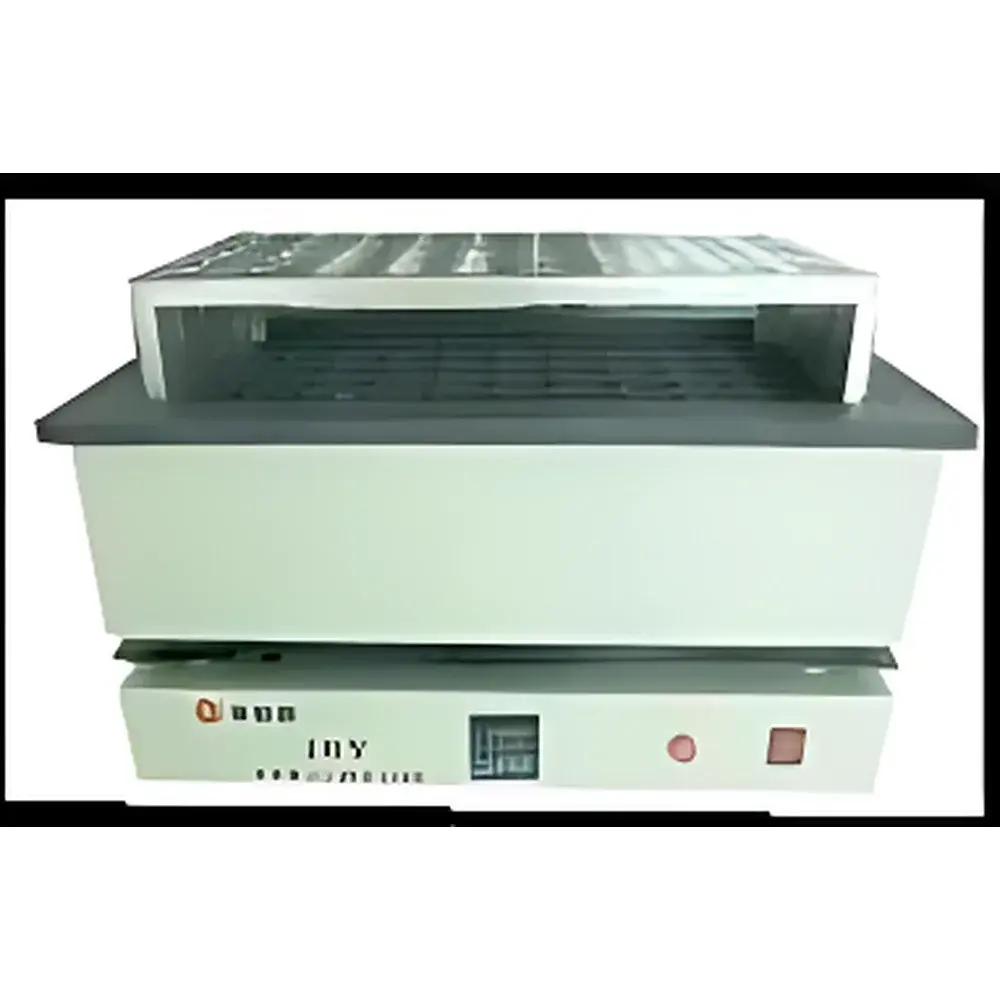
JRY X350-18 Smart Graphite Block Digestion System
| Brand | JRY |
|---|---|
| Origin | Hunan, China |
| Manufacturer Type | Direct Manufacturer |
| Country of Origin | China |
| Model | JRY-X350-18 |
| Rated Power | 4000 W |
| Max Temperature | 350 °C |
| Temp. Accuracy | ±1 °C |
| Sample Capacity | 18 × Ø58 mm × H30 mm vessels |
| Heating Zone Dimensions | 585 mm × 350 mm |
| Weight | 20 kg |
| Voltage/Frequency | 220 V / 50 Hz |
| Control Method | Digital PID Temperature Control with Real-Time Display |
| Construction Material | High-Purity Graphite Block with Acid- and Alkali-Resistant Coating |
| Application Scope | Soil, Food, Biological Tissues, Agricultural Products, Wastewater Sludge, Cosmetics, Clinical Specimens |
Overview
The JRY X350-18 Smart Graphite Block Digestion System is a precision-engineered laboratory digestion platform designed for open-vessel, conductive heating-based sample preparation in accordance with standardized wet digestion protocols. Unlike microwave-assisted digestion systems that rely on dielectric heating, this instrument utilizes high-thermal-mass graphite blocks to deliver uniform, controllable, and reproducible conductive heating across all sample positions—ensuring consistent thermal transfer to digestion vessels (e.g., quartz, PTFE, or borosilicate glass). Its operational range from ambient temperature up to 350 °C enables complete mineralization of complex organic matrices including soil humic substances, plant tissues (e.g., tea leaves), protein-rich biological samples, and wastewater sludge. The system serves as a robust alternative—or complementary tool—to microwave digestion workflows, particularly where post-microwave acid evaporation (“acid-out”) or extended low-temperature charring steps are required prior to ICP-OES, ICP-MS, AAS, or colorimetric analysis.
Key Features
- Uniform Surrounding Heating Architecture: Integrated graphite block with embedded high-wattage heating elements ensures radial and axial thermal homogeneity across the entire 585 mm × 350 mm surface—minimizing inter-vessel temperature deviation to ≤±1 °C at setpoint.
- Precision Digital PID Temperature Control: Microprocessor-driven control loop with real-time digital display provides stable thermal regulation, programmable ramp/soak profiles, and automatic over-temperature cutoff for GLP-compliant operation.
- Chemically Inert Graphite Platform: Surface-coated high-purity graphite resists corrosion from concentrated HNO₃, HCl, HF, H₂SO₄, and aqua regia—validated per ASTM D5673 for acid digestion vessel compatibility and long-term structural integrity.
- Optimized Sample Throughput Design: Accommodates 18 standard Ø58 mm × 30 mm digestion tubes—compatible with common EPA Method 3050B, ISO 11466, and GB/T 17134 digestion vessels—enabling parallel processing without cross-contamination risk.
- Ergonomic & Service-Oriented Engineering: Reinforced stainless-steel chassis, low-profile footprint (585 × 350 × 220 mm), front-access ventilation ducts, and tool-free maintenance access reduce lab space demand and extend service intervals.
- Energy-Efficient Thermal Management: Graphite’s high specific heat capacity (0.71 J/g·K) and low thermal conductivity (119 W/m·K) enable rapid heat retention and reduced power cycling—achieving >85% thermal efficiency vs. conventional ceramic or metal-block digesters.
Sample Compatibility & Compliance
The JRY X350-18 supports digestion of solid and semi-solid matrices compliant with major regulatory frameworks: EPA SW-846 Methods 3050B (acid digestion of sediments and soils), 3051A (microwave-assisted, but compatible with post-digestion evaporation), and 3015A (total recoverable metals); ISO 11466 (heavy metals in soils); and Chinese national standards GB/T 17134 (arsenic in soil) and GB 5009.12 (lead in food). It is routinely deployed in accredited environmental testing labs (CNAS-CL01), food safety QA/QC departments, and public health laboratories conducting surveillance per WHO/FAO Joint Expert Committee on Food Additives (JECFA) guidelines. The system meets electrical safety requirements per IEC 61010-1 and carries CE marking for laboratory equipment.
Software & Data Management
While the base model operates via standalone digital controller, optional RS-485/Modbus RTU interface enables integration into LIMS environments (e.g., LabWare, Thermo Fisher SampleManager) for automated data logging. Time-stamped temperature profiles—including ramp rate, hold duration, and final soak stability—are exportable as CSV for audit trails. When used in regulated settings (e.g., FDA-regulated clinical labs or GMP-compliant contract research organizations), the system supports 21 CFR Part 11–compliant electronic records when paired with validated third-party SCADA software—providing user authentication, audit trail generation, and electronic signature capability.
Applications
- Soil and sediment analysis for total As, Cd, Cr, Cu, Ni, Pb, and Zn per EPA 3050B
- Digestion of tea, cereals, and animal feed for nutritional mineral profiling (Ca, Mg, Fe, Zn)
- Protein hydrolysis and collagen digestion prior to amino acid analysis
- Acid evaporation (“acid-out”) following microwave digestion to remove residual HNO₃/HF before ICP dilution
- Pre-concentration of trace metals from wastewater influent/effluent per ISO 15587-2
- Decomposition of cosmetic matrices (e.g., creams, powders) for heavy metal screening under EU Cosmetics Regulation (EC No 1223/2009)
FAQ
Is the graphite block resistant to hydrofluoric acid (HF)?
Yes—the surface coating has been tested per ASTM C724 for resistance to 40% HF at 150 °C for ≥2 hours without visible etching or mass loss.
Can this system be used for closed-vessel digestion?
No—it is designed exclusively for open-vessel digestion; closed-vessel applications require pressure-rated microwave or hot-block systems meeting ISO 17025 mechanical safety criteria.
What calibration documentation is provided?
Each unit ships with a factory-verified NIST-traceable temperature calibration certificate (at 100 °C, 200 °C, and 300 °C), valid for 12 months.
Does it support programmable multi-step temperature ramps?
Yes—the PID controller allows up to 3 independent ramp-and-hold segments with adjustable rates (0.1–10 °C/min) and dwell times (1–999 min).
How often does the graphite block require replacement?
Under routine use (≤4 h/day, ≤350 °C), the block maintains dimensional stability and thermal uniformity for ≥5 years; annual visual inspection for micro-cracking is recommended per manufacturer’s maintenance protocol.



