
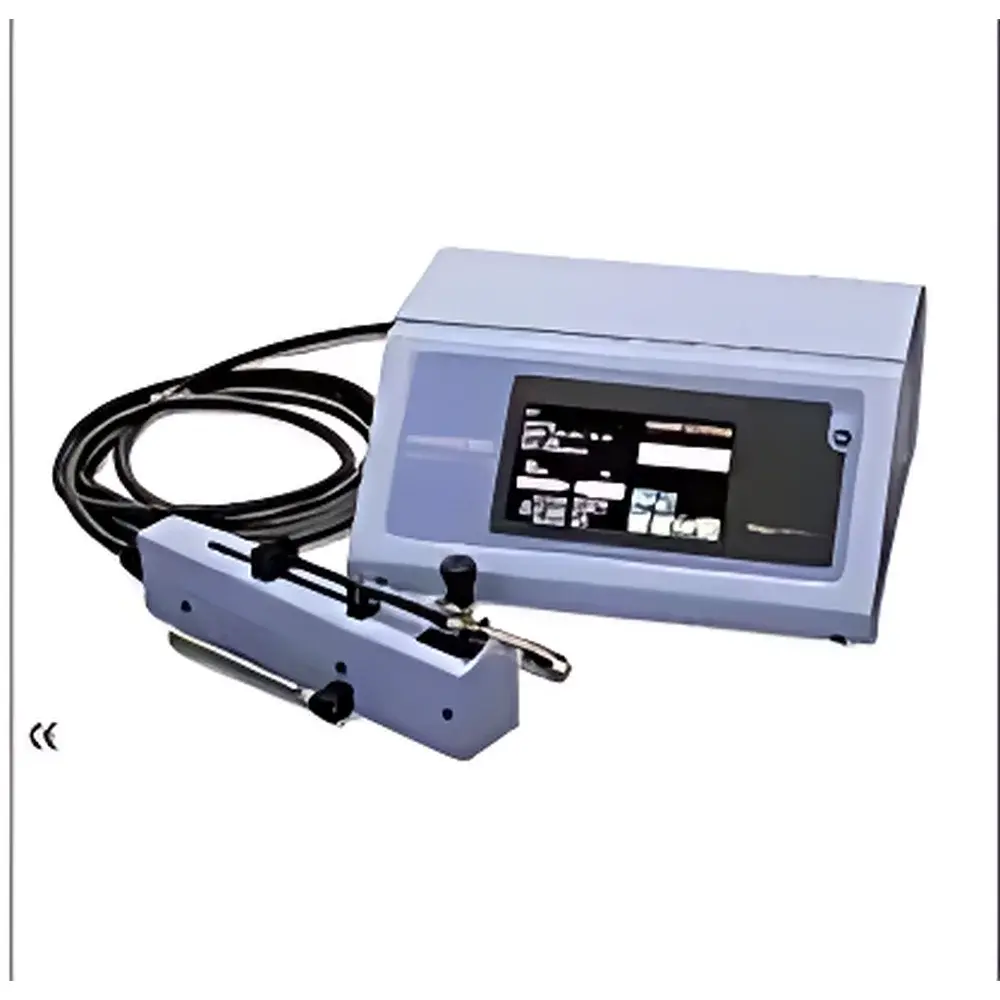
Harvard Apparatus PUMP 11 ELITE Nanomite Microprocessor-Driven Syringe Pump
| Brand | Harvard Apparatus |
|---|---|
| Origin | USA |
| Model | PUMP 11 ELITE Nanomite |
| Injection/Withdrawal Accuracy | ±0.5% |
| Repeatability | ±0.05% |
| Syringe Volume Range | 0.5 µL – 1 mL |
| Flow Rate Range | 3.66 pL/min – 3.818 mL/min |
| Motor Step Resolution | 0.198 µm/step |
| Linear Force | 5 kg (11 lbs) |
| Display | 4.3" WQVGA TFT color touchscreen |
| Connectivity | RS-232, USB, TTL footswitch, RS-485, IEEE-1394, 15-pin D-Sub, mini phono jack |
| Power Input | 12–30 VDC / 100–240 VAC, 50/60 Hz, 8 W |
| Dimensions (Controller) | 22.6 × 17.78 × 15 cm |
| Weight | 1.96 kg |
| Compliance | CE, ETL (UL/CSA), WEEE, EU RoHS, CB Scheme |
Overview
The Harvard Apparatus PUMP 11 ELITE Nanomite is a microprocessor-driven syringe pump engineered for ultra-precise fluid delivery and withdrawal in demanding laboratory applications. Utilizing a high-resolution stepper motor coupled with a precision-machined lead-screw actuation system, the device achieves nanoliter-per-hour resolution through deterministic mechanical displacement—eliminating reliance on pressure-based or peristaltic flow estimation. This principle ensures volumetric accuracy independent of fluid viscosity, temperature, or backpressure within operational limits—making it suitable for applications where gravimetric or timed volumetric calibration is insufficient. Designed specifically for neuroscience, single-cell biology, microfluidics, and analytical chemistry workflows, the PUMP 11 ELITE Nanomite supports both infusion and bidirectional withdrawal with programmable ramping, dwell, and multi-step protocols. Its modular architecture separates the lightweight pump head from the control unit, enabling seamless integration with stereotaxic frames, micromanipulators, and automated platforms without introducing mechanical coupling errors.
Key Features
- Ultra-low flow capability: Programmable down to 3.66 pL/min with stable, pulse-free delivery enabled by Smooth Flow™ microstepping technology
- High-precision mechanical actuation: 0.198 µm per motor step resolution translates directly to volumetric displacement with traceable linearity across syringe sizes
- Dual-mode operation: Independent programming of infusion and withdrawal sequences, including synchronized multi-pump coordination via RS-485 or IEEE-1394
- Intuitive 4.3-inch WQVGA color touchscreen interface with haptic feedback and on-device parameter validation
- Non-volatile memory stores up to 100 user-defined protocols with timestamped execution logs
- Robust mechanical design: 5 kg linear force output accommodates high-viscosity media and large-diameter syringes while maintaining positional fidelity
- Comprehensive I/O suite: TTL footswitch input, analog voltage control, and digital trigger lines support synchronization with electrophysiology rigs, imaging systems, and environmental chambers
Sample Compatibility & Compliance
The PUMP 11 ELITE Nanomite accepts standard Luer-lock syringes ranging from 0.5 µL glass capillaries to 1 mL plastic or borosilicate glass barrels. Material compatibility extends to aqueous buffers, organic solvents (e.g., DMSO, ethanol), low-conductivity oils, and viscous suspensions—including cell-laden hydrogels—provided syringe plunger lubrication and seal integrity are maintained. The system complies with CE marking requirements under Directive 2014/30/EU (EMC) and 2014/35/EU (LVD), as well as ETL certification to UL 61010-1 and CSA C22.2 No. 61010-1 for laboratory equipment safety. It meets RoHS 2011/65/EU restrictions on hazardous substances and is registered under the WEEE Directive 2012/19/EU. While not FDA-cleared as a medical device, its performance characteristics align with ISO 8536-4:2017 (infusion equipment) and ASTM D3418 (thermal transitions of polymers) for calibration traceability in research-grade applications.
Software & Data Management
The pump operates natively via embedded firmware with no host PC dependency, yet supports full remote control and data logging through Harvard’s proprietary PumpControl software (Windows/macOS). This application enables protocol scripting using a structured command language compliant with SCPI (Standard Commands for Programmable Instruments), facilitating integration into LabVIEW, MATLAB, Python (via PySerial), or custom C++ frameworks. All executed commands, timestamps, error codes, and real-time flow status are recorded in CSV-formatted audit trails with optional encryption. For regulated environments, the system supports 21 CFR Part 11-compliant electronic signatures when deployed with validated IT infrastructure—though native electronic record functionality requires configuration of external authentication servers and time-stamping services per institutional SOPs.
Applications
- Stereotactic intracranial microinjection in rodent models, including viral vector delivery, pharmacological agents, or fluorescent tracers
- Single-cell electroporation and cytoplasmic/nuclear injection in live-cell imaging setups
- Precise reagent metering in microreactors and droplet-based chemical synthesis platforms
- Calibration of mass spectrometry sample introduction systems requiring sub-nanoliter reproducibility
- Controlled solvent exchange in cryo-electron microscopy grid preparation workflows
- Long-duration perfusion studies in organ-on-chip devices with programmable pulsatile or gradient profiles
FAQ
What syringe types are compatible with the PUMP 11 ELITE Nanomite?
Standard Luer-lock syringes made of glass or polypropylene, ranging from 0.5 µL capillaries to 1 mL barrels, are supported. Custom adapters are available for non-standard geometries.
Does the pump support closed-loop feedback control?
No—the PUMP 11 ELITE Nanomite operates in open-loop mode based on calibrated mechanical displacement. Pressure or flow sensors must be added externally if real-time feedback is required.
Can multiple pumps be synchronized?
Yes—up to 31 units can be daisy-chained via RS-485, or coordinated through IEEE-1394 with master-slave timing resolution better than ±10 ms.
Is firmware update capability built-in?
Yes—updates are delivered via USB flash drive or serial connection using Harvard’s signed firmware package format; version history and checksum verification are logged automatically.
What is the expected service life of the lead screw and motor assembly?
Under continuous operation at rated load, the mechanical actuator is rated for ≥10 million steps (equivalent to ~2 years at 50% duty cycle), with field-replaceable wear components available through authorized service centers.



