
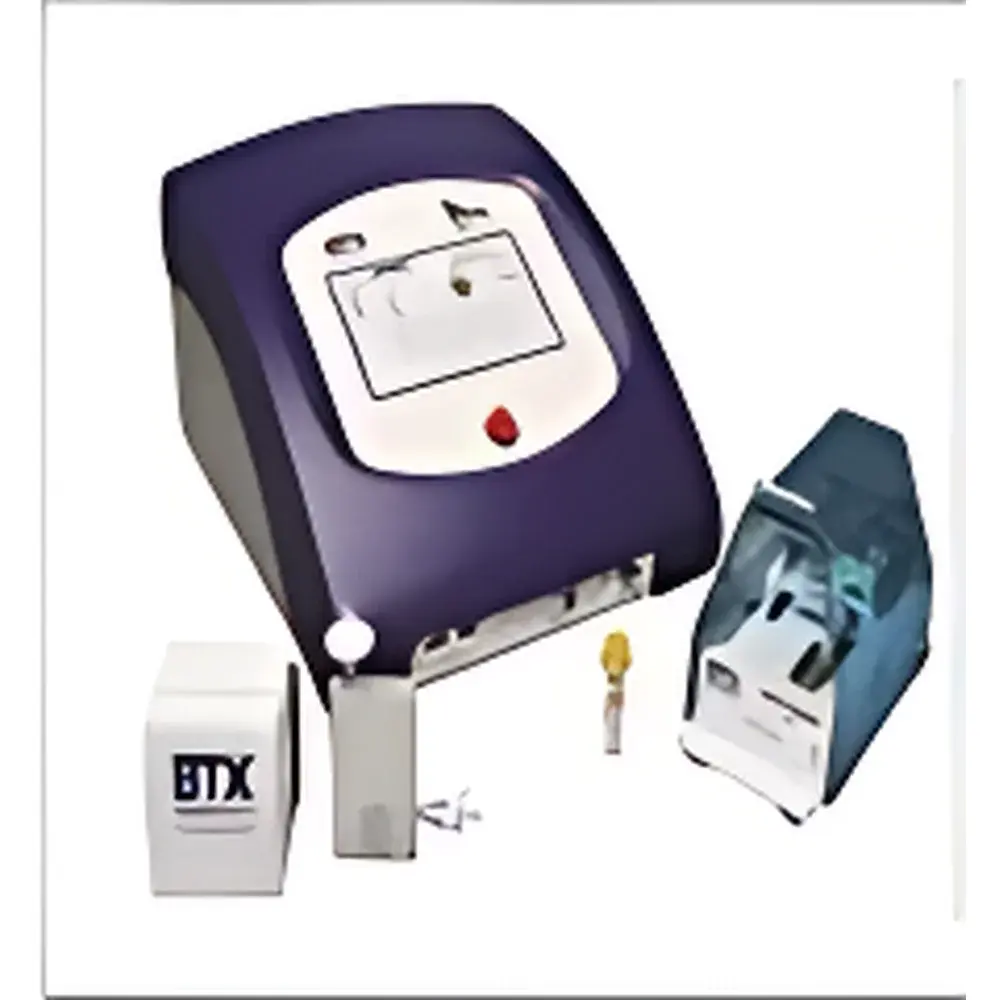
BTX MAX Transfection System
| Brand | Harvard Apparatus |
|---|---|
| Origin | USA |
| Manufacturer Type | Authorized Distributor |
| Product Category | Imported Instrument |
| Model | BTX MAX Transfection System |
| Pricing | Available Upon Request |
| Electroporation Chamber Gap | 4 mm |
| Sample Volume Range | 2–6 mL |
| Voltage Range | 50–1200 V |
| Pulse Duration | 0.05–10 ms |
| Inter-Pulse Interval | 0.2–1000 ms (1 Hz–5 kHz) |
| Data Interface | USB Flash Drive Support |
| Control Interface | Capacitive Touchscreen |
Overview
The BTX MAX Transfection System is a high-capacity, benchtop electroporator engineered for reproducible and scalable nucleic acid delivery into suspension cells at volumes ranging from 2 to 6 mL. Developed by BTX (now part of Harvard Apparatus), this system implements controlled square-wave electroporation—based on the well-established principle of transient membrane permeabilization via precisely timed electric field pulses—to enable efficient plasmid DNA, siRNA, or CRISPR RNP delivery without compromising cell viability. Unlike conventional low-volume electroporators optimized for 100 µL–1 mL samples, the MAX system addresses a critical gap in translational and preclinical workflows where larger-scale transfections are required for downstream functional assays, bioproduction seeding, or primary immune cell engineering. Its architecture integrates pulse parameter fidelity, thermal management during pulsing, and chamber geometry optimized for uniform field distribution across expanded sample volumes—key determinants of both transfection efficiency and post-pulse recovery.
Key Features
- High-volume electroporation capability: Supports consistent transfection of 2–6 mL suspension cell suspensions in a single run, eliminating serial processing and reducing inter-run variability.
- Patented AgilePulse™ technology: Delivers programmable, multi-pulse waveforms with microsecond-level timing resolution and minimal voltage droop, ensuring precise energy delivery independent of load impedance drift.
- Optimized 4 mm gap electroporation chamber: Engineered for uniform electric field distribution across large-volume samples; compatible with proprietary low-conductivity transfection buffers that minimize joule heating and enhance membrane resealing.
- Intuitive capacitive touchscreen interface: Enables rapid protocol selection, real-time parameter adjustment (voltage, pulse duration, interval, number of pulses), and immediate access to saved methods—no external computer required.
- USB flash drive data port: Facilitates secure export of pulse logs, timestamped parameters, and operator metadata for audit-ready documentation compliant with GLP and internal SOP requirements.
- Robust thermal design: Active heat dissipation integrated into the chamber base minimizes temperature rise during repeated pulsing, preserving sensitive primary and stem cell phenotypes.
Sample Compatibility & Compliance
The BTX MAX system is validated for use with human and murine T cells, PBMCs, hematopoietic stem/progenitor cells (HSPCs), Jurkat, K562, and other suspension-adapted lines. It operates within the electrical safety limits defined by IEC 61010-1 (Equipment for Laboratory Use) and conforms to electromagnetic compatibility standards per IEC 61326-1. While not FDA-cleared as a medical device, its operational parameters align with widely adopted research-grade electroporation protocols referenced in ISO/IEC 17025-accredited laboratories. The system supports traceability through user-defined method naming, operator ID tagging, and automatic timestamping—features essential for quality-controlled cell therapy process development under GMP-aligned frameworks.
Software & Data Management
No dedicated PC software is required for routine operation; all configuration and execution occur via the embedded touchscreen OS. However, exported USB logs (.csv format) contain full pulse-by-pulse metadata—including applied voltage, measured current, calculated field strength (V/cm), total delivered energy (J/mL), and chamber temperature at initiation—enabling retrospective analysis and correlation with viability/efficiency outcomes. These files are structured for direct import into LIMS or ELN platforms and support 21 CFR Part 11–compatible electronic signature workflows when paired with institutional authentication systems.
Applications
- Large-scale CAR-T and TCR-T cell engineering for preclinical expansion and manufacturing seed train preparation.
- High-efficiency siRNA or sgRNA/Cas9 RNP delivery into primary immune cells for functional genomics screens.
- Transient overexpression studies requiring >1 × 10⁷ cells per condition, such as cytokine profiling or phospho-proteomic time courses.
- Development and optimization of non-viral gene editing protocols where consistency across biological replicates is critical.
- Process transfer between academic discovery and contract development organizations (CDOs) due to standardized, instrument-locked parameter sets.
FAQ
Is the BTX MAX compatible with adherent cells?
No—it is specifically designed for suspension cells. Adherent cells require enzymatic detachment and resuspension in low-conductivity buffer prior to use; validation for each cell type is recommended.
Can I use third-party electroporation cuvettes?
Only BTX-certified 4 mm gap chambers are supported. Non-OEM chambers may cause arcing, inconsistent field strength, or failure to trigger pulse delivery.
Does the system support exponential decay waveforms?
No—the MAX exclusively delivers square-wave pulses. Exponential decay functionality is available only on legacy BTX ECM series instruments.
What buffer formulations are recommended?
Harvard Apparatus provides proprietary MAX Buffer kits formulated for minimal ionic strength and optimal osmolarity. Standard PBS or RPMI are incompatible and will result in excessive current draw and cell lysis.
How is calibration maintained?
The system performs automated self-diagnostic checks at power-on and before each pulse sequence. Voltage and timing accuracy are factory-traceable to NIST standards; annual verification is advised per institutional QA policy.
Related Products






