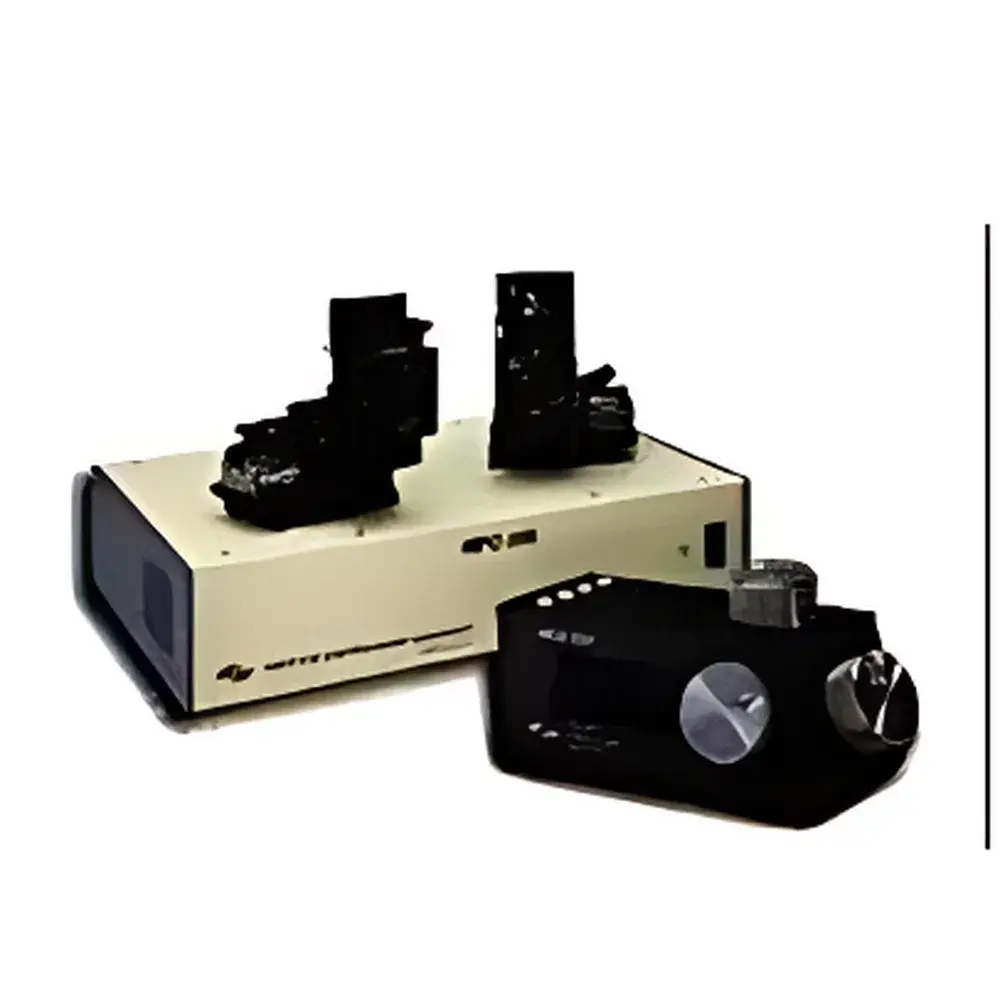
Sutter MPC-385-2 Dual-Axis Motorized Micromanipulator
| Brand | Sutter |
|---|---|
| Origin | USA |
| Model | MPC-385-2 |
| Controller | MPC-200 |
| Manipulators | (2) MP-285 |
| Rotary Encoder Module | ROE-200 |
| Axes | X, Y, Z, Oblique |
| Travel Range | 25 mm per axis |
| Max Speed | 5 mm/s |
| Resolution | 0.04 µm (high), 0.2 µm (low) |
| Drift | ≤10 nm/hr at 24°C |
| Motion Modes | Continuous & Step |
| Programmable | Yes, via RS-232/USB |
| Homing Function | Yes |
| Compatibility | Universal microscope mounting |
Overview
The Sutter MPC-385-2 is a dual-axis motorized micromanipulator system engineered for high-precision electrophysiological experimentation—particularly patch-clamp and intracellular recording applications requiring simultaneous, independent control of two microelectrodes. Built upon Sutter Instrument’s proven MP-285 manipulator platform and integrated with the MPC-200 universal controller and ROE-200 rotary encoder module, the MPC-385-2 delivers sub-micron positional stability and reproducible nanoscale actuation. Its operational principle relies on closed-loop piezoelectric stepping motors coupled with optical encoders to achieve real-time position feedback and drift-compensated motion across four degrees of freedom: orthogonal X, Y, and Z axes plus oblique (rotational tilt) movement. Designed for integration into upright or inverted electrophysiology rigs, the system maintains mechanical rigidity and thermal stability under prolonged recording conditions—critical for experiments demanding >1-hour stability, such as long-term synaptic plasticity studies or single-channel kinetic analysis.
Key Features
- Dual-manipulator architecture: Two synchronized MP-285 units mounted on a rigid aluminum baseplate, enabling independent, co-registered control of two recording electrodes.
- Four-axis motion control: Precise linear translation in X, Y, Z, and programmable oblique rotation for optimal electrode approach angles relative to cell membranes.
- High-resolution positioning: Selectable step resolution of 0.04 µm (high mode) or 0.2 µm (low mode), supporting both coarse positioning and fine membrane contact adjustment.
- Ultra-low thermal drift: ≤10 nm/hr at 24°C—validated per ISO 230-3 Annex B protocols—ensuring positional fidelity during extended voltage-clamp or current-clamp sessions.
- Real-time LCD interface: On-controller display shows absolute coordinates, velocity, and active motion mode (step/continuous) without requiring external software.
- Programmable homing: Dedicated HOME function returns both manipulators to factory-defined origin points with repeatability <±0.1 µm.
- Open-command architecture: RS-232 and USB 2.0 interfaces support deterministic command scripting via Python, MATLAB, or LabVIEW; compatible with National Instruments DAQ systems and commercial electrophysiology suites (e.g., pCLAMP, Axograph).
- Universal microscope compatibility: Standard dovetail and threaded mounting options accommodate Nikon, Olympus, Zeiss, and Leica upright/inverted frames without adapter modification.
Sample Compatibility & Compliance
The MPC-385-2 is routinely deployed in GLP-compliant neurophysiology laboratories performing ICH E6(R3)-aligned preclinical safety pharmacology studies. Its mechanical design conforms to ISO 13485:2016 requirements for medical device accessories used in in vitro diagnostic development. While not a Class II medical device itself, the system supports USP analytical instrument qualification (AIQ) protocols—including Installation Qualification (IQ), Operational Qualification (OQ), and Performance Qualification (PQ)—through documented calibration procedures, encoder linearity verification, and drift validation reports. It is routinely validated alongside Axon MultiClamp 700B amplifiers and Digidata 1550B digitizers in FDA-regulated contract research organizations conducting IND-enabling ion channel assays.
Software & Data Management
The MPC-200 controller supports ASCII-based SCPI-like command syntax over serial or USB, enabling traceable, timestamped motion logging directly into experiment metadata files. When interfaced with acquisition software that implements NIH ImageJ/Fiji plugins or custom Python scripts (e.g., using the sutter_mpc open-source driver), all manipulator positions are time-synchronized with electrophysiological traces and video timestamps. Audit trails include user-initiated commands, emergency stop events, and encoder error flags—fully compliant with 21 CFR Part 11 requirements when deployed with electronic signature-enabled LIMS environments. Firmware updates are delivered via signed .hex files with SHA-256 checksum verification.
Applications
- Simultaneous dual-patch recordings from coupled neurons or glial networks.
- Paired whole-cell recordings in brain slice preparations for synaptic transmission quantification.
- Single-cell electroporation combined with post-transfection patch-clamp characterization.
- Microinjection of dyes, CRISPR-Cas9 ribonucleoprotein complexes, or optogenetic constructs into embryonic stem cells or primary cortical cultures.
- Controlled mechanical stimulation of mechanosensitive ion channels using calibrated electrode deflection.
- Automated electrode array alignment in multi-electrode array (MEA) hybrid setups.
FAQ
What distinguishes the MPC-385-2 from the MPC-325-2?
The MPC-385-2 integrates two MP-285 manipulators, whereas the MPC-325-2 uses two MP-225 units—differing primarily in travel range (25 mm vs. 12.5 mm), maximum speed (5 mm/s vs. 2.5 mm/s), and encoder resolution (0.04 µm vs. 0.1 µm). The MP-285 also features enhanced thermal compensation circuitry.
Is the MPC-385-2 compatible with vibration isolation tables?
Yes—the baseplate includes M4 tapped holes spaced to match standard optical table grid patterns (25 mm pitch); optional passive damping mounts (Sutter PDM-1) are available for resonance suppression below 5 Hz.
Can motion sequences be saved and recalled?
Yes—up to 100 user-defined coordinate sets can be stored in non-volatile memory and executed via front-panel buttons or remote command triggers.
Does the system support closed-loop feedback during recording?
While the MP-285 encoders provide real-time position verification, true closed-loop force feedback requires integration with third-party piezoresistive sensors (e.g., FEMTO-Tools FT-MTA) via analog voltage input to the MPC-200 auxiliary port.
What maintenance is required for long-term stability?
Annual recalibration of encoder linearity and zero-offset drift is recommended; Sutter provides NIST-traceable calibration certificates upon request. No lubrication or consumable replacement is required under normal operating conditions.