
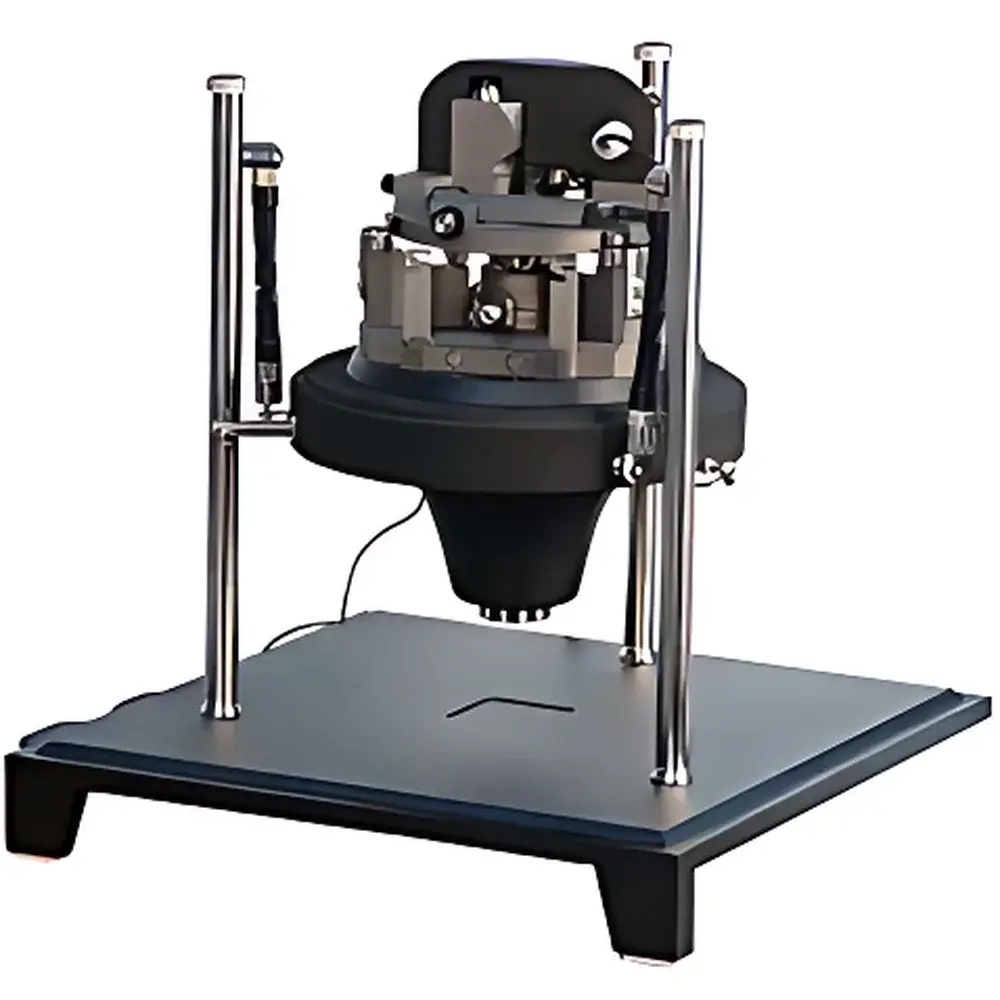
NT-MDT Solver P47-Pro Multifunctional Scanning Probe Microscope (SPM) / Atomic Force Microscope (AFM)
| Brand | NT-MDT |
|---|---|
| Origin | Imported |
| Manufacturer Type | Authorized Distributor |
| Model | Solver P47-Pro |
| Pricing | Available Upon Request |
| Measurement Modes | STM, AFM (Contact/Tapping/Non-contact), LFM, Phase Imaging, Force Modulation, Force Spectroscopy, Adhesion Mapping, MFM, EFM, Kelvin Probe, SSRM, Nanoindentation, Voltage/Force Nanolithography |
| Scanning Configurations | Sample Scanning, Tip Scanning, Dual-Scan Option |
| Max Sample Size (Sample Scan) | Ø40 mm × 10 mm |
| XY Sample Positioning Range | 5 × 5 µm |
| Positioning Accuracy | ±5 µm |
| Environmental Operation | Ambient Air, Controlled Atmosphere, Liquid Cell Compatible |
| Temperature Control | Room Temperature to 130 °C |
| Optical System | Custom-Configurable |
| SPM Techniques Supported | >40 Quantitative Modes |
Overview
The NT-MDT Solver P47-Pro is a high-precision, modular scanning probe microscope engineered for quantitative nanoscale characterization across diverse operational environments. Based on the fundamental principles of probe–surface interaction mechanics and piezoelectric displacement feedback, the system delivers spatial resolution down to atomic lattice spacing (sub-Å vertical, ~1 nm lateral under optimal conditions) while maintaining robust signal-to-noise performance in air, inert gas, vacuum, and liquid media. Unlike electron-beam-based techniques, SPM does not require conductive coating or high-vacuum conditions, enabling direct analysis of soft biological specimens, polymer films, electrochemical interfaces, and functional oxide surfaces in their native or operando states. The platform’s dual-scanning architecture—comprising independent tip and sample positioning mechanisms—decouples thermal drift from mechanical coupling, significantly enhancing long-term stability during force spectroscopy, nanomechanical mapping, and time-resolved surface dynamics studies.
Key Features
- Modular design supporting interchangeable SPM heads: standard AFM/STM head, liquid-cell-compatible head, and high-temperature head (up to 130 °C)
- Dual-scan capability (optional): extends maximum imaging area to 200 × 200 µm while preserving sub-nanometer resolution via active drift compensation
- Integrated multi-mode controller enabling seamless switching among >40 SPM techniques—including current-sensing STM, amplitude/phase-modulated tapping, Kelvin probe force microscopy (KPFM), magnetic force microscopy (MFM), electrostatic force microscopy (EFM), scanning spreading resistance microscopy (SSRM), and quantitative nanoindentation
- High-stability Z-piezo with closed-loop feedback (resolution < 0.05 nm) and low thermal drift (< 0.1 nm/min at room temperature)
- Optically aligned cantilever approach system with integrated CCD viewing (configurable magnification and illumination options)
- Compliant mechanical base with passive vibration isolation, optimized for benchtop deployment in standard laboratory environments
Sample Compatibility & Compliance
The Solver P47-Pro accommodates a broad spectrum of sample types without mandatory pre-treatment: conductive and insulating substrates (Si/SiO₂, mica, HOPG, ITO, PET), hydrated biomolecules (DNA, proteins, lipid bilayers), battery electrode composites, ferroelectric thin films, and catalytic nanoparticles. Its liquid cell configuration supports in situ electrochemical AFM (EC-AFM), corrosion monitoring, and real-time biointerface evolution studies. For regulated environments, the system supports audit-ready operation: data acquisition logs include timestamped metadata (user ID, instrument state, environmental parameters), and optional software modules comply with GLP/GMP documentation requirements per FDA 21 CFR Part 11 when paired with validated electronic signature workflows. All measurement modes adhere to ISO/IEC 17025 traceability frameworks through factory calibration certificates for piezo scanners, photodetectors, and force calibration standards (e.g., NIST-traceable Si gratings and thermal tune methods).
Software & Data Management
Acquisition and analysis are managed via Nova software—a cross-platform (Windows/Linux), scriptable environment supporting Python and MATLAB APIs. Nova implements real-time FFT filtering, multi-channel lock-in demodulation, automated tip optimization routines, and batch-processing pipelines for large-area mosaic stitching and statistical roughness analysis (Sq, Sa, Rq, bearing ratio curves). Raw data are stored in vendor-neutral HDF5 format with embedded metadata (including instrument configuration, environmental logs, and user annotations), ensuring long-term archival integrity and third-party interoperability. Export options include TIFF, SVG, CSV, and VTK formats compatible with MATLAB, Gwyddion, and commercial FEA packages. Software updates follow a documented version-control policy with release notes specifying validation status against ASTM E2539 (Standard Guide for SPM Data Analysis) and ISO 25178-2 (Geometrical Product Specifications – Surface Texture).
Applications
- Nanomechanics: Elastic modulus and adhesion mapping of polymer blends, hydrogels, and composite coatings using force-distance spectroscopy and contact resonance analysis
- Electrofunctional Materials: Domain structure imaging in ferroelectrics (PZT, BFO) via PFM; charge trapping dynamics in dielectrics using KPFM under bias sweep
- Energy Interfaces: In situ SEI layer growth on Li-ion battery anodes in liquid electrolyte cells; catalyst surface restructuring during CO oxidation
- Life Sciences: Conformational changes in membrane proteins under osmotic stress; fibril assembly kinetics of amyloid-β peptides in physiological buffer
- Microelectronics: Defect localization in gate oxides, dopant profiling via SSRM, and lithographic fidelity assessment of EUV resist patterns
FAQ
Is the Solver P47-Pro compatible with ultra-high vacuum (UHV) environments?
No—the standard configuration is rated for ambient, controlled-atmosphere, and liquid operation. UHV compatibility requires a custom chamber integration and is not part of the base platform specification.
Can force spectroscopy data be exported for third-party mechanical modeling?
Yes—force–distance curves are saved in HDF5 with calibrated deflection and piezo extension channels, enabling direct import into COMSOL Multiphysics or ANSYS for contact mechanics simulation.
What calibration standards are supplied with the system?
Each shipment includes NIST-traceable step-height standards (Si grating), thermal tuning calibration wafers, and certified cantilevers with nominal spring constants and resonant frequencies.
Does the dual-scan option affect measurement reproducibility in large-area scans?
No—dual-scan mode maintains metrological equivalence to single-scan operation by applying synchronized coordinate transformation and drift-correction algorithms validated per ISO/IEC 17025 internal audit protocols.
Is remote operation supported for collaborative labs?
Yes—Nova software supports secure remote desktop access (via TLS-encrypted VNC) and scheduled unattended acquisitions with email alerts upon completion or error detection.





