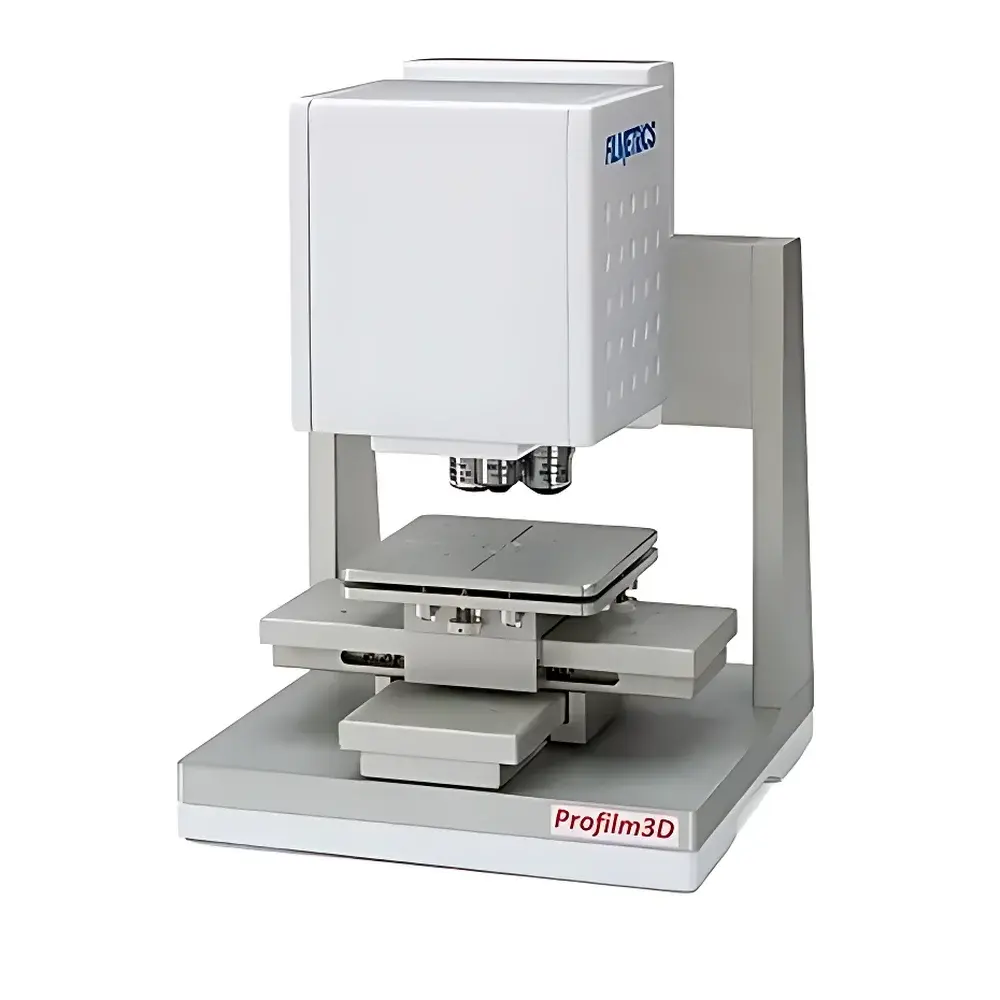
KLA Profilm 3D Optical Profilometer
| Brand | KLA |
|---|---|
| Model | Profilm 3D |
| Type | Non-contact Optical Profilometer / Surface Roughness Analyzer |
| Measurement Principle | White Light Interferometry (WLI) with Vertical Scanning Interferometry (VSI) and Phase-Shifting Interferometry (PSI) |
| Vertical Range | VSI: 50 nm – 100 mm |
| PSI | 0 – 3 µm |
| Reflectance Range | 0.05% – 100% |
| Piezo Scan Range | 500 µm |
| XY Stage Travel | 100 mm × 100 mm |
| Compliance | ISO 25178-604, ISO 4287, ISO 4288, ASME B46.1, ASTM E2923 |
| Software | ProfilmOnline™ Cloud-Based Analysis Platform |
| Data Export | CSV, TIFF, BMP, OBJ, STP, DXF |
| Roughness Parameters | 47 ISO/ASME/EUR-compliant parameters |
Overview
The KLA Profilm 3D Optical Profilometer is a high-precision, non-contact surface metrology instrument engineered for quantitative 3D topography characterization of micro- and nano-scale surface features. It operates on the physical principles of white light interferometry (WLI), integrating both vertical scanning interferometry (VSI) for broad dynamic range and phase-shifting interferometry (PSI) for sub-nanometer vertical resolution on smooth, highly reflective surfaces. Unlike contact stylus profilometers, the Profilm 3D eliminates mechanical loading, tip wear, and sample deformation—making it suitable for soft polymers, photoresists, thin films, and delicate coatings. Its dual-mode acquisition architecture enables seamless transition between high-speed large-area mapping (VSI) and ultra-high-resolution localized analysis (PSI), supporting applications ranging from semiconductor wafer inspection to precision optics manufacturing and biomedical device surface validation.
Key Features
- Dual-Mode Interferometric Engine: Combines VSI (50 nm – 100 mm vertical range) and PSI (0 – 3 µm range, <0.1 nm height repeatability on ideal surfaces) within a single optical path—no hardware switching required.
- Large-Area Automated Metrology: Motorized 100 mm × 100 mm XY translation stage with programmable stitching enables fully automated, calibrated mosaic acquisition across extended fields-of-view while maintaining traceable step-height accuracy.
- Universal Sample Compatibility: Measures surfaces with reflectance as low as 0.05% (e.g., black silicon, carbon composites) up to 100% (polished metals, fused silica), eliminating need for anti-reflective coatings or surface preparation.
- Integrated Piezo Z-Scanner: 500 µm closed-loop piezoelectric actuator delivers nanometer-level positioning stability and thermal drift compensation over extended scan durations.
- LED-Based Illumination: Solid-state broadband white-light source with >10,000-hour lifetime—no lamp replacement, no warm-up time, and stable spectral output for repeatable photometric calibration.
- Real-Time 3D Visualization & Manipulation: Interactive rendering engine allows real-time rotation, slicing, cross-sectioning, and false-color height mapping directly within the acquisition interface—no post-processing delay.
Sample Compatibility & Compliance
The Profilm 3D is validated for use across diverse material classes including but not limited to: monocrystalline and polycrystalline silicon wafers, amorphous dielectrics (SiO₂, Si₃N₄), hard ceramic coatings (Al₂O₃, TiN), polymer substrates (PMMA, PET, PDMS), photoresists (SU-8, AZ series), metallic thin films (Al, Cu, Ti), and optically transparent components (lens arrays, microfluidic channels). All measurements adhere to internationally recognized standards: ISO 25178-604 (coherent scanning interferometry), ISO 4287/4288 (surface roughness), ASME B46.1 (surface texture nomenclature), and ASTM E2923 (non-contact 3D surface topography). The system supports GLP/GMP-aligned audit trails and is compatible with FDA 21 CFR Part 11 requirements when deployed with validated ProfilmOnline™ configuration and electronic signature protocols.
Software & Data Management
ProfilmOnline™ is a browser-based, secure cloud platform enabling remote access, collaborative analysis, and long-term archival of 3D surface datasets. Users can upload, view, annotate, and quantitatively analyze profilometry data from any device—desktop, tablet, or smartphone—without local software installation. The platform implements ISO-compliant filtering (Gaussian, S-filter, robust polynomial fitting), shape removal algorithms (least-squares, reference sphere/cylinder), and full compliance with 47 standardized roughness parameters (Sa, Sq, Sz, Sk, Spk, Svk, etc.). Raw interferograms, height maps, and metadata are stored in vendor-neutral formats (TIFF, CSV, OBJ) and support export to CAD environments (STP, DXF) for design verification and reverse engineering workflows. Role-based access control, version history, and encrypted TLS 1.3 transmission ensure data integrity and regulatory readiness.
Applications
- Step height measurement of lithographically defined structures (MEMS, TSVs, BEOL layers)
- Surface roughness and texture analysis per ISO 25178 (Sa, Sq, Sdr, Str, etc.) for quality control in medical implants and aerospace components
- Thin-film thickness uniformity mapping via interference fringe analysis
- Wafer-level warpage and bow characterization using full-field topographic reconstruction
- Micro-optics surface form error evaluation (PV, RMS, Zernike decomposition)
- Large-area defect localization and classification via height thresholding and spatial frequency filtering
- Process development feedback for CMP, etch, and deposition tools through statistical process control (SPC) integration
FAQ
What interferometric techniques does the Profilm 3D support?
It combines vertical scanning interferometry (VSI) and phase-shifting interferometry (PSI) in a single optical head—automatically selecting optimal mode based on surface slope and reflectivity.
Does the system require vacuum or environmental isolation?
No—operation is certified for standard laboratory ambient conditions (20–25°C, 40–60% RH); active vibration isolation is recommended but not mandatory for most production-grade measurements.
Can ProfilmOnline be deployed on-premise instead of cloud-hosted?
Yes—enterprise customers may opt for private-cloud or on-premise deployment with validated IT infrastructure and documented change control procedures.
Is calibration traceable to NIST or other national metrology institutes?
Yes—system calibration uses NIST-traceable step-height standards (e.g., NIST SRM 2160, 2161) and includes documented uncertainty budgets compliant with ISO/IEC 17025.
How is measurement repeatability verified across multiple operators and sessions?
The software includes built-in Gage R&R (ANOVA-based) modules aligned with AIAG MSA guidelines; users can execute multi-operator, multi-part, multi-trial studies with automated report generation.