
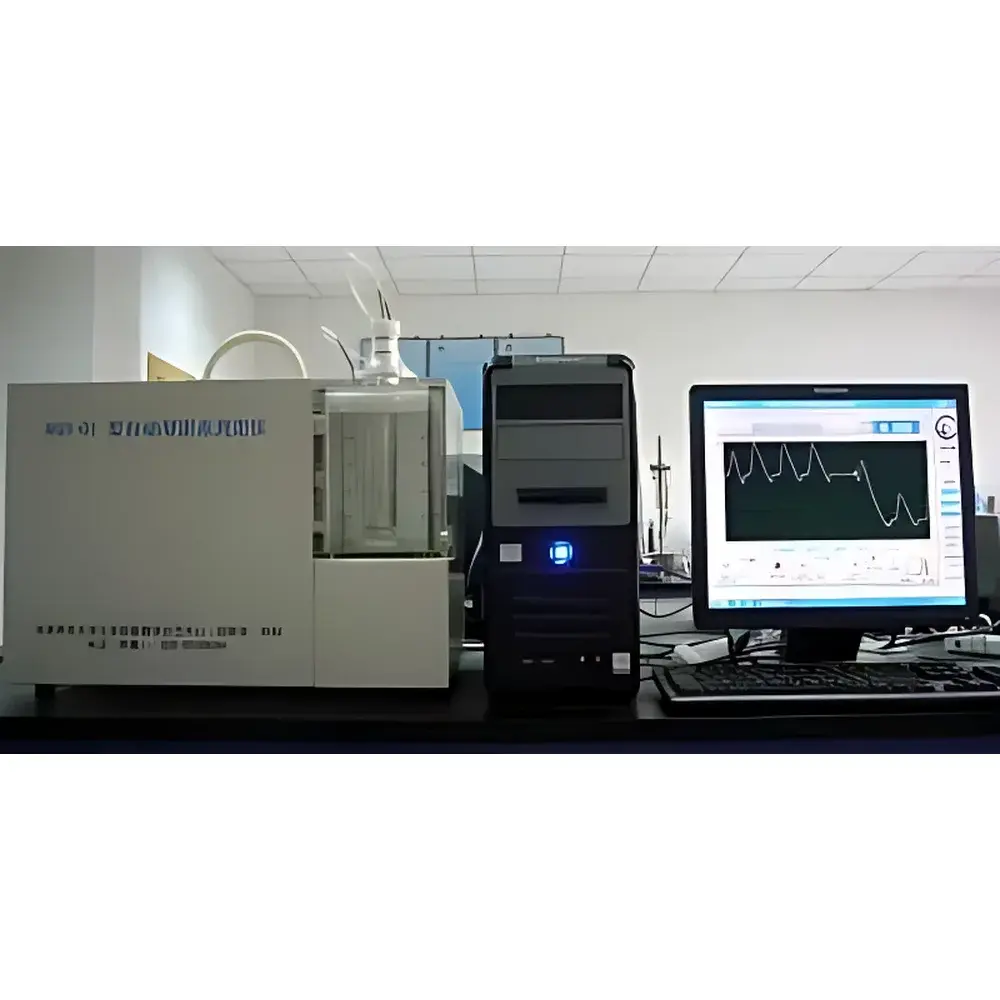
NGD-01 Automatic Freezing Point Depressometer
| Origin | Shaanxi, China |
|---|---|
| Manufacturer Type | Authorized Distributor |
| Origin Category | Domestic (PRC) |
| Model | NGD-01 |
| Price | USD 3,950 (FOB) |
| Temperature Range | −20 to 30 °C |
| Temp. Resolution | 0.001 °C |
| Inter-Parallel Deviation | ±0.001 °C |
| Stirring Speed | 0–800 rpm (continuously adjustable) |
| Cold Bath Control Range | Ambient to −20 °C |
| Temperature Stability | ±0.05 °C |
| Data Acquisition Rate | 1 sample/sec |
| Power Consumption | 600 W |
Overview
The NGD-01 Automatic Freezing Point Depressometer is a precision thermal analysis instrument engineered for the accurate determination of solute molar mass via freezing point depression—a colligative property governed by thermodynamic equilibrium between solid and liquid phases. Based on the classical cryoscopic principle described by van’t Hoff and rigorously defined in ISO 8287 and ASTM D97 (modified for laboratory-scale solution systems), the NGD-01 measures the temperature at which a solution transitions from liquid to solid phase under controlled cooling and dynamic equilibration conditions. Unlike conventional manual or semi-automated setups, this system integrates closed-loop PID temperature regulation, real-time solidification onset detection, and active heat-loss compensation during phase transition—enabling measurement repeatability within ±0.001 °C across parallel runs. Designed for both undergraduate physical chemistry laboratories and applied research environments, the NGD-01 delivers metrologically traceable data compliant with GLP documentation requirements and supports method validation per ICH Q2(R2) guidelines for analytical procedure verification.
Key Features
- Fully automated control of cold bath temperature (ambient to −20 °C), magnetic stirring speed (0–800 rpm), and programmed cooling/heating profiles via embedded microcontroller and PC interface.
- High-resolution platinum resistance thermometer (PT1000 class A) with 0.001 °C digital resolution and NIST-traceable calibration certificate included.
- Dynamic thermal compensation algorithm activates upon initial crystal nucleation detection, correcting for supercooling and latent heat dissipation to approximate thermodynamically reversible freezing points.
- Real-time data acquisition at 1 Hz sampling rate, with timestamped voltage-to-temperature conversion and automatic inflection point identification using second-derivative analysis.
- Integrated safety logic monitors abnormal temperature drift, motor stall, or sensor open-circuit conditions and triggers audible/visual alerts with system pause and error logging.
- Intuitive Windows-based GUI featuring multilingual support (English, Spanish, German), customizable report templates (PDF/CSV/XLSX), and audit trail functionality meeting FDA 21 CFR Part 11 readiness criteria.
Sample Compatibility & Compliance
The NGD-01 accommodates standard 15 mL glass capillary tubes or sealed sample cells (diameter ≤12 mm, height ≤80 mm) filled with aqueous or organic solutions (e.g., camphor/benzene, lauric acid/cyclohexane, sucrose/water). It is validated for use with non-hazardous, low-volatility solvents and non-corrosive solutes. All thermal modules comply with IEC 61010-1:2010 safety standards for laboratory electrical equipment. The instrument’s temperature control architecture satisfies ISO/IEC 17025:2017 clause 6.4.10 (environmental monitoring) when operated in climate-controlled labs (20 ±2 °C, RH <65%). Calibration protocols align with EURACHEM/CITAC Guide CG4 and are compatible with internal quality control (QC) checks using certified reference materials such as NIST SRM 746a (melting point standard).
Software & Data Management
The bundled NGD-Control Suite v3.2 provides full instrument orchestration, including method creation (predefined or user-defined ramp rates, hold times, stir thresholds), live curve visualization (T vs. t, dT/dt vs. t), and automated calculation of molality, van’t Hoff factor (i), and molar mass using user-input solute mass and solvent mass values. Raw data files (.ngd) retain full metadata (operator ID, date/time stamp, calibration ID, environmental logs) and support export to LIMS-compatible formats. Audit trails record all parameter changes, run initiations, and report generations with immutable timestamps—essential for regulatory submissions under GMP or academic integrity frameworks. Software validation documentation (IQ/OQ/PQ summary) is available upon request.
Applications
- Determination of molecular weight of unknown organic compounds in teaching labs (e.g., benzoic acid, naphthalene, urea derivatives).
- Quality control of polymer batch consistency via end-group analysis using cryoscopy in solvent systems like chloroform or THF.
- Validation of electrolyte dissociation behavior in battery electrolyte formulations through observed vs. theoretical ΔTf deviation.
- Supporting thermodynamic modeling efforts requiring precise activity coefficient estimation in binary and ternary mixtures.
- Method development for pharmacopeial compliance testing (e.g., USP related substances quantification where cryoscopic purity assessment applies).
FAQ
What types of solvents are compatible with the NGD-01?
Common low-viscosity, non-reactive solvents including water, ethanol, cyclohexane, benzene, chloroform, and acetone—provided they remain stable below −20 °C and do not attack PTFE or borosilicate components.
Can the NGD-01 be integrated into an existing LIMS environment?
Yes—via optional OPC UA server module (order code NGD-LIMS-OPC) supporting secure bidirectional communication with major LIMS platforms including LabWare, Thermo Fisher SampleManager, and Agilent OpenLab.
Is external calibration required annually?
While the built-in PT1000 sensor is factory-calibrated, users must perform annual verification using two-point calibration standards (e.g., ice point and certified eutectic mixture) per ISO/IEC 17025 Clause 6.6.2; calibration certificates are issued by accredited third-party labs.
Does the system support multi-sample sequential analysis?
No—NGD-01 is a single-cell platform optimized for high-precision individual measurements; however, throughput is enhanced via average cycle time of <12 minutes per run including cleaning and thermal equilibration.
What maintenance is recommended for long-term stability?
Quarterly inspection of stirrer magnet coupling integrity, annual replacement of silicone oil in cold bath reservoir, and biannual verification of thermal insulation integrity around sample chamber.





