
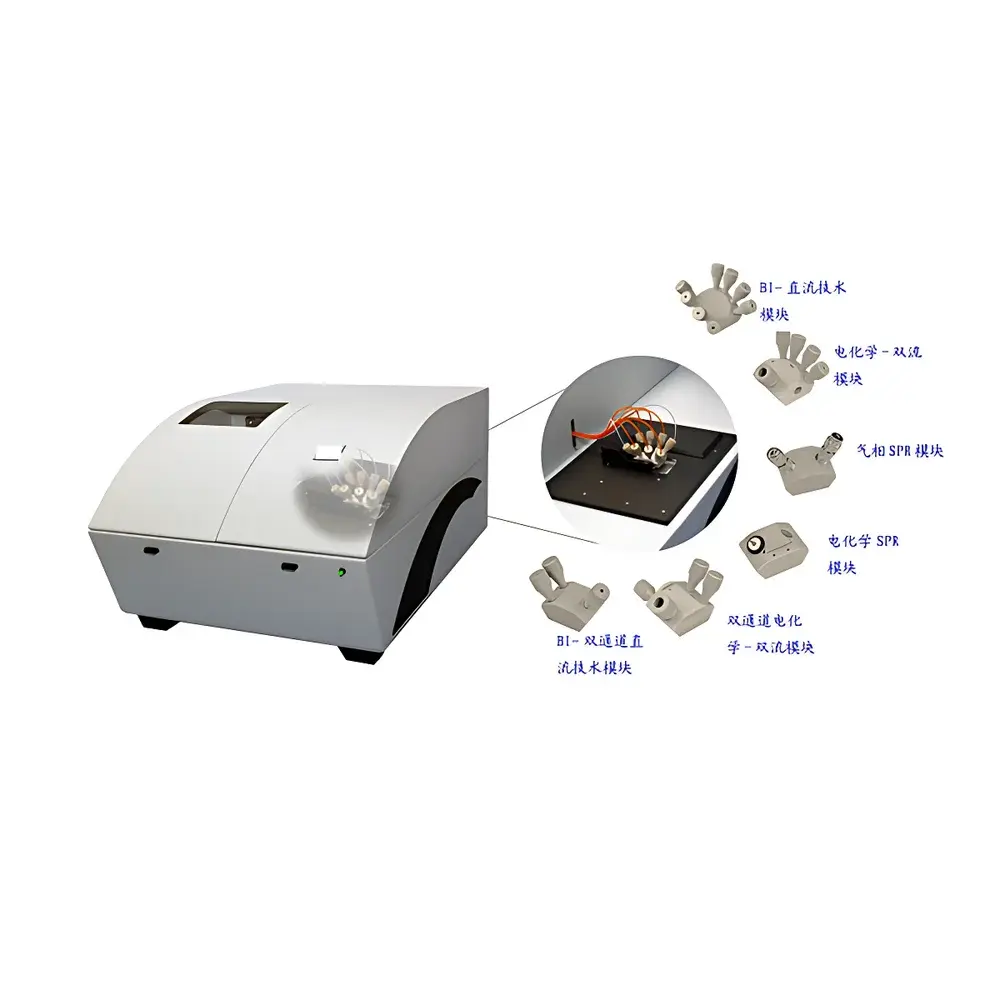
BI-4500 Surface Plasmon Resonance Analyzer
| Origin | USA |
|---|---|
| Manufacturer Type | Authorized Distributor |
| Origin Category | Imported |
| Model | BI-4500 |
| Price Range | USD 70,000 – 140,000 |
| Sample Flow Channels | 5 |
| Light Source | Dual 670 nm LEDs |
| Detection Speed | 4 ms |
| Incident Angle Range | 40–47° (gas phase), 67–81° (liquid phase) |
| Sensitivity | < 0.06 RU RMS (0.01 mdeg RMS) |
| Drift | ≤ 1 RU/hour (≤ 0.17 mdeg/hour) under ambient temperature drift < 1 °C/hour |
| Interface | USB 3.0 |
| Dimensions | 355 × 250 × 515 mm (W × H × D) |
| Weight | 11.5 kg |
Overview
The BI-4500 Surface Plasmon Resonance (SPR) Analyzer is a high-performance, multi-channel biosensing platform engineered for label-free, real-time monitoring of molecular interactions at solid–liquid and solid–gas interfaces. Based on the Kretschmann configuration of angular interrogation SPR, the instrument detects minute changes in the refractive index within ~200 nm of a functionalized gold sensor surface—enabling quantitative analysis of binding kinetics (ka, kd), affinity (KD), concentration, and stoichiometry without fluorescent or enzymatic labeling. Its dual 670 nm light source ensures stable baseline performance across extended acquisition periods, while the precisely controlled incident angle range (67–81° for liquid-phase assays; 40–47° for gas-phase studies) supports both aqueous biomolecular interaction analysis and volatile compound detection. Designed for reproducibility in regulated environments, the BI-4500 meets foundational requirements for method validation per ICH Q5E and supports GLP-compliant data integrity when integrated with audit-trail-enabled software.
Key Features
- Five independent fluidic channels enabling true parallel sample processing and reference subtraction—reducing inter-assay variability and accelerating throughput for kinetic screening.
- BI-DirectFlow™ technology: A proprietary microfluidic architecture that eliminates laminar diffusion artifacts during analyte delivery, ensuring precise bolus injection and mass-transport-limited binding conditions essential for accurate determination of fast-on/fast-off interactions (e.g., small-molecule inhibitors, peptide epitopes).
- Sub-RU-level sensitivity (< 0.06 RU RMS) combined with ultra-low thermal drift (≤1 RU/hour), achieved via active temperature stabilization and optical path compensation—critical for detecting low-molecular-weight analytes (<100 Da) and weak-affinity binders (KD > 100 µM).
- Modular sensor chip compatibility: Supports interchangeable SPR chips including bare gold, patterned gold, CM-dextran, streptavidin, and Ni-NTA surfaces—facilitating covalent, affinity, or capture-based immobilization strategies aligned with USP & ISO 10993 biocompatibility guidance.
- Compact benchtop footprint (355 × 250 × 515 mm) with USB 3.0 interface and embedded real-time signal processing—enabling seamless integration into shared core facilities and QC laboratories operating under ISO/IEC 17025 quality management systems.
Sample Compatibility & Compliance
The BI-4500 accommodates diverse sample matrices without requiring derivatization or amplification. In life sciences, it quantifies protein–protein, protein–DNA, antibody–antigen, and ligand–receptor interactions under physiologically relevant buffer conditions (e.g., PBS, HBS-EP+, low-salt formulations). For environmental and food safety applications, it enables direct detection of metal ions (e.g., Pb²⁺ in drinking water) using chelator-functionalized chips, and volatile organic compounds (VOCs) in breath or headspace gas via gas-phase SPR mode. Electrochemical SPR (EC-SPR) modules support in situ monitoring of electrodeposition, corrosion kinetics, and anodic stripping—compatible with ASTM G102 and ISO 9223 standards for electrochemical corrosion testing. All hardware and firmware comply with CE marking directives (2014/30/EU EMC, 2014/35/EU LVD) and RoHS 3 restrictions.
Software & Data Management
The BI-4500 operates with BI-SCOUT™ software v5.x—a validated application supporting 21 CFR Part 11 compliance through role-based user access control, electronic signatures, and immutable audit trails for all instrument parameters, sensorgram exports, and report generation. Raw data are stored in vendor-neutral HDF5 format with embedded metadata (timestamp, temperature, flow rate, chip ID), enabling traceability from raw resonance units (RU) to final kinetic constants. Batch processing workflows support global fitting of heterogeneous binding models (1:1, bivalent analyte, conformational change) and export to industry-standard formats (CSV, Excel, GraphPad Prism .pzfx). Optional API integration allows synchronization with LIMS platforms (e.g., LabWare, STARLIMS) and ELN systems via RESTful webhooks.
Applications
- Drug Discovery: Characterization of fragment-to-lead binding kinetics, epitope binning of monoclonal antibodies, and off-rate ranking of PROTAC degraders.
- Diagnostics Development: Quantitative immunoassay calibration for point-of-care biosensors; detection of heavy metal biomarkers (e.g., Cd²⁺, As³⁺) in serum via competitive inhibition assays.
- Environmental Monitoring: Real-time quantification of pesticide residues (e.g., neonicotinoids) in fruit washes using hapten-coupled dextran chips.
- Materials Science: In situ analysis of polymer thin-film swelling dynamics and gas permeation coefficients on catalytic nanoparticle surfaces.
- Academic Research: Validation of CRISPR-Cas9 guide RNA binding specificity; mapping allosteric communication networks in GPCRs via ligand-induced conformational shifts.
FAQ
What is the minimum analyte molecular weight detectable with the BI-4500?
The system reliably detects analytes as small as 50 Da under optimized immobilization and flow conditions—enabled by BI-DirectFlow™’s minimized mass transport limitation and sub-RU noise floor.
Can the BI-4500 be used for kinetic analysis of membrane proteins?
Yes—when coupled with nanodisc- or liposome-embedded chips (e.g., BI-LipidChip series), the instrument supports real-time binding analysis of GPCRs, ion channels, and transporters in near-native lipid bilayers.
Is the software compatible with networked deployment in a multi-user lab environment?
BI-SCOUT™ supports concurrent client-server operation over local area networks, with centralized license management and database-backed project archiving—validated for use in FDA-audited biopharma QC labs.
Does the system support automated regeneration protocols?
Yes—predefined or custom regeneration sequences (pH shift, chaotropic agents, detergent pulses) can be programmed per channel and executed with full logging of recovery efficiency and surface stability metrics.
What regulatory documentation is provided for IQ/OQ/PQ validation?
Brockton Instruments supplies a comprehensive validation toolkit including URS, FRS, test scripts, and raw data templates compliant with ASTM E2500-13 and Annex 11, plus optional third-party qualification services.




