
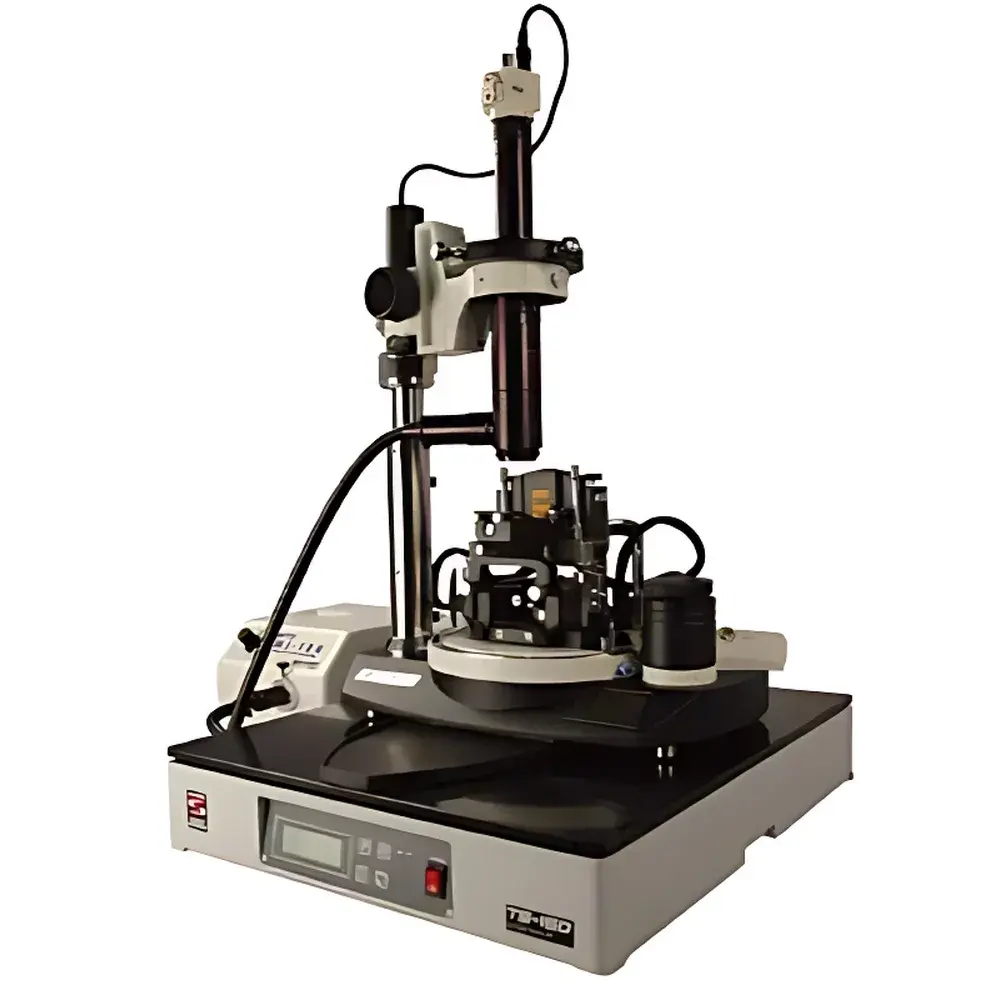
NTegra Platform Series Multifunctional Scanning Probe Microscope (SPM) – Atomic Force Microscopy (AFM) System
| Origin | Imported |
|---|---|
| Manufacturer Type | Authorized Distributor |
| Model | NTegra Platform Series (Prima, Aura, Therma, Maximus, Solaris, Vita, Tomo, Spectra) |
| Pricing | Available Upon Request |
Overview
The NTegra Platform Series is a modular, high-precision scanning probe microscopy (SPM) system engineered for advanced nanoscale characterization across diverse physical, chemical, and biological environments. Built upon a robust mechanical architecture with active vibration isolation and thermal drift compensation, the platform implements core SPM measurement principles—including tunneling current (STM), dynamic and static force detection (AFM), electrostatic and magnetic field sensing (EFM/MFM), surface potential mapping (KPFM), and piezoelectric response (PFM)—all within a single, unified control framework. Its design adheres to fundamental metrological requirements for traceable nanomechanical and nanoelectrical measurements, supporting both ambient and controlled-environment operation (liquid, low vacuum, inert gas, temperature- and atmosphere-regulated chambers). The system’s dual-scanner architecture enables large-area scanning up to 200 × 200 µm while maintaining sub-angstrom Z-resolution—critical for correlative multimodal imaging where topography, mechanical properties, and functional contrast must be spatially registered with nanometer fidelity.
Key Features
- Modular platform supporting eight specialized configurations: Prima (core SPM), Aura (controlled-atmosphere electromagnetic studies), Therma (ultra-low thermal drift: ≤10 nm/h; operating range −30 °C to +300 °C), Maximus (100-mm sample handling with semi-automated stage), Solaris (integrated scanning near-field optical microscopy, SNOM), Vita (inverted optical microscope coupling for live-cell AFM), Tomo (ultramicrotome integration for serial sectioning and fresh-surface analysis), and Spectra (hybrid AFM–SNOM–confocal Raman–TERS platform)
- Dual-scanner design: selectable sample-scanning, tip-scanning, or synchronized dual-scanning modes; maximum scan range of 90 × 90 × 9 µm (closed-loop, sensor-equipped); optional extended-range scanners up to 200 × 200 µm
- Closed-loop XY positioning with ≤0.5% nonlinearity and Z-noise floor of 0.04 nm RMS (1 kHz bandwidth, typical); atomic-resolution capability in low-voltage mode
- Integrated high-NA optical microscope (1 µm lateral resolution with optimized objectives); real-time optical navigation and simultaneous tip-sample alignment
- Multi-environment compatibility: fully operational in air, liquid (with fluid cells and liquid-compatible cantilevers), low vacuum (<10⁻² mbar), and controlled-gas atmospheres
Sample Compatibility & Compliance
The NTegra Platform accommodates samples up to 40 mm in diameter and 15 mm in thickness in standard sample-scanning configuration; tip-scanning mode removes dimensional constraints. Liquid-cell modules support physiological buffers, electrolytes, and organic solvents. Temperature-controlled stages meet ASTM E2550 and ISO 11357 standards for thermal analysis integration. All hardware and firmware comply with CE marking requirements for electromagnetic compatibility (EMC Directive 2014/30/EU) and low-voltage safety (LVD Directive 2014/35/EU). Data acquisition protocols are compatible with GLP/GMP audit trails when used with validated software configurations per FDA 21 CFR Part 11 guidelines.
Software & Data Management
Control and analysis are performed via Nova software—a cross-platform application supporting real-time feedback loop tuning, multi-channel data acquisition (up to 16 simultaneous signals), and batch processing of force-distance curves, phase spectra, and nanomechanical maps. Raw data is stored in vendor-neutral HDF5 format with embedded metadata (timestamp, scanner calibration, environmental conditions, user annotations). Export modules support TIFF, ASCII, and MATLAB .mat formats. Optional plugins enable automated feature recognition (e.g., nanoparticle height distribution), statistical roughness analysis (ISO 25178), and TERS spectral deconvolution using Voigt-profile fitting algorithms.
Applications
The NTegra Platform serves as a foundational tool in academic and industrial R&D labs focused on nanomaterials science, semiconductor process development, polymer physics, battery electrode interface analysis, biomolecular mechanics, and nanophotonics. Specific use cases include: quantifying Young’s modulus gradients across graphene oxide membranes; mapping surface potential heterogeneity in perovskite solar cell layers; correlating amyloid fibril morphology with mechanical stiffness in neurodegenerative disease models; characterizing piezoelectric domain switching in ferroelectric thin films; performing tip-enhanced Raman spectroscopy (TERS) on catalytic nanoparticles under operando conditions; and conducting time-lapse nanomechanical imaging of live osteoblasts under shear stress.
FAQ
What SPM modalities are natively supported without add-on modules?
All core modes—including contact/non-contact/tapping-mode AFM, STM, LFM, phase imaging, force modulation, adhesion mapping, MFM, EFM, KPFM, SCM, PFM, and nanoindentation—are implemented at the base firmware level.
Is the system compatible with third-party cantilevers and fluid cells?
Yes—mechanical and electrical interfaces follow ISO/IEC 17025-aligned specifications; standard 125-µm and 250-µm cantilever holders and commercial liquid cells (e.g., JPK, Bruker, Asylum) are supported via adapter kits.
Can the NTegra Platform be integrated into automated lab workflows?
Via TCP/IP-based remote API (Python/C++ SDK), the system supports integration with robotic sample handlers, environmental chambers, and central LIMS databases for unattended overnight experiments.
Does the software provide traceable calibration documentation?
Yes—calibration certificates for scanner linearity, Z-sensitivity, and photodiode responsivity are generated per NIST-traceable procedures and archived with each dataset.
What maintenance intervals are recommended for long-term stability?
Annual recalibration of closed-loop scanners and optical alignment is advised; piezoelectric actuators undergo lifetime monitoring via built-in hysteresis tracking algorithms.





