
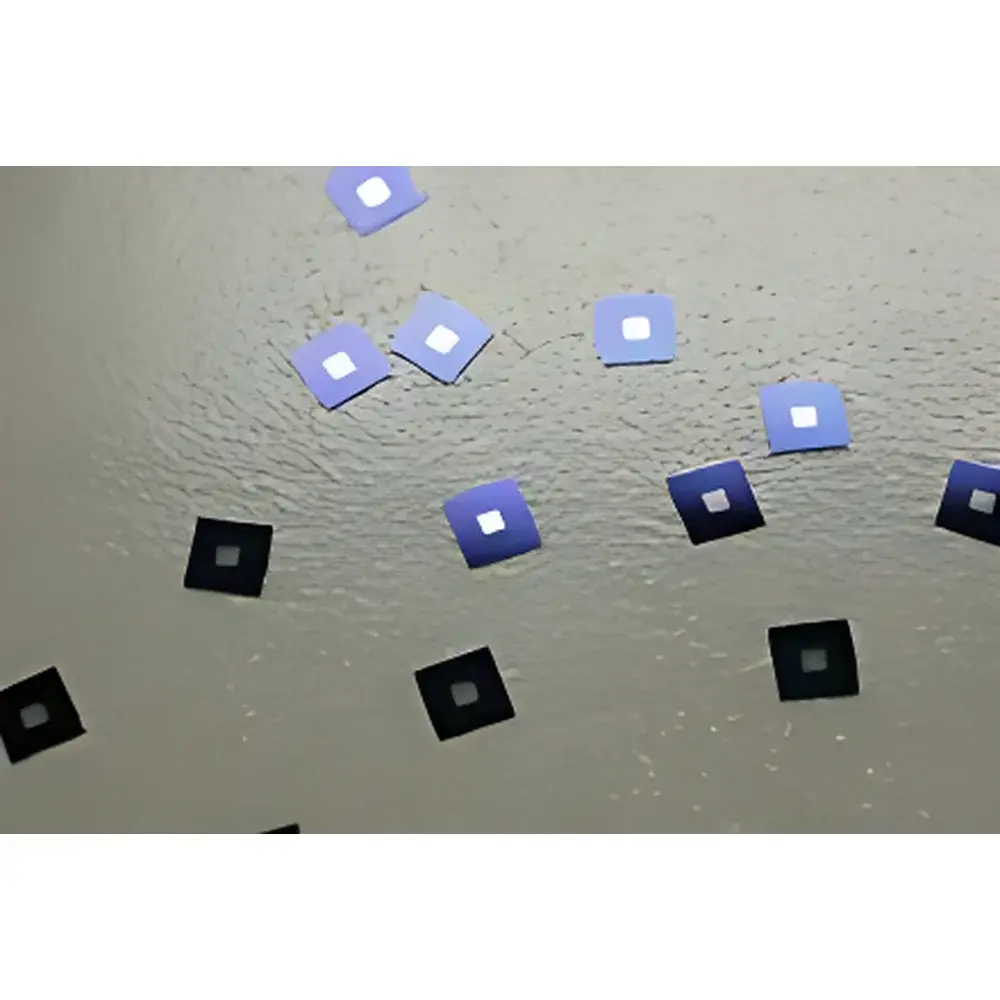
SHNTI SN-LDE Series Silicon Nitride Membrane Windows for Synchrotron X-ray Transmission Microscopy and Spectroscopy
| Brand | SHNTI |
|---|---|
| Origin | USA |
| Manufacturer Type | Authorized Distributor |
| Product Category | Imported |
| Model | SN-LDE |
| Pricing | Upon Request |
| Frame Dimensions | 5×5 mm, 7.5×7.5 mm, or 10×10 mm |
| Window Aperture | 1.0×1.0 mm to 5.0×5.0 mm (square) |
| Si₃N₄ Membrane Thickness | 50–200 nm (custom 30–500 nm, MOQ 100 pcs) |
| Frame Thickness | 200 µm, 381 µm, or 525 µm |
| Surface Roughness | <1 nm RMS |
| Max Operating Temperature | 1000 °C |
| Vacuum Rating | ≥1 atm differential pressure (dependent on membrane thickness & aperture size) |
| Chemical Stability | Inert, compatible with plasma, glow discharge, and mild chemical cleaning (no ultrasonication) |
Overview
The SHNTI SN-LDE Series Silicon Nitride Membrane Windows are precision-engineered microelectromechanical systems (MEMS)-fabricated substrates designed specifically for high-transmission soft X-ray applications in synchrotron radiation facilities, transmission electron microscopy (TEM), scanning electron microscopy (SEM), infrared (IR), and ultraviolet (UV) spectroscopy. These windows leverage low-stress silicon nitride (Si₃N₄) films—tensile stress controlled within 0–250 MPa—to achieve superior mechanical robustness compared to stoichiometric (ST) or LPCVD Si₃N₄ membranes. The ultra-thin, atomically smooth membranes (50–200 nm nominal thickness) maximize photon transmission in the vacuum ultraviolet (VUV) and soft X-ray regimes (e.g., C K-edge at 284 eV), where absorption scales inversely with membrane thickness and directly with incident angle. Their compatibility with off-axis beam geometries—critical for tomographic tilt-series acquisition and grazing-incidence experiments—makes them indispensable for quantitative transmission imaging and energy-dispersive X-ray spectroscopy (EDS/EDX) under ultra-high vacuum (UHV) or differential pumping environments.
Key Features
- MEMS-fabricated low-stress Si₃N₄ membranes with precisely controlled thickness (50, 100, 150, or 200 nm standard; custom 30–500 nm available)
- Four standard frame formats: 5×5 mm, 7.5×7.5 mm, 10×10 mm—with corresponding square apertures ranging from 1.0×1.0 mm to 5.0×5.0 mm
- Three substrate thickness options: 200 µm (standard), 381 µm, and 525 µm—selected based on mechanical stability requirements and vacuum flange compatibility
- Atomic-scale surface flatness (<1 nm RMS roughness), ensuring minimal wavefront distortion for coherent X-ray imaging and diffraction
- Thermal stability up to 1000 °C in inert or reducing atmospheres—enabling in situ CVD growth of nanomaterials directly on the membrane
- Chemically inert platform compatible with O₂ plasma, Ar glow discharge, and ethanol/isopropanol rinsing—strictly prohibited for ultrasonic cleaning due to risk of membrane rupture
- Optional functionalized variants: Au-coated (10 nm) configurations for enhanced conductivity and electron transparency; SiO₂ membrane alternatives for complementary spectral transmission profiles
Sample Compatibility & Compliance
The SN-LDE windows support a broad range of specimen types including hydrated biological cells, polymer thin films, colloidal suspensions, aerogels, and self-assembled monolayers (SAMs). Post-plasma treatment imparts uniform hydrophilicity, facilitating even spreading of aqueous samples. Each batch undergoes rigorous vacuum integrity testing per ASTM E493-20 (Standard Practice for Leak Detection Using Helium Mass Spectrometer) and is certified for sustained 1 atm differential pressure across defined aperture/thickness combinations (e.g., ≥100 nm film supports ≤1.5×1.5 mm aperture at ambient temperature). The product conforms to ISO 14644-1 Class 5 cleanroom handling protocols during final packaging and is supplied in hermetically sealed, particle-free containers suitable for UHV load-lock insertion. While not FDA-regulated as a medical device, its material composition (Si₃N₄) and fabrication process comply with ISO 10993-5 cytotoxicity screening prerequisites for research-grade biospecimen carriers.
Software & Data Management
As a passive substrate, the SN-LDE window requires no embedded firmware or driver software. However, it integrates seamlessly into established synchrotron data acquisition workflows—including those using Bluesky, EPICS, or Tango control frameworks—where window metadata (frame ID, membrane thickness, aperture geometry) is programmatically logged alongside experimental parameters (photon energy, detector distance, exposure time) in HDF5 or NeXus-compliant files. For TEM/SEM users, the window’s consistent thickness and low background scattering enable automated contrast normalization and drift correction in serial section tomography pipelines (e.g., IMOD, TomoJ). All product SKUs are traceable via unique lot numbers linked to MEMS wafer-level test reports, including thickness uniformity maps (±3% CV across aperture) and tensile stress verification data—available upon request for GLP/GMP-aligned facility audits.
Applications
- Synchrotron-based soft X-ray transmission microscopy (TXM) and spectromicroscopy at beamlines such as BL08U1A (Shanghai Synchrotron Radiation Facility), ALS Beamline 5.3.2, or PETRA III P06
- In situ and operando characterization of catalytic nanoparticles, battery electrode interfaces, and 2D material heterostructures under thermal or reactive gas environments
- High-resolution cryo-TEM sample support for vitrified biological specimens, leveraging membrane hydrophilicity and minimal ice contamination
- IR and UV-Vis spectroscopy of ultra-thin films where conventional CaF₂ or KBr windows introduce unacceptable absorption or scattering
- Substrate for direct deposition of functional coatings (e.g., graphene, MoS₂, metal-organic frameworks) prior to X-ray absorption fine structure (XAFS) analysis
- Microfluidic cell encapsulation platforms for time-resolved X-ray imaging of dynamic processes (e.g., droplet coalescence, phase separation)
FAQ
Can SN-LDE windows be reused after plasma cleaning?
No. These are single-use components. Repeated plasma exposure degrades membrane stoichiometry and increases defect density, compromising vacuum integrity and X-ray transmission consistency.
What is the maximum recommended tilt angle for off-axis X-ray illumination?
For 100 nm membranes with 1.5×1.5 mm apertures, tilt angles up to ±30° are routinely validated at 284 eV photon energy without measurable transmission loss or mechanical deformation.
Are custom frame geometries (e.g., circular apertures or non-square layouts) available?
Yes—custom photomask design and deep-reactive ion etching (DRIE) processes support non-standard apertures and multi-window arrays (e.g., 3×3, 4×4), subject to minimum order quantity and lead-time agreement.
How does membrane thickness affect energy-dependent transmission efficiency?
Transmission follows an exponential decay model: T(E) ≈ exp(−μ(E)·t), where μ(E) is the mass attenuation coefficient and t is thickness. At the oxygen K-edge (543 eV), 50 nm Si₃N₄ achieves >85% transmission versus ~45% for 200 nm—making thickness selection critical for edge-jump sensitivity.
Is there documentation supporting vacuum compatibility for differential pumping stages?
Yes—each product datasheet includes empirically validated pressure-difference vs. aperture-area curves derived from leak-rate measurements conducted in accordance with ISO 20483-2017 for micro-membrane integrity assessment.






