
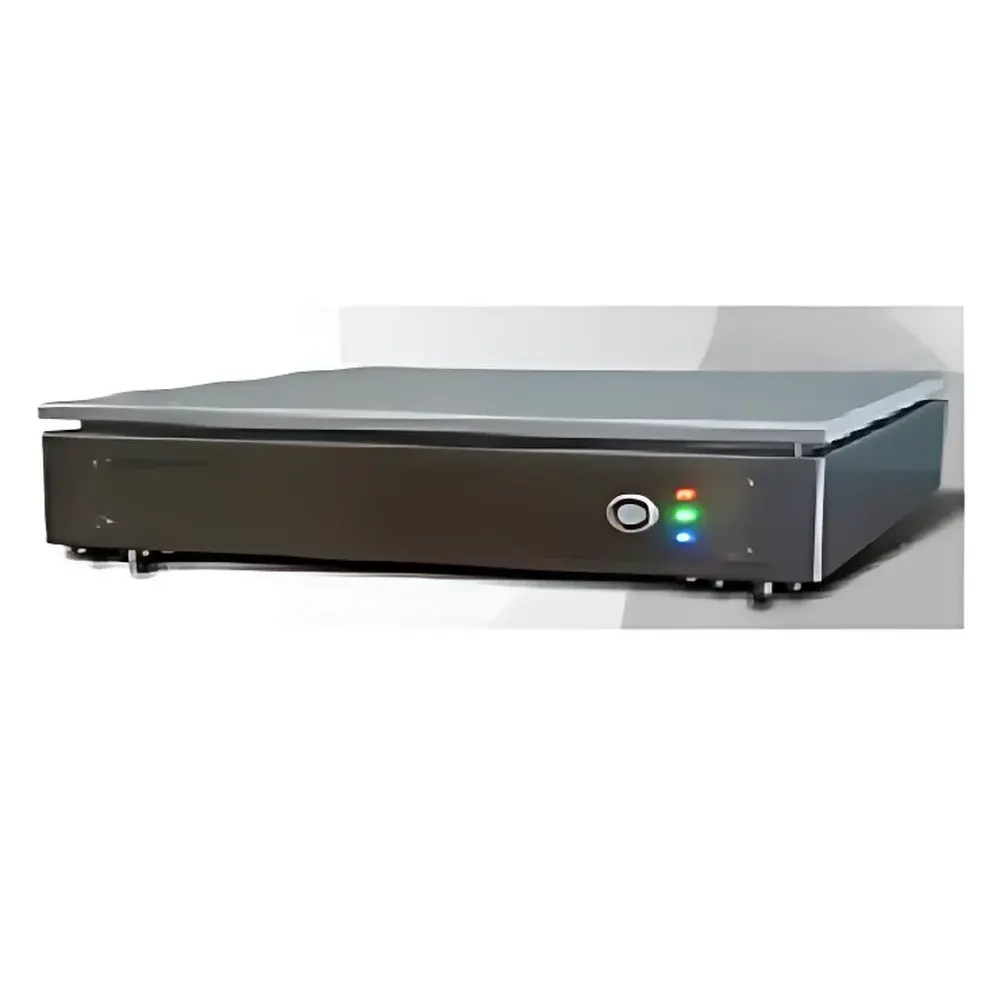
AMT Active Vibration Isolation Table
| Brand | SHNTI |
|---|---|
| Origin | Shanghai, China |
| Model | AMT |
| Type | Desktop Active Vibration Isolation System |
| Control Architecture | Digital Adaptive Feedback + Bottom-Mounted Feedforward |
| Sensor Configuration | Triaxial Floor-Mounted + Platform-Mounted Accelerometers |
| Stability | Robust Control Algorithm with Long-Term Drift Compensation |
| Compliance | Designed for ISO 20483 Class 1–2 Laboratory Environments |
| Load Capacity | Up to 50 kg (typical for mid-size AFM, optical interferometers, nanoindenter systems) |
| Interface | Ethernet/USB, Web-Based GUI with Real-Time Monitoring |
Overview
The AMT Active Vibration Isolation Table is a compact, desktop-grade active vibration control system engineered for high-sensitivity metrology and nanoscale characterization applications. Unlike passive damping platforms that rely solely on mechanical compliance and mass inertia, the AMT employs a hybrid control architecture combining real-time feedback and floor-level feedforward compensation. It operates on the principle of force cancellation: triaxial accelerometers mounted both beneath the isolation platform (feedforward path) and directly on the payload interface (feedback path) continuously monitor vibrational disturbances across 0.5–100 Hz. A digital signal processor computes counteracting actuation forces—delivered via electromagnetic actuators—to suppress transmitted motion with sub-micron residual displacement performance. This dual-path strategy specifically targets low-frequency structural vibrations (<10 Hz), such as those induced by HVAC systems, footfall, or nearby machinery—common limiting factors in atomic force microscopy (AFM), scanning white-light interferometry (SWLI), and laser Doppler vibrometry setups.
Key Features
- Hybrid Dual-Path Control: Integrates bottom-mounted triaxial feedforward sensing with platform-integrated feedback accelerometers to decouple environmental ground-borne noise from payload-induced dynamics.
- Adaptive Digital Control Loop: Automatically identifies system transfer functions during initialization and iteratively optimizes controller gains without manual tuning—eliminating dependency on operator expertise for gain separation or phase margin calibration.
- Robust Stability Architecture: Implements H∞-based robust control design to maintain closed-loop stability under variable payload mass, center-of-gravity shifts, and ambient vibration amplitude fluctuations exceeding ±50 µm/s² RMS.
- Self-Leveling Mechanism: Integrated piezoelectric tilt sensors and motorized leveling feet enable automatic horizontal alignment within ±0.02° tolerance, ensuring optical axis stability for interferometric and confocal systems.
- Modular Interface & Diagnostics: Ethernet and USB 2.0 connectivity support remote configuration, real-time spectral monitoring, and event-triggered logging; firmware updates and parameter backups are performed via browser-based GUI.
Sample Compatibility & Compliance
The AMT is validated for use with instruments requiring vibration transmissibility ≤ 0.1 at 2 Hz and ≤ 0.01 at 5 Hz—meeting ISO 20483:2021 Class 1 specifications for nanometrology laboratories. It supports payloads up to 50 kg with moment-of-inertia constraints compatible with commercial AFMs (e.g., Bruker Dimension Icon), optical profilers (Zygo NewView), and nanoindenters (Hysitron TI 950). The system complies with CE marking requirements for EMC Directive 2014/30/EU and Low Voltage Directive 2014/35/EU. While not certified to FDA 21 CFR Part 11, its audit-trail-capable logging module supports GLP/GMP-aligned documentation practices when integrated into validated laboratory workflows.
Software & Data Management
The AMT is managed through a web-hosted application accessible via standard HTML5 browsers—no client installation required. The interface provides live FFT spectra (0.1–200 Hz, 0.1 Hz resolution), time-domain waveform capture (up to 10 kHz sampling), and configurable alarm thresholds for RMS acceleration deviation. All operational parameters—including sensor calibration offsets, gain matrices, and leveling history—are stored in non-volatile memory with timestamped version control. Export formats include CSV (time-series), PNG (spectral plots), and JSON (system metadata), facilitating integration with LabVIEW, MATLAB, or LIMS platforms. Firmware revisions follow semantic versioning (e.g., v2.3.1), with changelogs documenting traceable improvements to noise floor reduction and thermal drift compensation.
Applications
- Atomic Force Microscopy (AFM) and Scanning Tunneling Microscopy (STM) in ambient and controlled-environment chambers
- Optical coherence tomography (OCT) and digital holographic microscopy requiring sub-wavelength path-length stability
- Nanoindentation and microscratch testing where load-frame resonance compromises modulus measurement fidelity
- Laser-based particle sizing and dynamic light scattering (DLS) systems sensitive to Brownian motion artifacts from platform jitter
- Calibration laboratories performing ISO/IEC 17025-compliant dimensional metrology with coordinate measuring machines (CMMs) or gauge block comparators
FAQ
What is the minimum recommended floor vibration level for optimal AMT performance?
The AMT achieves specified attenuation down to floor vibration levels of ≤ 10 µm/s² RMS below 10 Hz. For sites exceeding 50 µm/s² RMS in the 2–5 Hz band, supplemental passive base isolation (e.g., concrete pier or pneumatic slab) is advised.
Does the AMT require periodic recalibration?
No scheduled recalibration is required. The adaptive control algorithm continuously validates sensor response and actuator linearity; however, annual verification using NIST-traceable shaker excitation (per ISO 10816-1 Annex B) is recommended for GxP environments.
Can the AMT be integrated into a cleanroom environment?
Yes—the enclosure meets IP54 ingress protection, and all internal components are RoHS-compliant with non-outgassing elastomers suitable for ISO Class 5 cleanrooms.
Is third-party software SDK support available?
A documented RESTful API (JSON over HTTPS) enables programmatic access to status, control, and diagnostic endpoints; Python and C++ reference libraries are provided under MIT license.



