
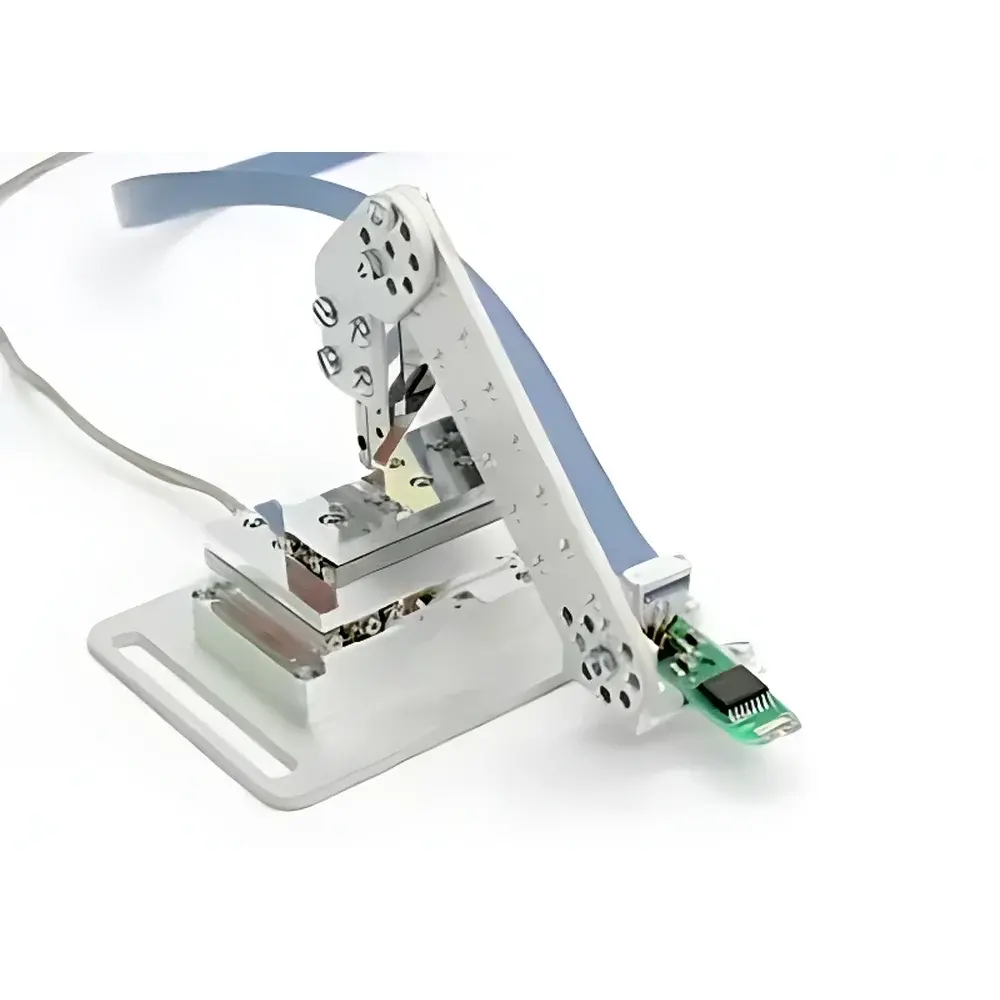
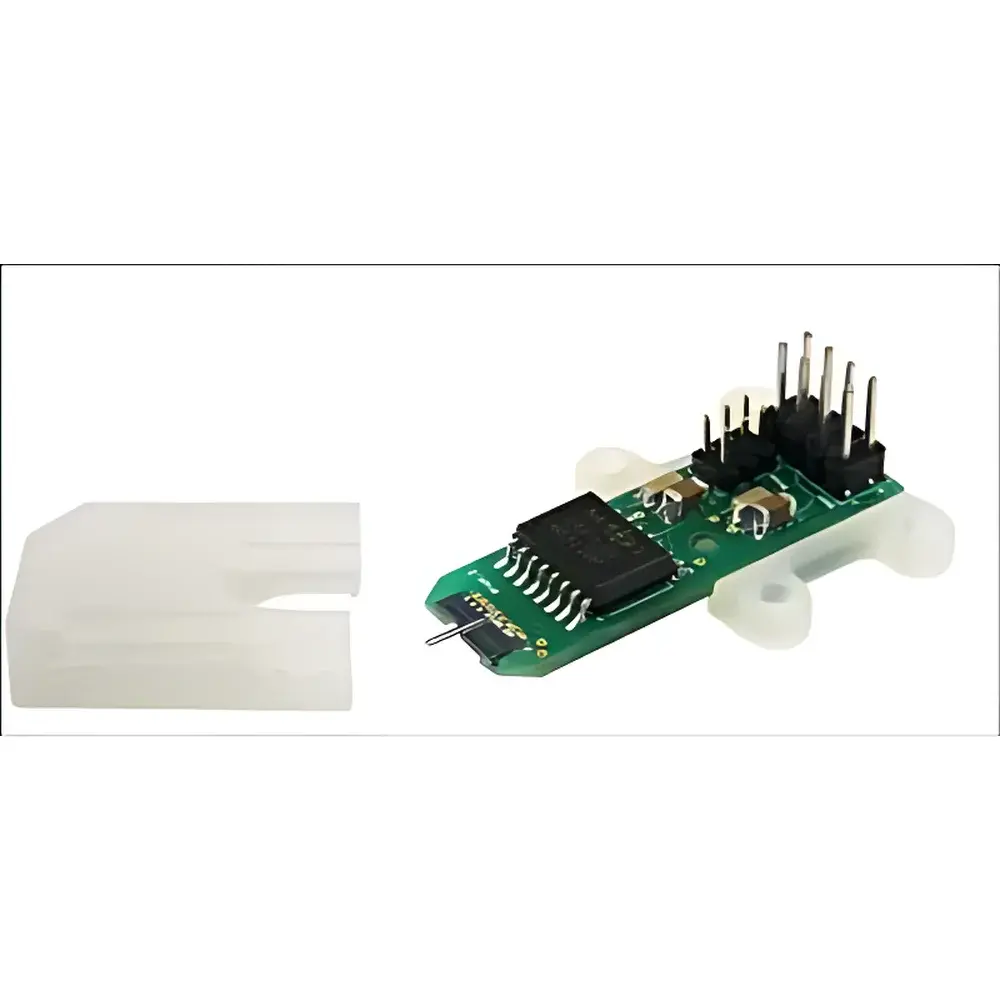
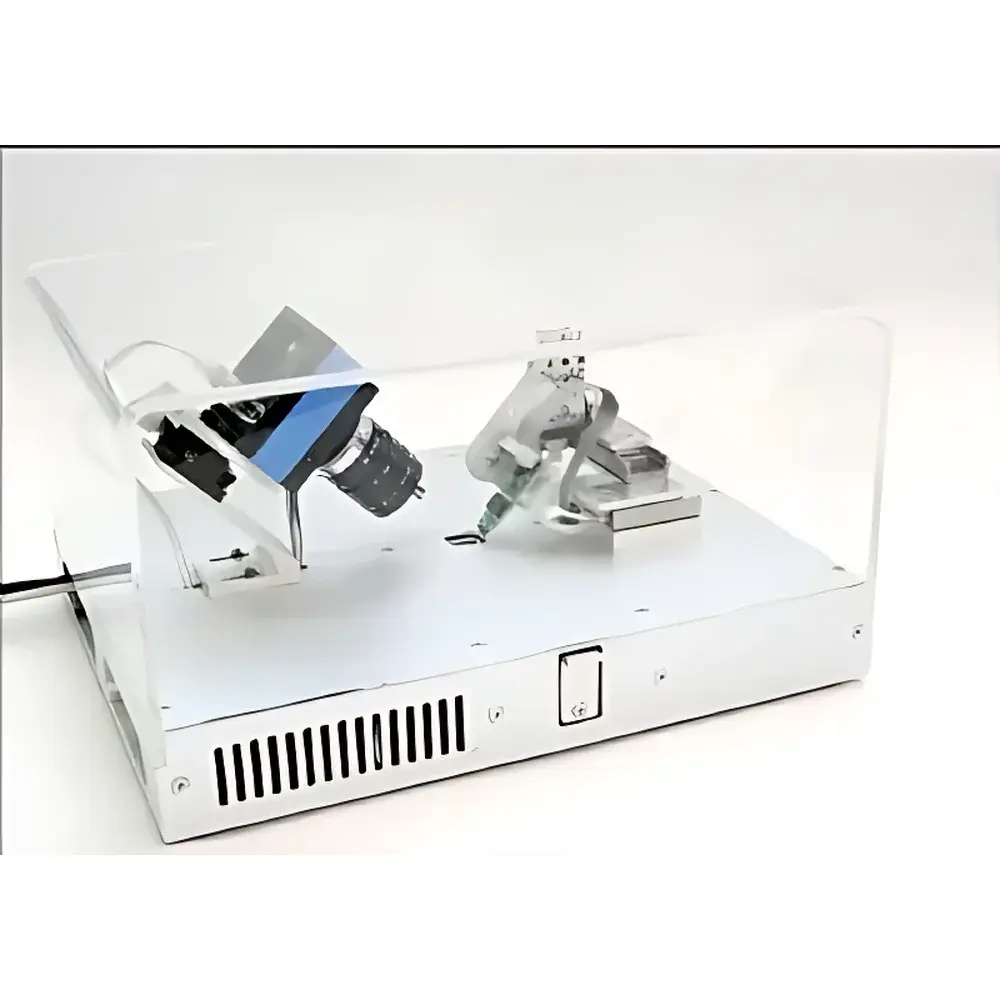
FemtoTools FT-G Series Nanomanipulator
| Brand | FemtoTools |
|---|---|
| Origin | Switzerland |
| Model | FT-G Series Nanotweezers (FT-G30, FT-G60, FT-G100) |
| Compatible Systems | FT-GS1000 Micro-Nano Assembler, FT-GS5000 Nano Assembly System |
| Controller | FT-GC01 Nanotweezer Controller |
| Operating Environments | Ambient air, liquid, and high vacuum (SEM-compatible) |
| Force Feedback | Integrated capacitive force sensor (FT-G30 & FT-G100) |
| Displacement Resolution | <1 nm |
| Force Resolution | <100 pN |
Overview
The FemtoTools FT-G Series Nanomanipulators are precision electrostatic nanotweezers engineered for real-time mechanical interrogation and manipulation of micro- to nanoscale objects within scanning electron microscopes (SEM), focused ion beam (FIB) systems, and environmental chambers. Unlike conventional piezoelectric or thermal actuators, the FT-G platform employs monolithic silicon MEMS architecture with integrated capacitive force sensing—enabling simultaneous nanoscale positioning and quantitative mechanical feedback during manipulation. Each device operates on the principle of electrostatic comb-drive actuation, delivering sub-nanometer displacement resolution and piconewton-level force sensitivity without hysteresis or thermal drift. Designed for in situ SEM nanomechanics, the FT-G series supports direct observation of deformation, fracture, adhesion, and viscoelastic response of individual nanowires, biological cells, MEMS components, and 2D materials under controlled loading conditions.
Key Features
- Monolithic silicon MEMS construction ensures long-term stability, >10⁷ operational cycles, and immunity to creep or fatigue-induced calibration drift.
- Integrated capacitive force transduction—available on FT-G30 and FT-G100 models—provides real-time, calibrated force feedback with <100 pN resolution and traceable NIST-traceable calibration certificates.
- Dual independent electrode configuration enables asymmetric potential application across tweezer arms, facilitating dielectrophoretic positioning and selective electrostatic trapping of insulating specimens.
- Sub-1 nm closed-loop displacement resolution achieved via embedded position-sensing electrodes and proprietary FPGA-based servo control.
- Full environmental compatibility: validated operation in high vacuum (<10⁻⁶ mbar), ambient air, and aqueous environments—including buffered saline and cell culture media—without performance degradation.
- Plug-and-play integration via USB 2.0 interface and FT-GC01 dedicated controller, supporting deterministic command protocols (SCPI-compliant) for automated scripting in Python, MATLAB, or LabVIEW.
- Customizable jaw geometry—including tip radius, opening angle, and arm length—to match specimen morphology and experimental constraints (e.g., TEM grid mounting, AFM cantilever handling).
Sample Compatibility & Compliance
The FT-G Series accommodates specimens ranging from 1 µm to 400 µm in lateral dimension, including brittle semiconductor nanowires, polymer microbeads, lipid vesicles, carbon nanotubes, and live adherent cells. Its low-inertia actuation and non-contact electrostatic engagement minimize sample damage during pickup and release. All models comply with IEC 61000-6-3 (EMC emissions) and IEC 61000-6-2 (immunity). Force sensor calibration adheres to ISO/IEC 17025 requirements through accredited third-party verification. For regulated environments, the FT-GC01 controller supports audit-trail logging and user-access controls aligned with FDA 21 CFR Part 11 principles when deployed in GLP/GMP-aligned nanomaterial characterization workflows.
Software & Data Management
The FemtoTools Control Suite (v4.x) provides a modular GUI for manual operation, script-based automation, and synchronized acquisition of force–displacement–time datasets. Raw sensor data is streamed at up to 10 kHz with 16-bit ADC resolution and timestamped using internal hardware clocks synchronized to external triggers (e.g., SEM frame sync). Export formats include HDF5 (with metadata schema compliant with FAIR principles), CSV, and MATLAB .mat. The software includes built-in modules for Hertzian contact modeling, elastic modulus extraction (via Oliver–Pharr correction), and adhesion energy quantification—validated against ASTM E2546-22 standards for nanomechanical testing of thin films.
Applications
- In situ mechanical testing of nanowires and nanotubes inside SEM/FIB platforms, including tensile failure analysis and bending stiffness mapping.
- Single-cell biomechanics: compression, indentation, and shear testing of erythrocytes, neurons, and cancer spheroids under physiological media.
- Nanofabrication support: precise placement and alignment of photonic crystals, plasmonic antennas, and quantum dot arrays onto substrates.
- Failure analysis of MEMS/NEMS devices: probing stiction, anchor yield, and package-induced stress relief mechanisms.
- Interfacial mechanics: measuring pull-off forces between colloidal particles and functionalized surfaces to quantify van der Waals, electrostatic, and hydration contributions.
- Microelectromechanical system (MEMS) probe card calibration and validation in wafer-level test environments.
FAQ
What vacuum levels are supported for SEM integration?
The FT-G Series is rated for continuous operation in high vacuum down to 1×10⁻⁷ mbar, with bake-out compatibility up to 80 °C. All moving parts are dry-lubricated with MoS₂-coated silicon surfaces to prevent outgassing.
Is force calibration traceable to national standards?
Yes—capacitive force sensors are factory-calibrated using primary-standard electrostatic actuators traceable to PTB (Physikalisch-Technische Bundesanstalt) and accompanied by ISO/IEC 17025-accredited calibration reports.
Can the FT-G be used in liquid for live-cell experiments?
Absolutely—the FT-G30 and FT-G100 models feature hermetically sealed actuation channels and gold-plated electrodes optimized for electrochemical stability in PBS, DMEM, and other biocompatible buffers.
How is positional accuracy maintained under thermal drift?
Thermal drift is mitigated via on-chip differential position sensing and real-time closed-loop correction; typical drift rates are <0.5 nm/min at 23 °C ambient, verified per ISO 20957-4 Annex C protocols.
Does the system support third-party automation frameworks?
Yes—SCPI command set and TCP/IP API enable seamless integration with custom LabVIEW VIs, Python-based control stacks (e.g., PySerial + NumPy), and industrial PLCs via Modbus TCP gateway adapters.



