
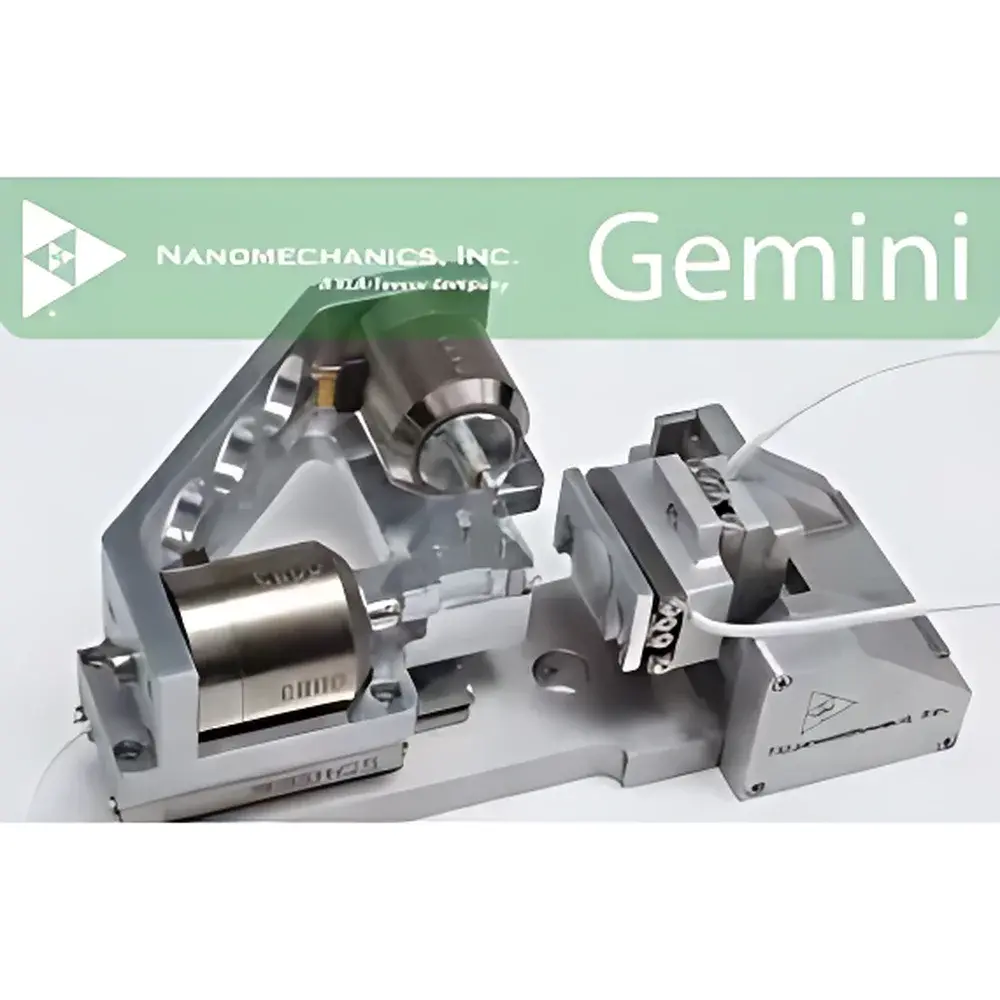
KLA Gemini Nanoindentation and Scratch Testing System
| Brand | KLA |
|---|---|
| Origin | USA |
| Manufacturer Type | Authorized Distributor |
| Product Category | Imported Instrument |
| Model | Gemini |
| Price Range | USD $65,000 – $130,000 |
| Instrument Type | Multi-Axis Nanomechanical Testing System |
| Maximum Indentation Depth | 50 µm |
| Effective Load Range | 50 mN |
| Load Resolution | 3 nN |
| Displacement Range | 50 µm |
| Displacement Resolution | 4 nm |
| Maximum Friction Force | 50 mN |
| Indenter Tip Material | Single-Crystal Diamond |
Overview
The KLA Gemini Nanoindentation and Scratch Testing System is a purpose-built, multi-axis nanomechanical characterization platform engineered for high-fidelity measurement of contact mechanics, tribological behavior, and dynamic mechanical response at sub-micron length scales. Unlike conventional single-axis nanoindenters, the Gemini employs a true isotropic force–displacement transduction architecture—where normal (Z) and lateral (X/Y) axes share identical metrological traceability, bandwidth, and resolution—enabling concurrent, time-synchronized acquisition of load, displacement, friction force, and lateral displacement during indentation, scratching, and sliding protocols. This design eliminates axis-dependent calibration drift and cross-talk artifacts, making it uniquely suited for quantitative studies of adhesion hysteresis, stick–slip dynamics, viscoelastic dissipation, and anisotropic deformation in thin films, coatings, MEMS structures, and 2D materials. The system operates under ambient or controlled environmental conditions and is designed to meet the metrological rigor required for R&D labs pursuing ISO/IEC 17025-compliant nano-mechanical testing.
Key Features
- Isotropic multi-axis sensing architecture with matched 3 nN load resolution and 4 nm displacement resolution on all three primary axes (Z, X, Y)
- Dynamic bandwidth up to 50 kHz, enabling sub-20 µs time-constant measurements with sub-nanometer noise floor
- Integrated electromagnetic actuation with ultra-low thermal drift (<0.5 nN/h) and high frame stiffness (7 × 10⁵ N/m)
- Simultaneous acquisition of normal force, lateral force, vertical displacement, and lateral displacement with hardware-synchronized sampling
- Dual-mode operation: quasi-static loading (for hardness, modulus, fracture toughness) and dynamic oscillatory testing (for loss tangent, storage/loss moduli)
- Automated tip certification and area function calibration per ASTM E2546 and ISO 14577-1 standards
- Motorized, high-precision XYZ sample stage with 100 mm travel and sub-10 nm repeatability
Sample Compatibility & Compliance
The Gemini accommodates rigid and compliant substrates ranging from silicon wafers and optical glasses to polymer films, metallic coatings, and biological hydrogels. Its low-force capability (down to 3 nN) and high-resolution displacement control enable reliable characterization of ultra-thin layers (<5 nm), self-assembled monolayers, and lubricant films without substrate interference. The system supports standardized test protocols aligned with ASTM E2546 (nanoindentation), ASTM D785 (scratch resistance), ISO 20519 (tribological mapping), and USP (mechanical testing of pharmaceutical films). All data acquisition and instrument control comply with FDA 21 CFR Part 11 requirements for electronic records and signatures when configured with audit-trail-enabled software modules.
Software & Data Management
Operation is managed via KLA’s proprietary NanoTest™ software suite, which provides scriptable test sequencing, real-time force–displacement loop visualization, and automated post-processing for hardness, reduced modulus, coefficient of friction, scratch track depth/width, and energy dissipation metrics. Raw data are stored in HDF5 format with embedded metadata (timestamp, environmental conditions, calibration history, operator ID), ensuring full traceability. Export options include CSV, MATLAB .mat, and industry-standard CDF formats compatible with third-party analysis tools such as MATLAB, Python (NumPy/Pandas), and OriginLab. Software validation packages—including IQ/OQ documentation and GxP configuration files—are available for GLP/GMP-regulated environments.
Applications
- Quantitative nanoscale hardness and elastic modulus mapping of hard coatings (e.g., TiN, DLC, Al₂O₃) and soft biomaterials
- Scratch adhesion testing of PVD/CVD coatings with real-time acoustic emission correlation
- Stick–slip transition analysis in boundary-lubricated interfaces and ionic liquid films
- Mechanical anisotropy assessment in textured metals, graphene, and ferroelectric oxides
- Poisson’s ratio determination via coupled lateral/normal displacement tracking during uniaxial indentation
- Damping coefficient extraction from phase-resolved dynamic nanoindentation
- Mechanical reliability screening of MEMS/NEMS devices under cyclic loading
- Surface topography–mechanics correlation using synchronized AFM-like scanning and local property mapping
FAQ
What standards does the Gemini system support for nanoindentation testing?
ASTM E2546, ISO 14577-1, and JIS Z 2244 are fully supported through built-in test templates, calibration workflows, and reporting modules.
Can the Gemini perform simultaneous nanoindentation and scratch testing on the same location?
Yes—the system enables sequential or interleaved indentation and scratch protocols with sub-100 nm positional repeatability using its closed-loop piezo stage and vision-based alignment.
Is the diamond indenter certified and replaceable by the user?
Each indenter is individually calibrated and certified per ISO 14577 Annex B; replacement is field-serviceable with KLA-supplied calibration kits and alignment fixtures.
Does the system support environmental control (temperature, humidity, vacuum)?
Yes—optional environmental chambers integrate seamlessly with the Gemini platform for tests under inert gas, high vacuum (10⁻⁶ Torr), or temperature ranges from −100 °C to +300 °C.
How is data integrity ensured for regulated laboratory use?
NanoTest™ includes role-based access control, electronic signatures, full audit trail logging, and 21 CFR Part 11-compliant e-record generation when deployed with validated server infrastructure.



