
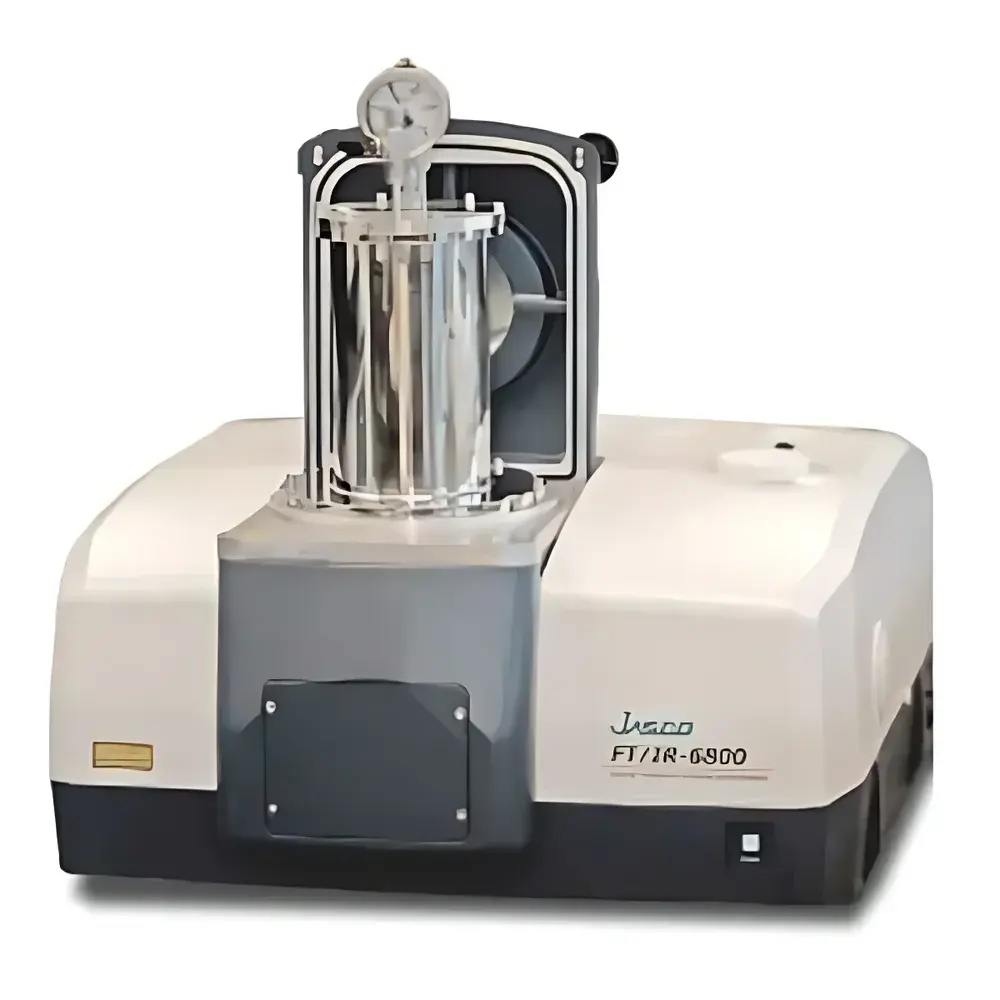
JASCO FT/IR-6X and FT/IR-8X Vacuum Fourier Transform Infrared Spectrometer
| Brand | JASCO |
|---|---|
| Origin | Japan |
| Instrument Type | Laboratory Benchtop |
| FTIR Architecture | Interferometer-Based Michelson Design |
| Wavenumber Range | 7800–400 cm⁻¹ |
| Spectral Resolution | 0.07 cm⁻¹ (unapodized, with He–Ne laser referencing) |
| Signal-to-Noise Ratio | 55,000:1 (at 4 cm⁻¹ resolution, 1 min scan, MCT detector, peak-to-peak) |
| Vacuum Performance | <10⁻³ Pa base pressure, <5×10⁻⁴ Pa during spectral acquisition |
| Optical Path Environment | Fully evacuated sample compartment and interferometer housing |
Overview
The JASCO FT/IR-6X and FT/IR-8X Vacuum Fourier Transform Infrared Spectrometers are high-stability, research-grade benchtop instruments engineered for ultra-sensitive molecular vibrational analysis under full vacuum conditions. Based on a precision Michelson interferometer architecture referenced by a stabilized He–Ne laser, these systems eliminate atmospheric interference—particularly from H₂O and CO₂—that fundamentally limits detection fidelity in conventional ambient-pressure FTIR. By evacuating the entire optical path—including the interferometer, beam splitter chamber, and sample compartment—to pressures below 5×10⁻⁴ Pa during data acquisition, the instruments deliver uncompromised spectral integrity across the full mid-IR range (7800–400 cm⁻¹). This vacuum integrity is essential for trace gas quantification at sub-ppm levels, low-absorbance thin-film characterization (e.g., monolayer adsorbates or ALD coatings), and time-resolved studies where background drift or water vapor condensation would otherwise degrade baseline stability and reproducibility.
Key Features
- Hermetically sealed optical train with active vacuum control: Dual-stage turbomolecular pumping system maintains stable sub-10⁻³ Pa base pressure; real-time pressure monitoring integrated into acquisition software.
- High-resolution spectral performance: 0.07 cm⁻¹ unapodized resolution enabled by high-precision mirror translation mechanics and laser-controlled position feedback.
- Optimized signal fidelity: 55,000:1 peak-to-peak S/N ratio achieved using liquid-nitrogen-cooled MCT detector, 128-scan coaddition at 4 cm⁻¹ resolution, and zero-filling interpolation without apodization artifacts.
- Dual-platform compatibility: FT/IR-6X configured for routine high-throughput analysis; FT/IR-8X adds motorized beam splitter selection (KBr, CsI, CaF₂), automated purge-gas interface, and optional cryogenic sample stage (-196°C to +300°C).
- Robust mechanical architecture: Monolithic optical baseplate, vibration-damped enclosure, and temperature-stabilized interferometer housing minimize thermal drift and ensure long-term wavenumber accuracy (<0.005 cm⁻¹/h).
Sample Compatibility & Compliance
The vacuum environment supports diverse sampling modalities including transmission cells (path lengths 0.1–100 mm, CaF₂ or BaF₂ windows), reflection accessories (variable-angle ATR, specular reflectance), and gas-phase flow cells (with heated inlet/outlet ports and pressure regulation up to 100 kPa absolute). All configurations maintain full vacuum integrity during operation. The system complies with ISO 17025 requirements for analytical instrument qualification, supports ASTM E1421 and USP guidelines for IR method validation, and provides full audit trail functionality aligned with FDA 21 CFR Part 11 for electronic records and signatures. GLP/GMP-compliant calibration protocols include NIST-traceable polystyrene film verification and water vapor reference spectra for vacuum leak diagnostics.
Software & Data Management
Spectra Manager™ C2 software (v3.5+) provides fully integrated vacuum control, real-time pressure logging synchronized with spectral acquisition, and automated leak-rate calculation. Data handling includes advanced baseline correction (Rubberband, Concave Rubberband), quantitative analysis via classical least-squares (CLS) and partial least-squares (PLS) regression, and spectral library search against commercial (Sadtler, Hummel) and custom-built databases. Raw interferogram and spectrum files are stored in open-format JCAMP-DX v6.00 with embedded metadata (vacuum pressure, detector bias, mirror velocity), enabling third-party processing in Python (SciPy), MATLAB, or R environments. All user actions—including parameter changes, calibration events, and vacuum cycle logs—are timestamped and stored in an encrypted SQLite audit database.
Applications
- Ultra-trace gas monitoring: Quantitative detection of NH₃, NOₓ, H₂S, and volatile organic compounds (VOCs) at concentrations ≤0.1 ppm in environmental or catalytic reaction effluents.
- Surface science: Characterization of self-assembled monolayers (SAMs), oxide interfacial layers, and 2D material phonon modes without atmospheric broadening.
- Pharmaceutical solid-state analysis: Identification of polymorphic transitions and hydrate/dehydrate kinetics under controlled vacuum, avoiding moisture-induced spectral artifacts.
- Materials degradation studies: Real-time tracking of oxidation, hydrolysis, or photolysis pathways in polymer films and battery electrolyte components.
- Fundamental spectroscopy: High-resolution rovibrational analysis of weakly absorbing species (e.g., isotopologues, transient radicals) requiring maximum spectral purity.
FAQ
How does full vacuum improve detection limits compared to purged systems?
Purged systems reduce—but do not eliminate—H₂O and CO₂ absorption; residual partial pressures cause non-linear baseline distortion and peak overlap. Full vacuum (99.99% of atmospheric gases, enabling linear Beer–Lambert behavior even for absorptions below 0.001 absorbance units.
Can the system operate with non-vacuum accessories?
Yes—standard transmission, ATR, and diffuse reflectance accessories are compatible, but vacuum integrity must be verified prior to acquisition; accessories with O-ring seals and metal gaskets are required for full-vacuum mode.
What maintenance is required for the vacuum system?
Turbomolecular pump oil-free operation requires only periodic inspection of foreline trap filters and annual calibration of the capacitance manometer; no routine oil changes or bake-out procedures are needed.
Is spectral wavenumber accuracy certified to international standards?
Yes—each instrument ships with NIST SRM 1921b polystyrene film certification report; wavenumber repeatability is validated per ISO 13777:2022 Annex B using 1619 cm⁻¹ and 1583 cm⁻¹ bands.
Does the software support automated method transfer between vacuum and ambient modes?
No—vacuum and ambient acquisitions use separate method templates due to fundamental differences in background collection, detector gain settings, and spectral post-processing requirements.




