
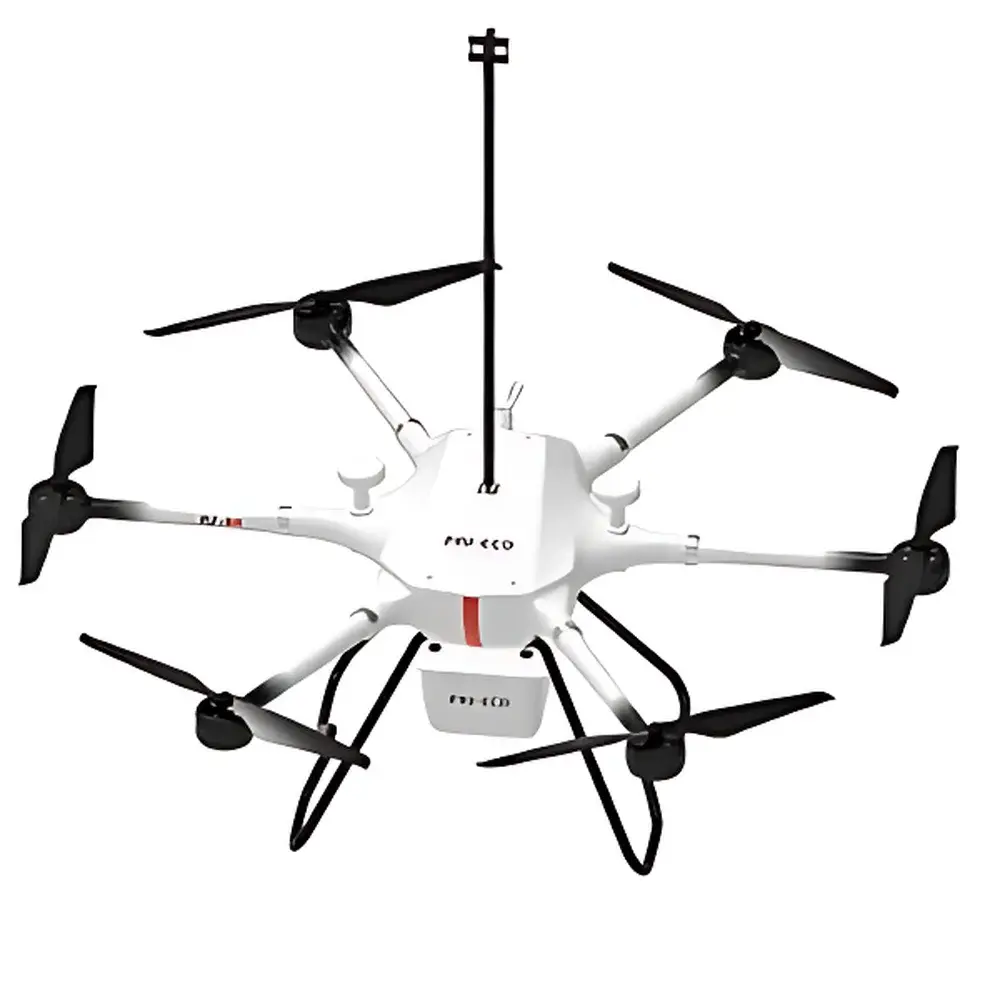
Pri-eco PRI-5251f Plus Multi-Gas UAV-Mounted Greenhouse Gas Analyzer System
| Brand | Pri-eco |
|---|---|
| Origin | Beijing, China |
| Manufacturer | Yes |
| Country of Origin | China |
| Model | PRI-5251f Plus |
| Detection Principle | Mid-Infrared Laser Direct Absorption Spectroscopy (MIRLAS) |
| Measured Gases | CO, CO₂, CH₄, N₂O, H₂O |
| Accuracy (1s) | 0.7 ppb (CO), 0.5 ppm (CO₂), 1 ppb (CH₄), 0.3 ppb (N₂O), 50 ppm (H₂O) |
| Accuracy (5s) | 0.5 ppb (CO), 0.4 ppm (CO₂), 0.5 ppb (CH₄), 0.25 ppb (N₂O), 40 ppm (H₂O) |
| Measurement Range | 0–500 ppm (CO), 0–3500 ppm (CO₂), 0–500 ppm (CH₄), 0–500 ppm (N₂O), 0–3 %v/v (H₂O) |
| Sampling Rate | 1 Hz |
| Operating Temperature | −10 to +45 °C |
| Relative Humidity Limit | <99% RH, non-condensing |
| Power Supply | DC |
| Power Consumption | 50 W |
| Weight | 8 kg |
| Data Output | Wi-Fi, USB, RS-232 |
Overview
The Pri-eco PRI-5251f Plus Multi-Gas UAV-Mounted Greenhouse Gas Analyzer System is an integrated, field-deployable measurement platform engineered for high-precision, real-time, in-situ quantification of five key atmospheric trace gases—carbon monoxide (CO), carbon dioxide (CO₂), methane (CH₄), nitrous oxide (N₂O), and water vapor (H₂O)—from aerial platforms. At its core lies the PRI-5251f Plus analyzer, which employs mid-infrared laser direct absorption spectroscopy (MIRLAS) operating in the fundamental vibrational absorption bands of each target gas. This technique delivers inherent selectivity, minimal cross-interference, and exceptional sensitivity without requiring optical cavity enhancement or high-reflectivity mirrors. The system is purpose-built for integration with lightweight unmanned aerial vehicles (UAVs), including the ELF-600 hexacopter, and incorporates synchronized micro-meteorological sensing (3D ultrasonic anemometry, air temperature, relative humidity, and barometric pressure) to enable flux calculation via eddy covariance or mass balance approaches.
Key Features
- ppb-level detection limits across all five analytes: 0.5 ppb (CO, 5 s), 0.4 ppm (CO₂, 5 s), 0.5 ppb (CH₄, 5 s), 0.25 ppb (N₂O, 5 s), and 40 ppm (H₂O, 5 s)
- Single-beam MIRLAS architecture with no moving parts or optical cavities—ensuring long-term stability and low system drift (<0.5% per month typical)
- Compact, ruggedized design optimized for UAV payload constraints: 8 kg total mass, 50 W nominal power draw, and operation over −10 to +45 °C ambient range
- Robust environmental tolerance: validated for continuous operation at up to 99% RH (non-condensing) and tested per MIL-STD-810G for shock, vibration, and thermal cycling
- Onboard data synchronization: precise timestamp alignment between gas concentration readings and meteorological parameters at 1 Hz native sampling rate
- Modular architecture supporting field recalibration, firmware updates, and optional post-processing modules for spectral baseline correction and pressure/temperature compensation
Sample Compatibility & Compliance
The PRI-5251f Plus is designed for ambient air sampling under uncontrolled field conditions. Its inlet configuration supports laminar flow control and heated sample lines to prevent condensation-induced bias in H₂O and volatile organic compound–sensitive measurements. The analyzer complies with ISO 14064-3 guidance for greenhouse gas monitoring system validation and meets technical criteria referenced in EPA Method TO-15 and ASTM D6348 for trace gas quantification. While not certified for regulatory emissions reporting per se, its performance characteristics align with Tier 2 instrumentation requirements defined in IPCC 2006 Guidelines for National Greenhouse Gas Inventories. All firmware and calibration protocols support audit-ready documentation per GLP principles, including full traceability of zero/span events, sensor health logs, and environmental metadata tagging.
Software & Data Management
Data acquisition and instrument control are managed via Pri-eco’s proprietary TerraLink™ software suite, compatible with Windows and Linux environments. The system outputs time-stamped ASCII files compliant with CF (Climate and Forecast) Metadata Conventions, enabling seamless ingestion into Python-based analysis pipelines (e.g., EddyPro®, TK3, or custom PyFlux workflows). Real-time telemetry—including raw spectra, concentration values, diagnostic flags, and meteorological vectors—is accessible via Wi-Fi, RS-232, or USB-C interfaces. Firmware supports remote diagnostics, over-the-air updates, and configurable alarm thresholds. Audit trails—including user login history, parameter changes, and calibration records—are retained locally and exportable in CSV format to satisfy internal QA/QC or external verification requirements under ISO/IEC 17025.
Applications
- Aerial eddy covariance flux mapping over agricultural soils, wetlands, landfills, and forest canopies
- Mobile source emission characterization (e.g., livestock facilities, biogas plants, municipal waste transfer stations)
- Boundary layer profiling and vertical gradient studies for atmospheric transport modeling
- Validation of satellite-derived GHG column retrievals (e.g., OCO-2/3, TROPOMI, GOSAT)
- Baseline monitoring for CCUS (Carbon Capture, Utilization, and Storage) site integrity assessment
- Urban air quality surveys integrating CO as a combustion tracer alongside CO₂ and CH₄
FAQ
What is the recommended calibration frequency for field deployment?
Calibration is recommended every 3–6 months depending on operational intensity; zero checks should be performed daily using certified synthetic air, and span verification with NIST-traceable standards is advised weekly during active campaigns.
Can the system operate autonomously on battery power?
Yes—the 50 W power requirement allows integration with high-capacity UAV batteries or external LiFePO₄ packs (e.g., 24 V / 10 Ah), supporting >90 minutes of continuous flight time when paired with the ELF-600 platform.
Is spectral interference between CH₄ and N₂O corrected in real time?
Yes—multi-gas fitting algorithms apply constrained least-squares regression across overlapping MIR absorption features, with factory-characterized cross-sensitivity coefficients embedded in the spectral inversion engine.
Does the system meet FDA 21 CFR Part 11 requirements?
While primarily intended for environmental research, the TerraLink™ software optionally supports electronic signatures, audit trail logging, and role-based access control—features that may be configured to align with Part 11 expectations for regulated applications.
How is water vapor interference handled in CO₂ and CH₄ quantification?
H₂O concentration is measured simultaneously and used as a dynamic input to the radiative transfer model; pressure-broadening and line-mixing effects are pre-compensated using HITRAN-based parameters optimized for ambient tropospheric conditions.







