
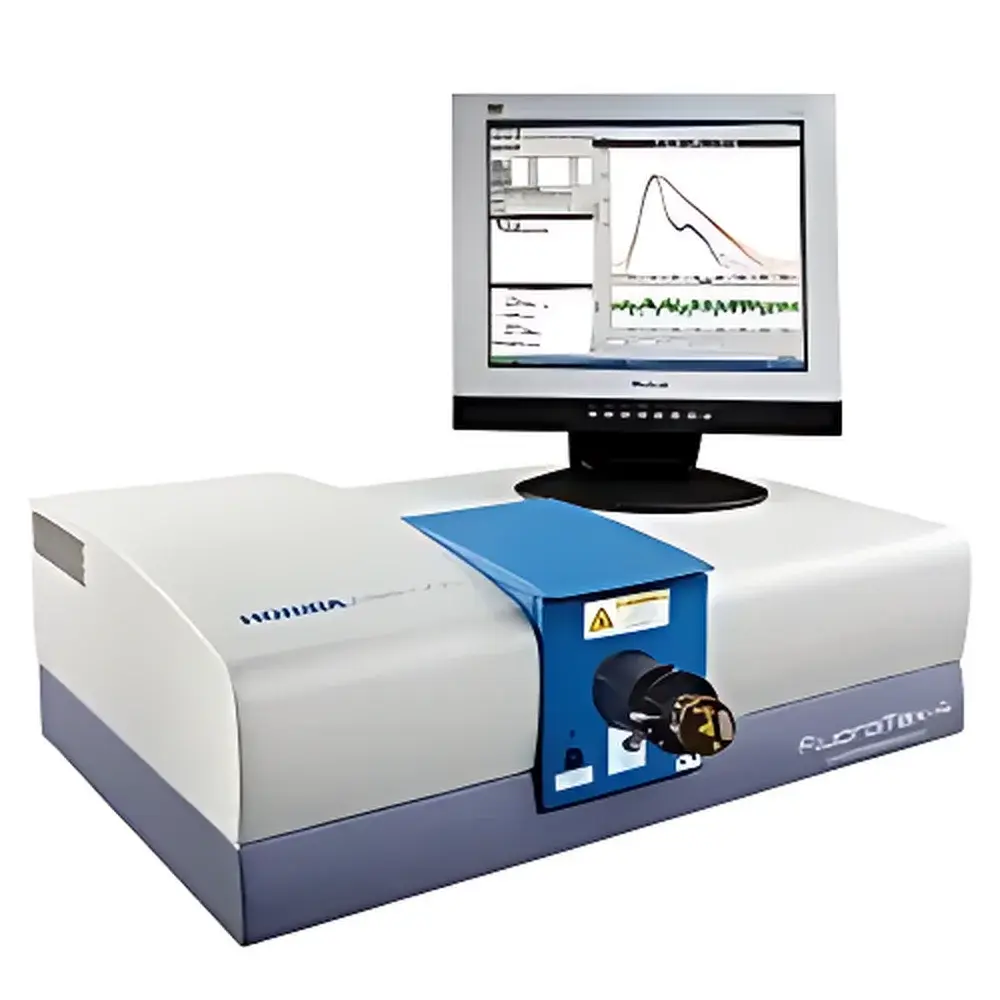
HORIBA Scientific FluoroMax-4 High-Sensitivity Integrated Fluorescence Spectrometer
| Brand | HORIBA |
|---|---|
| Origin | USA |
| Model | FluoroMax-4 |
| Wavelength Accuracy | ±0.5 nm |
| Spectral Bandwidth (Slit Width) | 0–30 nm |
| Optical Resolution | 0.2 nm |
| Sensitivity | >6000:1 (RMS method reported as up to 16,000:1) |
| Excitation Source | 150 W ozone-free Xenon lamp (vertically mounted) |
| Monochromator Type | Plane grating, Czerny-Turner design |
| Detection Mode | Photon counting |
| Optional Upgrades | TCSPC fluorescence lifetime module, phosphorescence lifetime unit, IR extension, integrating sphere, TIRF, Stop-Flow, polarization, temperature-controlled stages (Peltier & LN₂), microplate reader, microscope coupling |
Overview
The HORIBA Scientific FluoroMax-4 is a high-performance, fully automated molecular fluorescence spectrometer engineered for precision steady-state and time-resolved photoluminescence measurements. Based on a reflective Czerny-Turner optical architecture with plane gratings and no transmissive optics, the system eliminates chromatic aberration—ensuring wavelength fidelity, photometric accuracy, and long-term signal stability across the UV-Vis-NIR range (typically 185–1000 nm, dependent on detector and grating configuration). Its photon-counting detection architecture delivers exceptional signal-to-noise ratio, enabling reliable quantification of weakly fluorescent samples, dilute biomolecules, quantum dots, and low-yield phosphors. The instrument supports both intensity-based quantification and advanced kinetic analysis, including millisecond-scale phosphorescence decay profiling—and can be upgraded with time-correlated single-photon counting (TCSPC) hardware for sub-nanosecond fluorescence lifetime resolution.
Key Features
- Monolithic all-reflective optical platform: All mirrors, gratings, and detectors are rigidly mounted on a single aluminum baseplate, minimizing thermal drift and mechanical misalignment.
- Computer-controlled continuously variable slits: Adjustable spectral bandwidth from 0 to 30 nm with <0.2 nm resolution, enabling precise control over signal throughput and spectral resolution.
- Dual-channel detection architecture: Simultaneous monitoring of sample and reference beams via a stabilized silicon photodiode reference channel, ensuring real-time correction for lamp intensity fluctuations.
- Vertical 150 W ozone-free xenon arc lamp: Optimized for stable output in the deep UV (down to 185 nm) without requiring external ozone evacuation systems.
- Integrated isolation partition: Separates the sample compartment from the optical bench to reduce dust accumulation, humidity exposure, and thermal convection—extending mirror coating lifetime and calibration stability.
- Modular expansion interface: Standard electrical, optical, and mechanical ports support seamless integration of optional modules including TCSPC electronics, phosphorescence delay units, cryogenic sample holders, and fiber-optic coupling kits.
Sample Compatibility & Compliance
The FluoroMax-4 accommodates a broad range of sample formats—including cuvettes (1–250 µL), solid substrates, powders, thin films, microplates (96-/384-well), and flow cells—via interchangeable sample holders and accessory mounts. Temperature control is supported from –196 °C (liquid nitrogen) to +150 °C (Peltier or heated stages), with programmable ramping and isothermal stability ≤±0.1 °C. All firmware and software comply with GLP/GMP documentation requirements, supporting 21 CFR Part 11–compliant audit trails, electronic signatures, and secure user access levels when configured with HORIBA’s Synapse™ Data Acquisition Suite. Instrument performance adheres to ISO 17025 traceable calibration protocols, and spectral accuracy meets ASTM E275 and USP guidelines for fluorescence instrumentation validation.
Software & Data Management
Controlled by HORIBA’s Synapse software (v5.x or later), the FluoroMax-4 provides intuitive workflow-driven acquisition, real-time spectral preview, multi-dimensional mapping (excitation-emission matrices, lifetime decays, anisotropy), and automated baseline correction algorithms. Raw data is stored in vendor-neutral HDF5 format with embedded metadata (wavelengths, slit widths, integration times, detector gain, temperature logs). Batch processing supports custom scripting (Python API), peak deconvolution (Gaussian/Lorentzian fitting), Stern-Volmer analysis, Förster resonance energy transfer (FRET) modeling, and quantum yield calculation (PLQY) using integrated integrating sphere accessories. Data export options include CSV, ASCII, JCAMP-DX, and direct linkage to MATLAB, OriginLab, and GraphPad Prism.
Applications
The FluoroMax-4 serves diverse research and quality control applications across academia and industry: characterization of organic LEDs and perovskite emitters; protein folding and ligand-binding kinetics via intrinsic tryptophan fluorescence; nanoparticle quantum yield assessment; pharmaceutical photostability testing per ICH Q1B; polymer degradation monitoring under UV exposure; environmental sensing of polycyclic aromatic hydrocarbons (PAHs); and semiconductor defect analysis through deep-level transient spectroscopy (DLTS)-compatible luminescence mapping. Its modular design enables routine coupling with HPLC effluent detection, total internal reflection fluorescence (TIRF) surface studies, stopped-flow rapid kinetics, and confocal microscopy platforms.
FAQ
Can the FluoroMax-4 measure absolute quantum yields?
Yes—when equipped with an integrating sphere accessory and calibrated standards, it calculates absolute photoluminescence quantum yield (PLQY) per ASTM E1942 and IUPAC recommendations.
Is TCSPC lifetime capability built-in or added post-purchase?
TCSPC functionality requires installation of the optional Time-Harp 260 Pico or similar TCSPC timing electronics, laser driver, and pulsed excitation source—fully supported via Synapse software synchronization.
What maintenance is required for long-term wavelength accuracy?
Annual verification using NIST-traceable holmium oxide or didymium filters is recommended; the all-reflective design minimizes recalibration frequency compared to refractive monochromators.
Does the system support GMP-compliant reporting?
Yes—Synapse software optionally enables 21 CFR Part 11 compliance with role-based permissions, electronic signatures, and immutable audit logs for regulated environments.
Can solid powder samples be measured without pressing into pellets?
Yes—using the included solid-sample holder with diffuse reflectance geometry or coupled to an integrating sphere, enabling direct measurement of scattering-dominated materials.





