
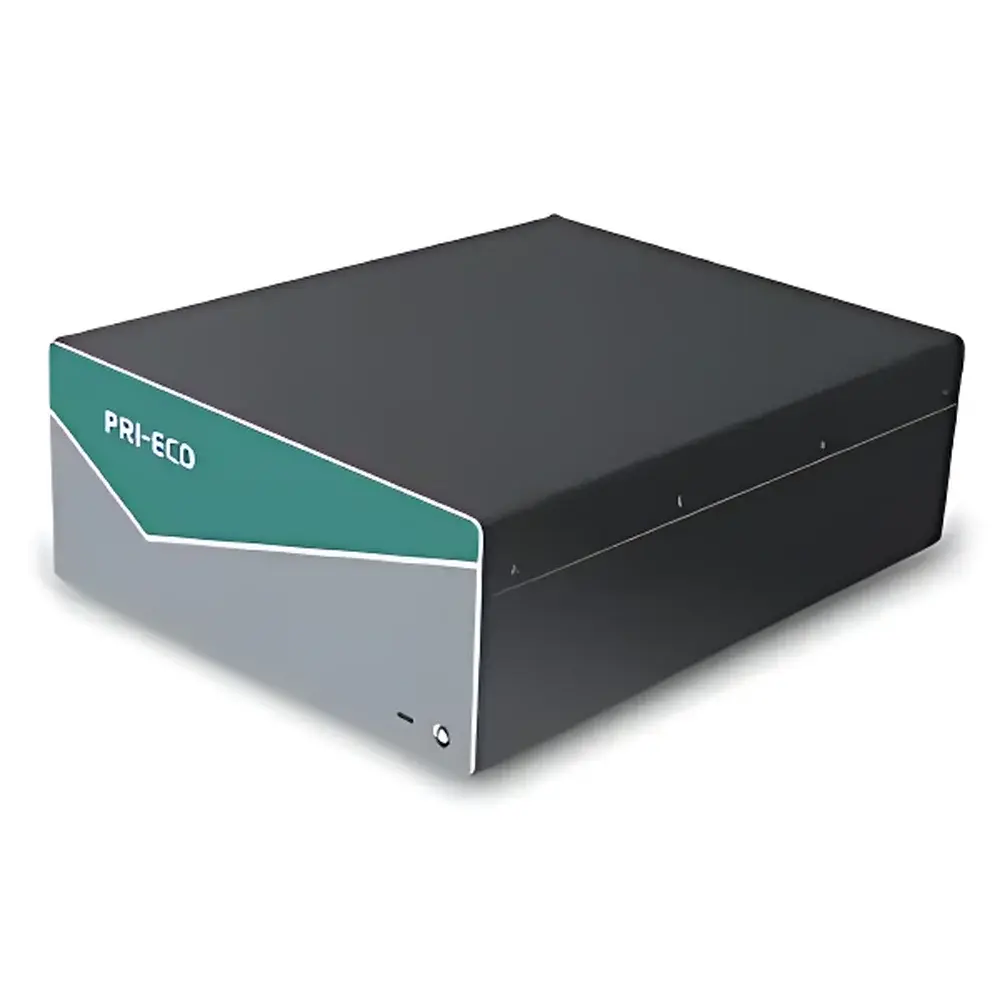
Pri-eco PRI-6250 CO CO₂ CH₄ H₂O Cavity-Enhanced Absorption Spectrometer
| Brand | Pri-eco |
|---|---|
| Origin | Beijing, China |
| Manufacturer Type | Original Equipment Manufacturer (OEM) |
| Model | PRI-6250 |
| Detection Principle | Optical-Feedback Cavity-Enhanced Absorption Spectroscopy (OF-CEAS) |
| Target Gases | CO, CO₂, CH₄, H₂O |
| Measurement Range | CO (0–30 ppm), CO₂ (350–1200 ppm), CH₄ (1–12 ppm), H₂O (0–3 %v/v) |
| Precision (5-min avg) | <1 ppb (CO), <80 ppb (CO₂), <1 ppb (CH₄), <60 ppm (H₂O) |
| Drift (24 h) | <3 ppb (CO), <0.5 ppm (CO₂), <3 ppb (CH₄) |
| Response Time | <4 s |
| Sampling Flow Rate | ~200 mL/min |
| Data Output | Ethernet (TCP/IP, Modbus TCP), RS-232/485, Analog (4–20 mA / 0–10 V), USB |
| Power Supply | 110–230 VAC, 50–60 Hz |
| Power Consumption | 150 VA |
| Dimensions | 19″ rack-mount, 4U (height: 178 mm) |
| Weight | 20 kg |
| Operating Environment | Sample Temp. −10 to +45 °C |
| Cavity Temp. Stability | ±0.002 K |
| Cavity Pressure Stability | ±0.016 mbar |
| Mirror Reflectivity | >99.999% (three ultra-high-reflectivity cavity mirrors) |
Overview
The Pri-eco PRI-6250 is a high-performance, field-deployable trace gas analyzer engineered for continuous, simultaneous quantification of carbon monoxide (CO), carbon dioxide (CO₂), methane (CH₄), and water vapor (H₂O) in ambient air or process streams. It employs Optical-Feedback Cavity-Enhanced Absorption Spectroscopy (OF-CEAS)—a robust evolution of cavity ring-down spectroscopy (CRDS)—to achieve sub-ppb detection limits with exceptional long-term stability and spectral specificity. Unlike conventional absorption techniques, OF-CEAS leverages a three-mirror optical cavity with reflectivity exceeding 99.999%, enabling effective optical path lengths of up to tens of kilometers within a compact 25 mL measurement cell. This architecture enhances sensitivity while maintaining mechanical simplicity: laser frequency is actively locked to cavity resonance modes via optical feedback, eliminating the need for pulsed lasers or rapid beam interruption. The result is a fundamentally stable, drift-resistant system suitable for unattended operation in demanding environments—including mobile platforms (vehicle-, aircraft-, and vessel-mounted deployments)—where thermal, vibrational, and pressure perturbations are common.
Key Features
- Simultaneous, real-time measurement of CO, CO₂, CH₄, and H₂O at 1 Hz data acquisition rate
- Sub-ppb precision (1 ppb CO, 1 ppb CH₄, 80 ppb CO₂, 60 ppm H₂O) over 5-minute averaging—validated against WMO GHG Observing Network (GAW) compatibility criteria
- Integrated cavity temperature control (±0.002 K) and pressure regulation (±0.016 mbar) to minimize thermodynamic artifacts and ensure metrological traceability
- Self-calibrating architecture: no external span gases required; baseline and gain corrections executed autonomously using internal reference spectra and cavity mode monitoring
- Ruggedized mechanical design qualified for shock, vibration, and thermal cycling per IEC 60068-2 standards; compliant with MIL-STD-810G for transport-grade deployment
- Low sample flow requirement (~200 mL/min) enables integration with low-flow sampling manifolds and reduces pumping energy demand
Sample Compatibility & Compliance
The PRI-6250 accepts gaseous samples across a wide environmental envelope: inlet temperature from −10 °C to +45 °C and relative humidity up to 99% RH (non-condensing). Its chemically inert, electropolished stainless-steel flow path minimizes surface adsorption and memory effects for reactive species such as CO. All optical and electronic subsystems conform to CE marking requirements (EMC Directive 2014/30/EU, Low Voltage Directive 2014/35/EU). While not certified under ISO/IEC 17025 for accredited testing, the instrument’s performance metrics align with WMO GAW compatibility goals for greenhouse gas monitoring stations and support adherence to EPA Method TO-11A (for CO) and ISO 14687 (for CH₄/CO₂ in ambient air). Data integrity protocols—including time-stamped raw spectra storage and configurable audit logs—facilitate GLP-compliant operation and retrospective validation.
Software & Data Management
The embedded firmware supports dual-mode operation: autonomous logging (internal SD card, ≥16 GB) and real-time streaming via Ethernet (Modbus TCP, TCP/IP ASCII), RS-232/485, analog outputs (4–20 mA, 0–10 V), and USB 2.0. The Pri-eco Control Suite (Windows/Linux) provides remote configuration, spectral visualization, cavity alignment diagnostics, and automated calibration verification reports. All raw interferograms and processed concentration time series are stored with NTP-synchronized timestamps and embedded metadata (cavity temp/pressure, laser current, mirror alignment status). Export formats include CSV, NetCDF-4 (CF-compliant), and HDF5—enabling direct ingestion into atmospheric modeling pipelines (e.g., NOAA’s HYSPLIT, WRF-Chem) and national reporting frameworks such as the UNFCCC Biennial Transparency Report (BTR) data templates.
Applications
- Atmospheric research: Long-term monitoring at WMO GAW stations, flux tower networks (e.g., ICOS, AmeriFlux), and airborne eddy covariance campaigns
- Urban emission inventory validation: Mobile mapping of CO/CH₄ hotspots along roadways and industrial corridors
- Landfill and biogas facility compliance: Continuous CH₄ and CO monitoring per EU Landfill Directive (1999/31/EC) and U.S. EPA Subpart HH
- Carbon capture utilization and storage (CCUS): Real-time CO₂ purity verification and trace impurity (CO, H₂O) detection in pipeline-grade streams
- Calibration transfer labs: Primary reference instrument for generating site-specific calibration curves for lower-cost sensor networks
FAQ
Does the PRI-6250 require external calibration gases during routine operation?
No. It implements an internal zero-reference and gain-stabilization algorithm based on cavity mode tracking and spectral line shape analysis. External calibration is only recommended annually or after major maintenance.
Can the instrument operate continuously in unheated outdoor enclosures?
Yes—provided ambient temperature remains within −10 °C to +45 °C and condensation is prevented. An optional thermostatically controlled enclosure kit is available for sub-zero deployments.
Is the data output compatible with SCADA systems?
Yes. Modbus TCP and standard analog outputs (4–20 mA) enable seamless integration with industrial supervisory control systems without middleware.
How is measurement uncertainty quantified and reported?
Uncertainty budgets follow GUM (JCGM 100:2008) methodology and include contributions from cavity length stability, laser frequency noise, temperature/pressure transducer accuracy, and spectral fitting residuals—all documented in the factory calibration certificate.
What maintenance intervals are specified for field operation?
Routine maintenance is limited to quarterly particulate filter replacement and annual optical inspection. No laser or detector replacement is scheduled within the first five years under normal operating conditions.







