
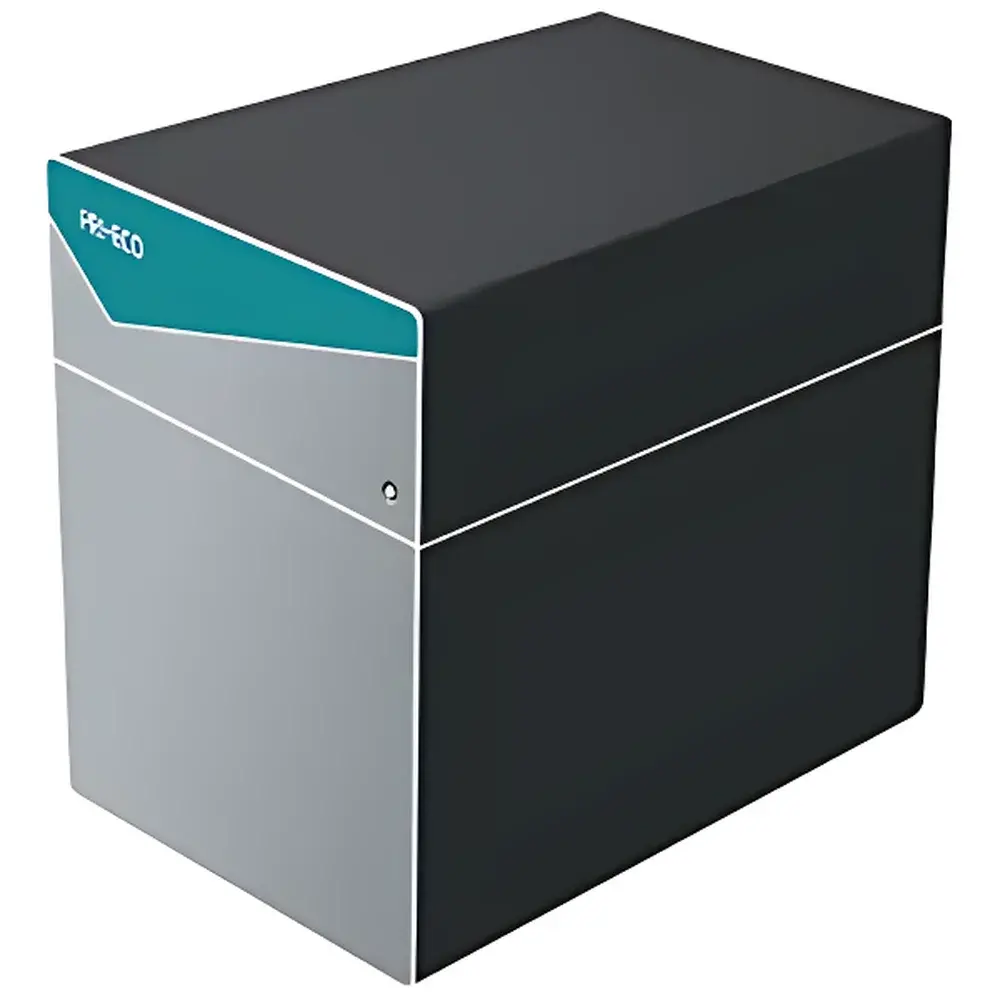
PRI-ECO PRI-5251CT Fully Automated Low-Temperature Cold Trap Online Water Removal System
| Brand | PRI-ECO |
|---|---|
| Origin | Beijing, China |
| Manufacturer Type | Direct Manufacturer |
| Product Type | Integrated System |
| Circulating Pump Flow Rate | 11 L/min (customizable) |
| Operating Mode | Multi-Channel Dual-Switching with Quadruple Cold Traps in Alternating Dual-Mode |
| Primary Dehydration Temperature Range | 0–2 °C |
| Secondary Dehydration Temperature | −78 °C |
| Residual Moisture Output | < 0.01 % @ 500 mL/min |
| Dry Gas Output | ≤ 0.9 L/min (adjustable) |
| Sample Inlet Temperature Range | −50 to 60 °C |
| Total Gas Pathways | 9 + 8 (4 reference gas, 2 target gas, 3 QC gas, 8 sample gas) |
| Main Pump Flow | 11 L/min |
| Input Humidity Tolerance | < 99 % RH (non-condensing) |
| Communication Interfaces | RS232, RS485, USB |
| Power Supply | 230 V AC |
| Power Consumption | < 750 W (steady-state), < 1350 W (defrost cycle), < 1500 W (peak, dual-trap active) |
| Dimensions | 440 mm × 820 mm × 820 mm |
| Weight | 120 kg |
Overview
The PRI-ECO PRI-5251CT Fully Automated Low-Temperature Cold Trap Online Water Removal System is an engineered solution for high-precision greenhouse gas (GHG) measurement applications requiring stringent moisture control. It employs single-compressor auto-cascade refrigeration technology to achieve stable, reliable cryogenic operation without the complexity and maintenance burden of dual-compressor architectures. The system implements a dual-stage dehydration strategy: first-stage condensation at 0–2 °C removes bulk water vapor, followed by ultra-low-temperature capture at −78 °C to eliminate residual moisture down to < 0.01 % (v/v) at 500 mL/min flow. Its core architecture features four independently controlled cold traps arranged in two parallel pairs—enabling true alternating dual-mode operation that eliminates measurement interruption during defrost cycles. All gas streams—including calibration standards, target samples, and quality control gases—pass through identical cold trap configurations, ensuring uniform system bias and traceable comparability across analytical workflows.
Key Features
- Auto-cascade single-compressor refrigeration delivering stable −78 °C secondary trapping temperature without external cryogens or liquid nitrogen dependency.
- Quadruple cold trap array organized into two redundant dual-trap modules, supporting seamless hot-swap switching with zero downtime between channels.
- Integrated dual-pump, dual-channel active gas delivery: one channel conditions while the other measures, enabling pre-purge, dry gas generation, and pressure-balanced transitions.
- Optimized low-volume cold trap geometry minimizing dead volume and gas consumption while maximizing gas turnover rate—critical for isotopic and trace-gas analysis where sample conservation is essential.
- Pressure- and flow-compensated multi-valve manifold (9+8 pathway configuration) mitigates transient pressure spikes during electromagnetic valve actuation, preserving measurement integrity in cavity ring-down spectroscopy (CRDS), off-axis ICOS, and quantum cascade laser absorption spectroscopy (QCLAS) platforms.
- Full-system thermal and flow homogeneity: both standard and sample gases traverse identical thermal paths and trap geometries, eliminating differential drift and enabling rigorous uncertainty budgeting per ISO/IEC 17025 and EPA Method TO-15 Annex A requirements.
Sample Compatibility & Compliance
The PRI-5251CT is designed for compatibility with all major GHG analyzers—including Picarro, Los Gatos Research, ABB, and Thermo Fisher Scientific platforms—as well as custom-built optical spectrometers requiring sub-ppmv water vapor suppression. Its gas path is constructed from electropolished 316 stainless steel and PFA-lined components to prevent adsorption, catalytic decomposition, or memory effects. The system conforms to fundamental requirements for environmental monitoring instrumentation under ISO 14064-3 (GHG validation), ASTM D6348 (gaseous sampling), and EU Monitoring and Reporting Regulation (EU) 2019/1842. While not certified to IEC 61000-6-4 or UL 61010-1 out-of-the-box, its electrical architecture supports third-party safety certification upon request. Data logging and parameter configuration comply with ALCOA+ principles when integrated with validated LIMS or SCADA systems.
Software & Data Management
The PRI-5251CT operates via embedded firmware with real-time status monitoring accessible via RS232, RS485, or USB interfaces. All operational parameters—including trap temperatures, flow rates, valve positions, defrost timers, and power draw—are timestamped and exportable in CSV format. Optional integration with PRI-ECO’s PRI-DataLink software enables remote diagnostics, scheduled maintenance alerts, and audit-trail-enabled configuration change logging aligned with FDA 21 CFR Part 11 requirements (when deployed with appropriate electronic signature controls). Firmware updates are delivered via secure SFTP; no cloud dependency or internet-facing services are required, ensuring compliance with air-gapped laboratory network policies.
Applications
- Continuous ambient GHG monitoring networks (CO₂, CH₄, N₂O) requiring long-term stability and minimal manual intervention.
- Calibration transfer laboratories performing primary standard dilution and gravimetric verification under ISO 6142.
- Mobile flux measurement platforms (e.g., eddy covariance towers, drone-mounted sensors) where compact footprint and robust thermal management are critical.
- Isotopic ratio measurements (δ¹³C-CO₂, δD-CH₄) demanding ultra-dry carrier gas to avoid spectral interference and memory artifacts.
- Stack emission testing per EPA Methods 3A and 25A, where moisture-induced analyzer drift must be eliminated prior to detection.
- Carbon accounting verification systems supporting national MRV (Measurement, Reporting, Verification) frameworks under UNFCCC guidelines.
FAQ
What refrigerant is used in the auto-cascade system?
R404A/R23 blended refrigerant is employed in the sealed auto-cascade loop, compliant with current F-Gas Regulation (EU) No 517/2014 phase-down schedules.
Can the system operate continuously without manual defrost intervention?
Yes—the alternating dual-mode architecture ensures one pair of cold traps remains active while the other undergoes automated thermal defrost, maintaining uninterrupted gas conditioning.
Is the 9+8 gas pathway configuration field-reconfigurable?
Pathway mapping is configurable via firmware; physical re-routing requires factory service due to calibrated flow restrictors and pressure sensor placement.
Does the system support analog output for integration with legacy DAQ systems?
Analog voltage outputs (0–10 VDC) for trap temperature, flow rate, and status signals are available as an optional hardware module.
What is the recommended preventive maintenance interval?
Compressor oil and filter replacement every 18 months; full cold trap inspection and PFA seal replacement every 36 months—documented in the included GLP-aligned maintenance logbook.



