
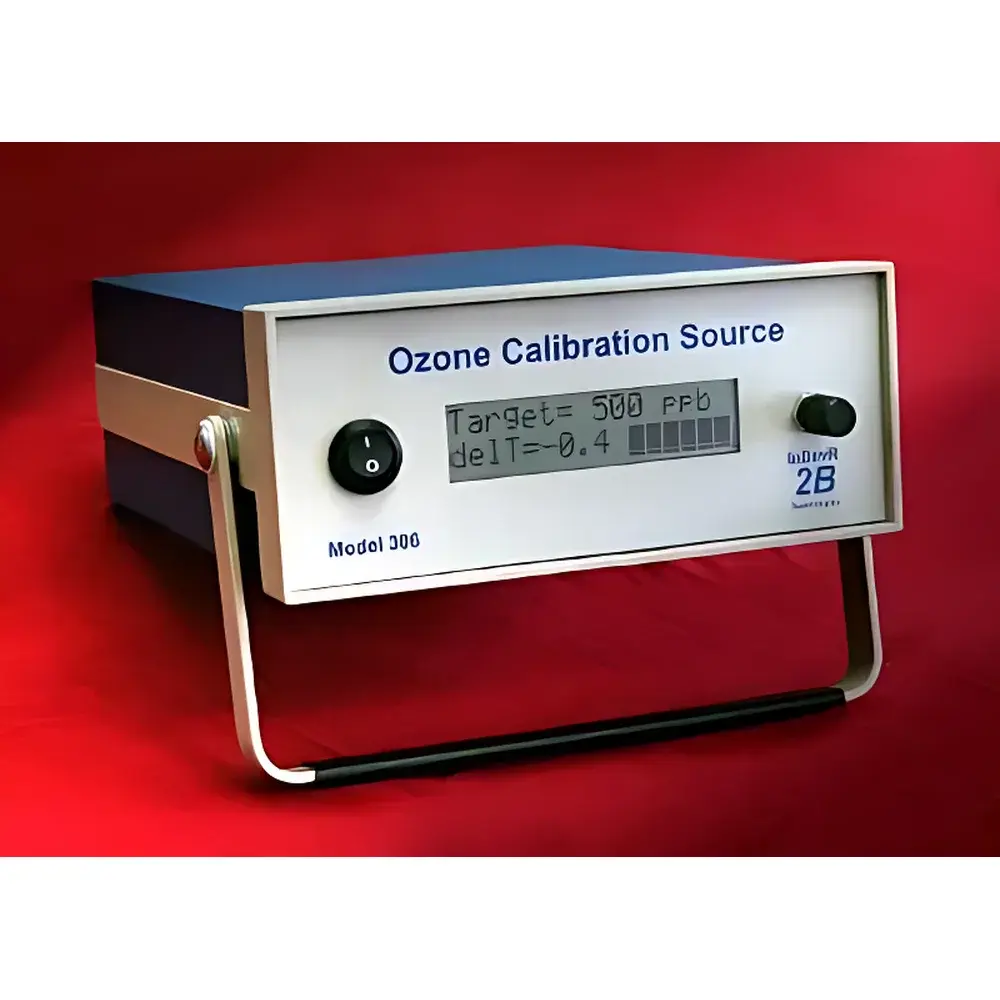
2B Technologies Model 306 Ozone Calibrator
| Brand | 2B Technologies |
|---|---|
| Origin | USA |
| Model | 306 |
| Instrument Type | Portable |
| Measurement Range | 0 and 30–1000 ppb |
| Response Time | <30 s |
| Ozone Generation Method | Photolysis of O₂ at 185 nm |
| Accuracy | ±2 ppb or ±1% of reading (whichever is greater) |
| Flow Rate | ~3.0 L/min |
| Rise Time | <30 s (to 95% of target concentration) |
| Output Interface | RS-232 |
| Power Supply | 12 V DC or 100–240 V AC, 18 W |
| Dimensions | 9 × 21 × 29 cm |
| Weight | 2.6 kg |
Overview
The 2B Technologies Model 306 Ozone Calibrator is a portable, NIST-traceable ozone generation and zero-air source engineered for field and laboratory calibration of ozone analyzers. It operates on the principle of vacuum-ultraviolet (VUV) photolysis: molecular oxygen (O₂) in ambient air is exposed to 185 nm UV radiation within a quartz lamp chamber, generating atomic oxygen that recombines with O₂ to form ozone (O₃). This method ensures stable, interference-free ozone production without reliance on ozone gas cylinders or chemical precursors. Unlike permeation-based or electrochemical ozone sources, the Model 306 delivers calibrated ozone concentrations directly in humidified ambient air—preserving the relative humidity (RH) of the sample stream. This eliminates artificial drying or humidification steps that introduce measurement bias during calibration of regulatory-grade monitors (e.g., EPA Reference and Equivalent Methods). The unit produces either true zero air (via catalytic ozone destruction) or precisely programmable ozone concentrations from 30 to 1000 ppb in 1 ppb increments, with full traceability to NIST Standard Reference Materials (SRMs) and compliance with ASTM D5012 and ISO 13964 protocols for ozone generator validation.
Key Features
- True zero-air generation via integrated catalytic scrubber—no external zero-air supply required
- Humidity-matched ozone output: maintains native RH of intake air across full concentration range, critical for calibrating UV photometric, chemiluminescence, and electrochemical ozone sensors
- Programmable multi-point calibration sequences: up to 10 user-defined ozone concentrations with configurable dwell times (1–9999 seconds per step)
- Pressure-, temperature-, and humidity-compensated control algorithm ensures stable output independent of ambient conditions (operating range: 0–40 °C, 10–90% RH, 70–106 kPa)
- Real-time diagnostic telemetry via RS-232 serial interface—including lamp intensity, flow rate, internal temperature, and ozone generation efficiency
- Compact, battery-compatible design (12 V DC input) optimized for mobile labs, stack testing, and remote site deployments
Sample Compatibility & Compliance
The Model 306 interfaces seamlessly with all major ozone analyzer platforms—including Thermo Scientific 49i, 49iPS, and 49i-TEI; Teledyne API 400E, 400E-TEI, and 204; Horiba APNA-370; and EcoChem APM 01—without signal conditioning or flow adapters. Its total output flow (~3.0 L/min) allows direct connection to instrument inlets; excess flow bypasses via integral vent port, eliminating backpressure artifacts. All ozone output values are certified traceable to NIST SRM 2691a (ozone in nitrogen) and validated per EPA EQOA-0102 protocol for ozone transfer standards. The device meets requirements for GLP-compliant calibration documentation and supports audit-ready data logging when paired with 2B’s proprietary CalCheck software. It is suitable for use in environments governed by 40 CFR Part 53 (Federal Reference Methods), ISO/IEC 17025-accredited laboratories, and EU Directive 2008/50/EC ambient air quality monitoring networks.
Software & Data Management
CalCheck software (Windows-compatible, included) enables full configuration, automated calibration sequences, and real-time data acquisition via RS-232. Each calibration event generates timestamped CSV files containing target concentration, measured lamp voltage, actual flow rate, ambient T/P/RH, and system diagnostics—structured for direct import into LIMS or QA/QC reporting tools. Audit trails include operator ID, calibration due dates, and firmware revision history. The software supports 21 CFR Part 11-compliant electronic signatures when deployed with validated Windows domain authentication and encrypted local storage. Firmware updates preserve all user-defined calibration profiles and maintain backward compatibility with legacy data formats.
Applications
- Field verification and span calibration of ambient air quality monitoring stations (AQS) per U.S. EPA and EEA requirements
- Performance evaluation of ozone monitors used in occupational health and safety (OSHA PEL, NIOSH REL) and indoor air quality (IAQ) assessments
- Method validation and inter-laboratory comparison studies under ISO 5725 and ASTM D6792
- Calibration of ozone generators used in water treatment pilot studies and disinfection efficacy testing
- Mobile emissions testing—integration with vehicle exhaust dilution tunnels and roadside monitoring vans
- Research applications requiring dynamically adjustable, humidity-stable ozone exposures (e.g., atmospheric chemistry simulation, material degradation studies)
FAQ
Does the Model 306 require external zero-air or calibration gases?
No. It generates true zero air internally using a heated catalytic converter and produces ozone on-demand from ambient oxygen.
Can it calibrate ozone analyzers operating at sub-ambient pressures (e.g., high-altitude sites)?
Yes. Its closed-loop pressure compensation maintains output accuracy across 70–106 kPa, verified per IEC 61261 Annex B.
Is humidity matching essential for accurate calibration?
Yes—especially for UV absorption analyzers, where RH-induced refractive index shifts affect path-length equivalence. The Model 306 preserves native humidity to eliminate this systematic error.
How often does the UV lamp require replacement?
Lamp lifetime exceeds 10,000 hours; output intensity is continuously monitored and reported in real time via RS-232.
Does it support automated unattended operation?
Yes—programmable multi-step sequences with scheduled start/stop allow overnight or multi-day calibration runs without operator intervention.







