
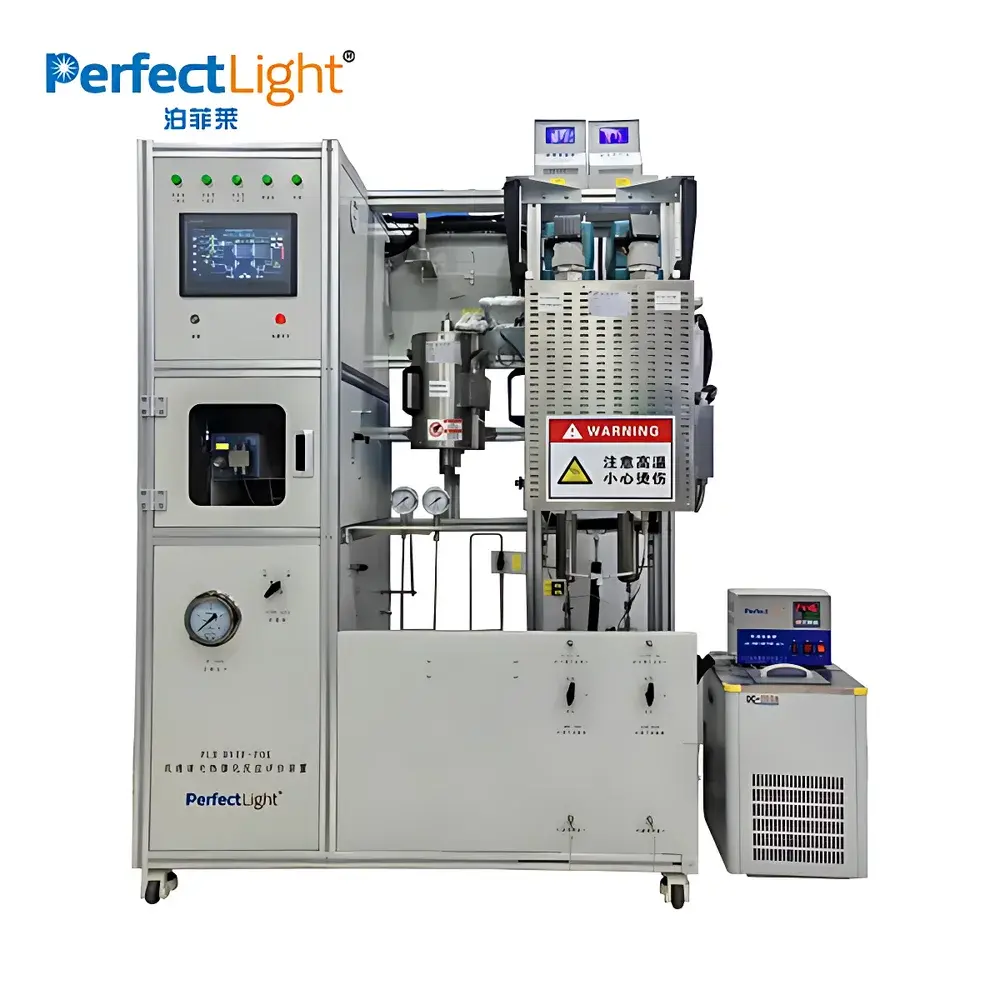
PLR RVTF-POX Dual-Channel Photothermal Catalytic Reaction Evaluation System
| Brand | PerfectLight |
|---|---|
| Origin | Beijing, China |
| Model | PLR RVTF-POX |
| Reaction Pressure Range | 0.2 (gauge) – 6 MPa |
| Reaction Temperature Range | 80 – 600 °C |
| Catalyst Bed Volume | 0.2 – 0.8 mL |
| Reactor Type | Quartz fixed-bed with metallic outer jacket and integrated light-conducting optics |
| Heating Configuration | Dual-channel, three-zone furnace with 16-segment programmable ramp/soak profiles |
| Gas Flow Control | Three independent mass flow controllers (500/200/200 mL/min, 4–100% FS, ±1% FS accuracy) |
| Liquid Flow Rate | 0.001–4.999 mL/min (water-compatible) |
| Preheating Temp Range | 50–400 °C (16-segment program) |
| Trace Heating | 150–240 °C |
| Total System Volume | ~1.2 L |
| Dual Separation Vessels | 350 mL each (max 300 mL liquid holdup per vessel) |
| Dimensions | 1300 × 700 × 1800 mm |
| Power Supply | 220 V AC / 32 A, ≤6.5 kW (including light source) |
| Interface | Metric 3 mm Swagelok®-compatible fittings |
Overview
The PLR RVTF-POX Dual-Channel Photothermal Catalytic Reaction Evaluation System is an engineered platform for high-fidelity, comparative screening of heterogeneous catalysts under controlled simultaneous light and thermal activation. Designed around the Couette-type fixed-bed geometry with coaxial optical access, it enables precise spatial overlap of photon flux and thermal gradient across two independent catalytic beds—facilitating direct side-by-side evaluation under identical boundary conditions. The system operates on a photothermal reaction principle: incident photons (typically UV–Vis, delivered via internal light-conducting pathways) excite electron–hole pairs in semiconductor or plasmonic catalysts, while the integrated three-zone resistive furnace maintains rigorous axial and radial temperature uniformity (±1 °C stability) from 80 to 600 °C. Pressure control spans 0.2 (gauge) to 6 MPa, supporting both low-pressure photocatalytic studies and high-pressure thermocatalytic processes such as Fischer–Tropsch synthesis or methane reforming. Its architecture eliminates external light path losses through top-illuminated, fiber-coupled or collimated source integration directly into the reactor head, ensuring reproducible photon delivery metrics critical for quantum yield quantification.
Key Features
- Dual-channel parallel operation: Two fully isolated quartz fixed-bed reactors housed within a shared dual-zone furnace—enabling statistically robust catalyst comparison without sequential run bias.
- Integrated photothermal delivery: Top-mounted illumination with internal light conduction minimizes optical attenuation; compatible with xenon, LED, or laser sources (wavelength range configurable per application).
- Modular gas–liquid co-feeding: Three independent MFCs support multi-gas blending (e.g., CO₂/H₂, CH₄/O₂, NO/NH₃), while precision syringe pumps deliver liquid reagents (e.g., H₂O, alcohols, organic acids) at rates from 0.001 to 4.999 mL/min.
- Programmable thermal management: Each channel features three independently controlled heating zones, supporting 16-segment ramp/soak profiles for complex temperature programming—essential for TPR, TPD, and kinetic step-change experiments.
- Automated pressure & sampling control: PLC-driven pressure regulation (0.2–6 MPa, ±0.2% full-scale accuracy) and timed liquid sampling from dual 350 mL separation vessels reduce operator intervention and improve data traceability.
- Compact, service-oriented mechanical design: Tool-free reactor disassembly, metric 3 mm Swagelok® interfaces, and centralized touch-panel HMI simplify maintenance, calibration, and method transfer across laboratory environments.
Sample Compatibility & Compliance
The PLR RVTF-POX accommodates catalysts in powder, pellet, or monolithic form within a defined bed volume of 0.2–0.8 mL (corresponding to 1–5 mm bed height in standard 8 mm ID quartz tubes). Its quartz–stainless steel hybrid reactor assembly ensures chemical inertness toward oxidizing, reducing, and mildly corrosive atmospheres (e.g., O₂, H₂O, NOₓ, SO₂ up to 240 °C). All wetted surfaces comply with ASTM E2913-21 for trace metal leaching in catalytic testing. The system supports GLP-compliant operation when paired with audit-trail-enabled PLC firmware (IEC 61131-3 compliant), and its pressure containment meets PED 2014/68/EU Category II requirements. Optional integration with FTIR or GC-MS effluent analyzers enables real-time speciation per ISO 22197-1 (photocatalytic VOC degradation) and ISO 14889-2 (CO₂ hydrogenation product distribution).
Software & Data Management
Control and data acquisition are managed via a CE-certified industrial touchscreen HMI running deterministic real-time firmware. All process variables—including temperature setpoints, pressure targets, gas flow rates, liquid injection timing, and lamp intensity—are logged at 1 Hz resolution with embedded time-stamping (NTP-synchronized). Raw data exports to CSV or HDF5 format include metadata tags for experiment ID, operator, catalyst lot number, and calibration certificate references. The system supports optional 21 CFR Part 11 compliance packages featuring electronic signatures, role-based access control, and immutable audit trails for regulated environments. Custom Python APIs enable integration with kinetic modeling suites (e.g., Cantera, DWSIM) and machine learning pipelines for catalyst performance ranking.
Applications
- Comparative evaluation of photocatalysts for CO₂ reduction (e.g., Cu/TiO₂ vs. g-C₃N₄ under simulated solar irradiation at 200 °C/2 MPa).
- Screening of bifunctional catalysts in low-temperature SCR (NH₃-SCR over V-W/TiO₂ under 250–400 °C, NO/NH₃/O₂ feed).
- Kinetic analysis of light-assisted methane oxidation over Pd/CeO₂ at 350–550 °C and 1–4 MPa.
- Stability testing of Ni-based reforming catalysts under cyclic photothermal stress (light-on/light-off transients coupled with temperature ramps).
- Quantitative assessment of VOC mineralization efficiency (e.g., formaldehyde, toluene) per ISO 22197-3 protocols.
- Process intensification studies for biomass-derived platform molecule upgrading (e.g., furfural hydrogenation) using tandem photo-thermal activation.
FAQ
What light sources are compatible with the PLR RVTF-POX?
The system accepts collimated or fiber-coupled sources emitting between 250–2500 nm, including 300 W Xe arc lamps, tunable LED arrays (365/405/450/520 nm), and CW diode lasers. Optical coupling is achieved via removable quartz windows aligned with internal light guides.
Can the system operate under vacuum or inert purge prior to pressurization?
Yes—integrated leak-tight valving and MFC-controlled N₂ purging allow automated evacuation-to-inert sequences (down to 10⁻² mbar base pressure) before pressurization, minimizing oxygen contamination during catalyst pre-reduction.
Is catalyst bed temperature measured directly or inferred?
Each channel includes a calibrated K-type thermocouple embedded within the catalyst bed (axial position adjustable), providing direct in-situ measurement—not inferred from furnace zone setpoints.
How is liquid-phase product sampling handled during continuous operation?
Dual 350 mL phase separators collect condensed effluents; automated solenoid valves enable timed withdrawal of aqueous or organic layers without interrupting flow, with sample volumes tracked and logged in real time.
Does the system support transient response experiments (e.g., step changes in light intensity or gas composition)?
Yes—the PLC firmware supports sub-second actuation of all MFCs, lamp drivers, and pressure regulators, enabling controlled perturbation studies with synchronized data capture at user-defined intervals.



